Transfer process · Explainer
Punjab e-registration 2026: registry without the patwari
By Pakizzle Editorial Team · Checked against official sources on
Published · 12 min read

The short answer
In Punjab, a property sale is now registered through the Punjab Land Records Authority's e-registration system. Under the Punjab Land Revenue (Amendment) Act 2026, a sale is reported to the Registering Authority, which has the mutation entered; the patwari handles inheritance reports. Stamp duty is 1% (Act XXIV of 2026), and taxes are paid by challan before registration.
Key facts
| Fact | Value | Source | As of |
|---|---|---|---|
| The Punjab Land Revenue (Amendment) Act 2026 sends sales, gifts and mortgages to the Registering Authority, which has the mutation entered. | Act XLII of 2026, in force 21 May 2026 | Punjab Gazette: Punjab Land Revenue (Amendment) Act 2026 (Act XLII of 2026) | |
| Punjab's Board of Revenue barred mutations based on oral sale, mortgage, exchange or gift; only a registered deed counts. Inheritance is exempt. | Notification of 30 December 2025, immediate effect | Dawn | |
| Punjab's Stamp (Amendment) Act 2026 made stamp duty on a sale 1% in both urban and rural areas; rural property paid 3% before. | 1% (urban and rural) | Punjab Gazette: Stamp (Amendment) Act 2026 (Act XXIV of 2026) | |
| Under the Registration (Amendment) Act 2026, a person executing a document is identified by NADRA biometric verification or an electronic signature. | Biometrics or e-signature | Punjab Gazette: Registration (Amendment) Act 2026 (Act XL of 2026) | |
| PLRA's service charge for registering a sale of land through the e-registration portal in 2026-27, on top of the government fee. | 0.1% of land value, minimum PKR 3,600 | Punjab Land Records Authority: Schedule of service charges FY 2026-27 | |
| Stamp duty challans on PLRA's e-stamp system need an OTP sent to the party's registered mobile; overseas users can verify by email OTP. | OTP required | Business Recorder |
Punjab has spent three years moving property sales off paper registers and out of the patwari's hands. In 2026 that move became law: a sale is now registered electronically, and the patwari handles inheritance reports rather than sales. Here is what changed, what it costs, and what you still need to do in person.
Quick facts
As of November 2026, a sale of land or a house in Punjab goes through the Punjab Land Records Authority (PLRA) e-registration system. Stamp duty is 1% of the property's value in both cities and villages, after the Stamp (Amendment) Act 2026 removed the old 3% rural rate. Federal advance taxes are paid before the deed can be registered. Since a notification of 30 December 2025, the Board of Revenue has refused mutations based on oral sales or gifts: only a registered deed counts. Inheritance is the one transfer that still runs through the patwari.
What changed in 2026
The February ordinances. Dawn reported on 18 February 2026 that the Governor of Punjab had promulgated the Punjab Land Revenue (Amendment) Ordinance 2026. In Dawn's words, "an e-registration system has been introduced for land transfer" and "all land transfers will be made digital." The same report says "the Patwari will have the power to make only hereditary transfers." The ordinance also lets notices and summonses be served electronically, and sets a legal procedure for demarcation and removal of illegal occupants. The Assembly then replaced the Land Revenue ordinance with a permanent law, the Punjab Land Revenue (Amendment) Act 2026 (Act XLII of 2026, in force 21 May 2026). A second ordinance, amending the property ownership protection law, set up tribunals of serving judges and penalties of five to ten years for illegal occupation, as Dawn reported.
No more oral transfers. A few weeks earlier, in a notification of 30 December 2025, the Board of Revenue told revenue officers that "no mutation shall be entered or sanctioned on the basis of an oral transaction in cases of sale, mortgage, exchange, or gift." Transfers are recognised only when backed by a registered instrument under the Registration Act 1908, read with the Transfer of Property Act 1882. Inheritance cases are exempt.
Lower stamp duty. A notification dated 10 April 2026 cut stamp duty on rural immovable property from 3% to 1%, matching the urban rate. Dawn quoted officials: "We have removed the difference between urban and rural immovable property by fixing 1pc stamp duty on both." The Punjab Assembly passed the Stamp (Amendment) Bill 2026 on 22 April, according to The Nation, and it became the Stamp (Amendment) Act 2026 (Act XXIV of 2026), published in the Punjab Gazette on 6 May 2026 and in force at once. It sets conveyance duty at 1% across Punjab and repeals the April ordinance.
Online e-stamps. In March 2026 the Board of Revenue moved e-stamps fully online. ProPakistani reported that citizens can pay stamp duty from home, verify with an OTP, and print the e-stamp on ordinary white paper. PLRA already required an OTP to the party's registered mobile for property stamp challans; overseas users can verify by email OTP, according to Business Recorder.
Why the patwari matters less now
For decades, a buyer in Punjab finished a deal in two places: the registry at the Sub-Registrar's office, and then the intiqal (mutation) with the patwari, who updated the land record. The gap between the two was where most delays and many frauds happened.
E-registration closes that gap. When Punjab ended manual registration at the end of May 2023, Dawn reported that under the new system the mutation is added to the land record automatically, so buyers no longer need repeated visits to the patwari, and that a deed cannot be processed until all government dues and taxes are paid. Dawn reported that manual registry was then disallowed across the province from 1 January 2024, with the system linked to e-stamp, the land record system and NADRA.
The 2026 Act puts this into the Land Revenue Act itself. Under the new section 42(7), a person who transfers land "through sale, mortgage, gift, or otherwise" must "forthwith" report the transfer to the Registering Authority under the Registration Act 1908, and under section 42(7-a) the Registering Authority has the mutation entered through the Arazi Record Centre. Inheritance is reported to the patwari, or to the designated Arazi Record Centre official once that is notified for the area (section 42-A). The Act does not literally say the patwari may only handle inheritance, but that is the effect for ordinary sales.
How a sale works under e-registration, step by step
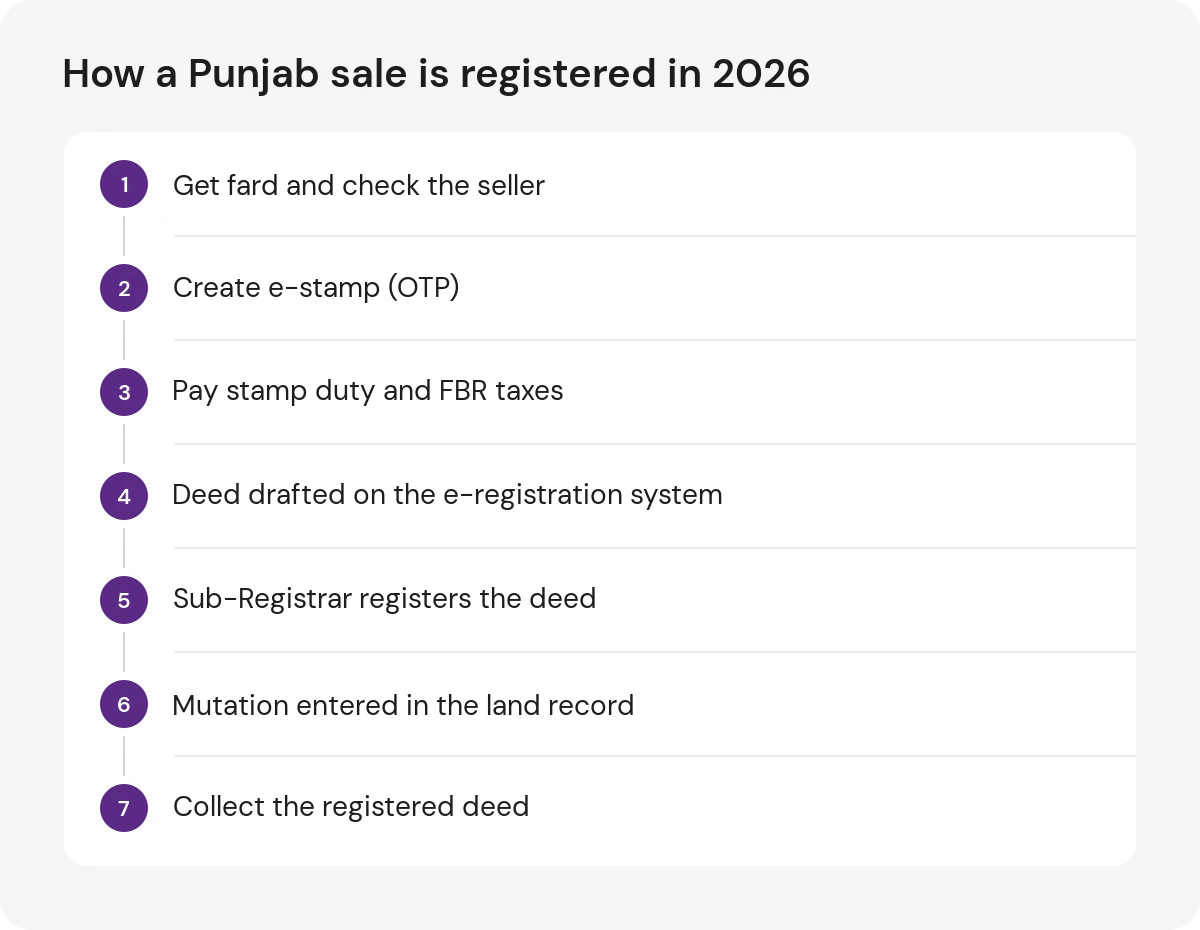
The order of steps for a sale under e-registration. Inheritance follows a different route.
- Check the seller and the land. Get a fard (the record-of-rights extract) for the khasra or khewat number and match the owner's name to the seller's CNIC. Our registry vs mutation guide explains the terms.
- Agree the price and pay a small bayana. Bayana is the token advance. Put it in writing and pay by bank transfer. Our token money checklist lists what the receipt should say.
- Create the e-stamp. The stamp duty challan is generated on PLRA's e-stamp system. The party gets an OTP on their registered mobile number (or by email if overseas).
- Pay stamp duty and taxes. Pay 1% stamp duty, plus the seller's and buyer's federal advance taxes. Pakistan Observer reported, citing information shared by PLRA, that from 26 August 2026 the FBR challan (PSID) for an e-registration is generated through the PLRA e-registration system, and a challan made directly on FBR's website is not accepted. We found no official PLRA or FBR notice, and some property sites go further and describe one combined slip for stamp duty and taxes, so ask the Sub-Registrar how to generate your challans before you pay.
- Prepare the deed on the portal. PLRA's Registry of Deeds public portal (eregistration.punjab-zameen.gov.pk) uses your CNIC number as the login.
- Appear before the Sub-Registrar. The Registration (Amendment) Act 2026 says each person executing a document is identified by NADRA biometric verification (fingerprints or face) or an electronic signature. PLRA's guidance says the parties and witnesses record their statements before the Sub-Registrar; an overseas party can do so through a Pakistan mission appointed as a commission. Then the Sub-Registrar registers the deed.
- Mutation follows. After registration, the Registering Authority has the mutation entered in the land record through the Arazi Record Centre. Get a fresh fard in the buyer's name a few days later to confirm it.
Documents to have ready
- Original CNICs of buyer and seller (NICOP or POC for overseas Pakistanis)
- Fard or ownership record for the property
- Previous registered deed (the seller's chain of title)
- Proof of tax payments and the e-stamp
- Passport-size photographs, if the Sub-Registrar asks (PLRA's published guidance mentions photos only for statements recorded abroad, so ask the office)
- A registered power of attorney if someone is acting for the owner
- Witnesses with original CNICs (PLRA's guidance requires witnesses but does not state the number for an ordinary sale deed; two is common, so confirm with the Sub-Registrar)
What it costs
| Item | Who pays | Rate (as of November 2026) | | --- | --- | --- | | Stamp duty, Punjab | Buyer, usually | 1% of property value | | Advance tax on purchase, section 236K | Buyer | 1.25% if on the Active Taxpayers List; 10.5% to 18.5% if not | | Advance tax on sale, section 236C | Seller | 2.75% if on the Active Taxpayers List; 11.5% if not | | PLRA e-registration service charge, sale of land | Buyer, usually | 0.1% of land value, minimum PKR 3,600 (PLRA, 2026-27) | | Government registration fee, CVT if any, and TMA or other local charges | Buyer, usually | Set by the Board of Revenue and local bodies; no 2026-27 schedule published, so ask the Sub-Registrar |
The tax rates come from FBR's withholding tax rate card updated for the Finance Act 2026. Our Budget 2026-27 explainer covers what changed. For 236K the Ordinance uses "fair market value", the value under section 68 that FBR's valuation tables set. For stamp duty, ask the Sub-Registrar which value goes on your challan, the official valuation or the price in the deed.
Private housing societies are next
E-registration began with revenue land, but Punjab is pulling society plots into the same system. In April 2026, ProPakistani reported, the Senior Member Board of Revenue said all private housing schemes must issue a "green certificate" through PLRA's Housing Societies Management System, that all property transactions in private schemes would run through PLRA software, and that some sub-registrar powers would be delegated to schemes through that software. Developers were given one month to move over. If you are buying a society plot, ask whether the society is on PLRA's system and how the transfer will be recorded there.
Red flags
- The seller offers a "sale on stamp paper" with mutation "to be done later by the patwari." For a sale, the patwari no longer has that role.
- Someone asks for cash to "speed up" the e-stamp or the mutation. Fees are paid by challan.
- The fard owner's name or CNIC does not match the seller.
- The seller will not register the deed because "taxes are too high." Since a deed cannot be processed until dues are paid, any shortcut means an unregistered transfer.
- An agent offers to generate your e-stamp with their phone number. The OTP goes to the party's own number for a reason.
If something goes wrong
- Do not pay the balance until the deed is registered.
- Get a fresh fard. If the mutation is not reflected in a reasonable time, visit the Arazi Record Centre or e-registration centre with the registered deed.
- If someone has occupied or claimed your land falsely, Punjab's property ownership protection law, amended by a 2026 ordinance, sends complaints to a tribunal of serving judges; Dawn reported a 30-day timeline for decisions. A lawyer can tell you the current procedure.
- For a large or disputed deal, speak to a property lawyer before you sign.
How Pakizzle helps
Pakizzle does not register property or check land records. What it can do is help you find a property worth registering. Listings can carry dated checks such as "Documents checked" and "Visited", owners and agents can be ID verified (the blue tick), and phone numbers are verified by call-back. Our token money checklist helps you put the bayana stage in writing before the registry. Use these as a starting point, then follow the official steps above.
For a large purchase, speak to the Sub-Registrar office, PLRA or a property lawyer before you pay.
Questions
Can the patwari still do my intiqal (mutation) after a sale?
No. Under the Punjab Land Revenue (Amendment) Act 2026, a person who transfers land by sale, gift or mortgage reports it to the Registering Authority under the Registration Act, and that authority has the mutation entered through the Arazi Record Centre. Inheritance is still reported to the patwari, or to the Arazi Record Centre once that is notified for the area.
Online registry Punjab: can I do everything from home?
No. You can create the e-stamp and pay duty and taxes online, and the PLRA e-registration portal lets you log in with your CNIC. But under the Registration (Amendment) Act 2026 each party is identified by NADRA biometrics or an e-signature, and PLRA's guidance says parties and witnesses give their statements before the Sub-Registrar. Confirm the in-person step with your Sub-Registrar office before you travel.
Is stamp duty in Punjab 1% or 3%?
It is 1% of the property value in both urban and rural areas. An ordinance of 10 April 2026 removed the old 3% rural rate, and the Stamp (Amendment) Act 2026 (Act XXIV of 2026, Punjab Gazette 6 May 2026) made it permanent. Check the amount on the e-stamp screen before paying, since the system calculates it for you.
Is a sale on plain stamp paper (iqrarnama) still valid for mutation?
An agreement to sell is not a transfer. Since a Board of Revenue notification of 30 December 2025, Punjab has barred mutations based on oral sales, mortgages, exchanges or gifts, and recognises transfers only through a registered instrument under the Registration Act 1908. Use the agreement for the bayana stage only, and complete the registry.
I live abroad. Can I sell through e-registration?
Yes, through a registered power of attorney or in your own name. PLRA says the Sub-Registrar can appoint a Pakistan mission official as a commission to record an overseas party's statement, with thumb impressions, photos and video verification; PLRA charges USD 100 for this in 2026-27. Overseas users can verify e-stamp challans by email OTP. Ask the Sub-Registrar how your case will be processed.
Sources
- Dawn: Laws on property, land revenue promulgated (18 Feb 2026)
- ProPakistani: Punjab introduces major reforms to land laws through new ordinances (18 Feb 2026)
- Dawn: Punjab bans land mutations based on oral transactions (1 Jan 2026)
- The Nation: PA slashes traffic fines, stamp duty on rural property (23 Apr 2026)
- ProPakistani: Punjab launches online e-stamp system (10 Mar 2026)
- Business Recorder: Punjab introduces OTP verification mechanism for property sale and purchase (17 Nov 2025)
- Dawn: E-registration hitches cause sharp decline in property transactions (5 Jun 2023)
- Dawn: E-registry system to be launched in Punjab (16 Jan 2024)
- ProPakistani: Punjab to grant certain sub-registrar powers to housing schemes (16 Apr 2026)
- Punjab Land Records Authority: Registry of Deeds public portal (login page)
- FBR: Withholding Income Tax Rate Card, updated as per Finance Act 2026
- Punjab Gazette: The Punjab Land Revenue (Amendment) Act 2026 (Act XLII of 2026), 21 May 2026
- Punjab Gazette: The Stamp (Amendment) Act 2026 (Act XXIV of 2026), 6 May 2026
- Punjab Gazette: The Registration (Amendment) Act 2026 (Act XL of 2026), 14 May 2026
- Punjab Land Records Authority: Schedule of PLRA service charges FY 2026-27 (notification of 8 Jul 2026, PDF)
- Pakistan Observer: FBR property registration challan process changed in Punjab (7 Sep 2026)
- Punjab Land Records Authority: Punjab Zameen portal (FAQs, helpline)
Tools for this
Related guides
- Society transfer fees and how they're charged Transfer process
A society transfer fee is what a housing society or authority charges to move a property into the buyer's name.
- Bahria Town transfer process: what to bring Transfer process
A Bahria Town transfer happens at the society's own office, not the patwari.
- Biometric verification for a property transfer Transfer process
Biometric verification matches each party's thumbprint, and in Sindh their face, against NADRA's records before a property document is…
- Succession certificate from NADRA: how legal heirs get one Transfer process
NADRA's Succession Facilitation Units issue succession certificates and letters of administration without a court case when all legal heirs…