Transfer process · Explainer
Registry vs mutation (intiqal): what is the difference?
By Pakizzle Editorial Team · Checked against official sources on
Published · 11 min read

The short answer
A registry is a sale or gift deed registered with the Sub-Registrar under the Registration Act 1908; it is the document that legally transfers ownership. An intiqal (mutation) is the later entry in the land revenue record under the Land Revenue Act 1967. Courts treat mutation as a fiscal record, not proof of title, so you need both.
Key facts
| Fact | Value | Source | As of |
|---|---|---|---|
| Non-testamentary documents that transfer a right in immovable property worth PKR 100 or more must be registered (Registration Act 1908, s.17(1)(b)). | Compulsory registration at PKR 100 and above | Punjab Laws Online: Registration Act 1908 (as applied in Punjab) | |
| A document that must be registered does not create or transfer any right in immovable property unless it has been registered (s.49). | Unregistered = no transfer of right | Punjab Laws Online: Registration Act 1908 (as applied in Punjab) | |
| Under the Punjab Land Revenue (Amendment) Act 2026, a sale, gift or mortgage is reported forthwith to the Registering Authority, which causes the mutation. | Report 'forthwith' (s.42(7)) | Punjab Gazette: Punjab Land Revenue (Amendment) Act 2026 (Act XLII of 2026) | |
| In October 2026 the Supreme Court held that cancelled mutation entries cannot by themselves establish legal ownership. | Mutation is not a title document | Associated Press of Pakistan (APP) | |
| Punjab's February 2026 ordinance, made permanent as Act XLII of 2026, sends sales through registration; the patwari handles inheritance reports. | Act XLII of 2026, in force 21 May 2026 | Punjab Gazette: Punjab Land Revenue (Amendment) Act 2026 |
People often use "registry" and "intiqal" as if they meant the same thing. They do not. They are two separate steps, under two separate laws, done at two separate offices. Skipping either one leaves a gap that can cost you the property years later.
Quick facts
A registry is a deed (sale, gift or other transfer) that has been registered with the Sub-Registrar under the Registration Act 1908. An intiqal, or mutation, is the entry that changes the owner's name in the land revenue record; in Punjab it is governed by the Punjab Land Revenue Act 1967. The fard (fard malkiyat) is the extract of that revenue record that shows who owns what share of a khewat. The deed is what transfers ownership in law. The mutation keeps the government's record in line with it. Courts have said many times that a mutation is a fiscal entry, not a title document.
What a registry is
The Registration Act 1908 decides which documents must be registered. Section 17(1) makes registration compulsory for "instruments of gift of immovable property" and for other non-testamentary documents that "create, declare, assign, limit or extinguish" a right in immovable property worth one hundred rupees or more. In practice, that covers almost every sale deed.
Section 49 sets the consequence. A document that must be registered does not "create, declare, assign, limit or extinguish" any right in immovable property "unless it has been registered". Section 23 says a document other than a will must be presented for registration within four months of being signed. Section 50 adds that a registered document takes effect against an unregistered document about the same property.
Before registration you buy e-stamp paper for the stamp duty, and the advance income taxes are collected. FBR's Circular No. 2 of 2026-27 describes these as taxes collected "at the time of registering, recording or attesting the transfer" (as of September 2026: 2.75% from a seller and 1.25% from a buyer who are on the Active Taxpayers' List). Stamp duty is provincial; in Punjab the Stamp (Amendment) Act 2026 (Act XXIV of 2026) brought rural stamp duty down from 3% to 1%, in line with urban areas. See our stamp duty by province guide.
What a mutation (intiqal) is
The revenue record is the government's land register: who owns which share, who cultivates it, and what is owed. Mutation is how that record is updated.
Section 42 of the Punjab Land Revenue Act 1967, as rewritten by the Punjab Land Revenue (Amendment) Act 2026 (Act XLII of 2026, in force 21 May 2026), now sets two routes. A person who acquires land by inheritance or letter of administration must "forthwith" report it to the patwari, who records it in the Roznamcha and gives a free copy; once computerised records are notified for the area, section 42-A sends that report to the designated official of the Arazi Record Centre instead. A person who transfers land "through sale, mortgage, gift, or otherwise" must "forthwith" report the transfer to the Registering Authority under the Registration Act, and the Registering Authority has the mutation entered, through the Arazi Record Centre. A Revenue Officer then inquires and makes an order, and the periodical record is corrected.
Three details matter:
- The earlier registered deed wins. New section 42(12) says a transfer made earlier through a registered document "shall take precedence over the latter" for recording the mutation and handing over possession.
- Jointly owned land needs a map reference. New section 42(13) says a registered deed for land held in joint ownership must refer to a Government land record map or survey, with the area and boundary measurements.
- Not reporting has a penalty. Section 48(1), which the 2026 Act left in place, lets the Collector fine a person who neglects to report within three months of acquiring the right up to five hundred rupees (PKR 500). The old rule in section 48(2) that the registrar reports registered deeds was dropped, because the new section 42(7-a) now makes the Registering Authority responsible for the mutation.
Mutation fees are fixed by the Board of Revenue under section 46. PLRA adds its own service charges under the PLRA Act 2017: for 2026-27 its notification of 8 July 2026 lists PKR 1,200 for an ordinary mutation and PKR 11,200 by express service, on top of the government fee.
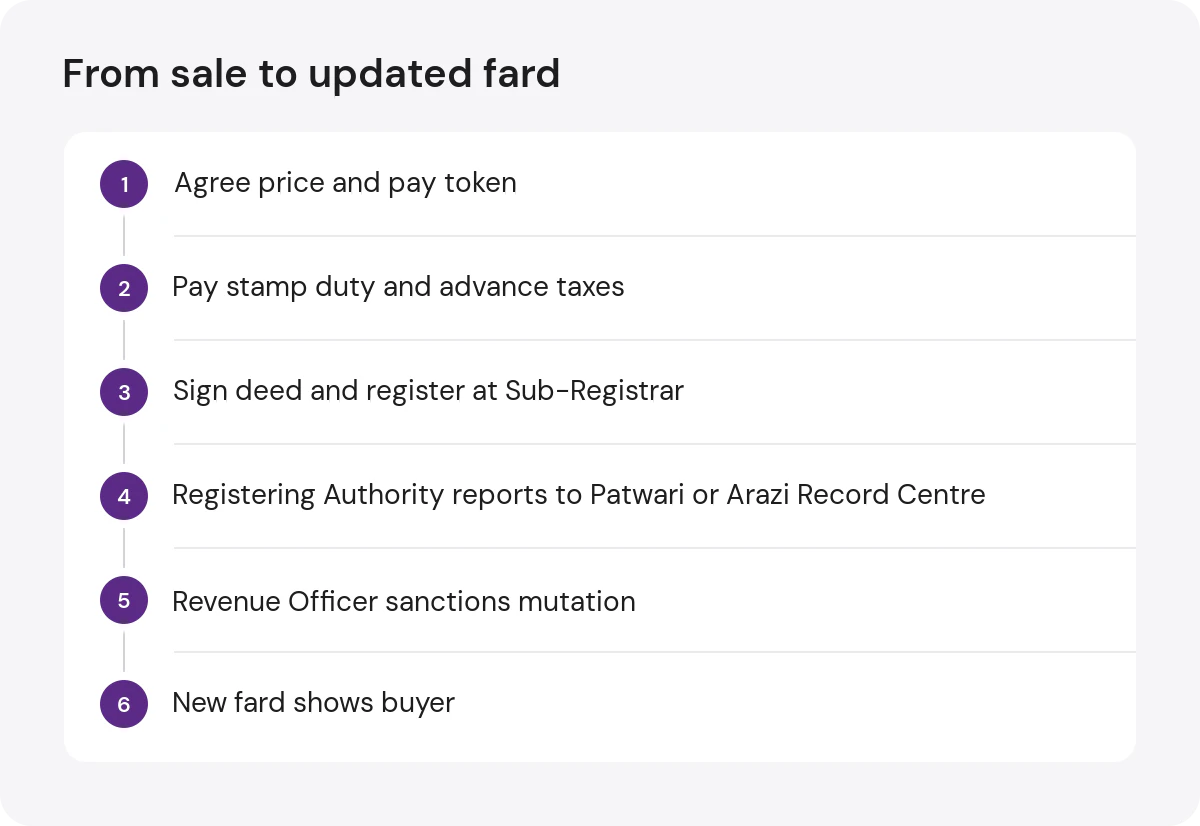
The usual order for a sale in Punjab: registry at the Sub-Registrar, then mutation in the revenue record.
Side by side
| | Registry | Mutation (intiqal) | | --- | --- | --- | | What it is | A registered deed of transfer | An entry in the land revenue record | | Main law | Registration Act 1908 | Punjab Land Revenue Act 1967 (Punjab) | | Where | Sub-Registrar's office (e-registration) | Arazi Record Centre (patwari for inheritance), sanctioned by a Revenue Officer | | Time limit | Present within 4 months of signing (s.23) | Report "forthwith" (s.42, 42-A as amended in 2026); fine up to PKR 500 if not reported within 3 months (s.48) | | Legal effect | Required to transfer a right worth PKR 100 or more (s.17, s.49) | Updates the record; courts treat it as fiscal, not proof of title | | Inheritance | No sale deed needed | Inheritance mutation records the heirs | | What you get | Registered deed copy | Sanctioned mutation and updated fard |
Why courts say mutation is not title
On 14 October 2026, as reported by APP, a three-member Supreme Court bench held that "cancelled mutation entries cannot, by themselves, establish legal ownership of property". The court also said that revenue entries are not title documents on their own, and that cancelling them does not automatically cancel the underlying sale deeds. In that case the claimant relied on a 1985 mutation, but the original sale deeds were never produced, and the appeal failed.
The lesson is simple. Keep the registered deed safe, and make sure the mutation follows it. One without the other is a weak position.
What changed in Punjab in 2026
These points are fast-moving, so check the current position before you rely on them (as of November 2026):
- E-registration. Dawn reported that the Punjab Land Revenue (Amendment) Ordinance 2026, promulgated in February 2026, introduced an e-registration system for land transfers. The Nation reported that the patwari's role is now limited to inheritance mutations. The Assembly replaced it with the Punjab Land Revenue (Amendment) Act 2026 (Act XLII of 2026, in force 21 May 2026). Under the Act, a sale, gift or mortgage is reported to the Registering Authority (the Sub-Registrar or e-registration), which has the mutation entered through the Arazi Record Centre; inheritance is reported to the patwari, or to the ARC official once notified.
- Inheritance mutations. Minute Mirror reported on 28 October 2026 that the Stamp (Second Amendment) Ordinance 2026 fully exempts inheritance mutations from fees and stamp duty. That ordinance (Ordinance XIV of 2026) is before the Assembly as the Stamp (Second Amendment) Bill 2026 (Bill 68 of 2026), which was introduced on 28 October 2026 and had not been passed when we checked the Assembly's bills page on 11 November 2026. The report says heirs can have property transferred into their names without paying charges for the inheritance mutation, but we could not read the ordinance itself, so before you go ask the Arazi Record Centre or PLRA's helpline (042-111-22-22-77, as listed on punjab-zameen.gov.pk) which fees, if any, still apply.
- Stamp duty. The Punjab Assembly passed the Stamp (Amendment) Bill 2026 in April 2026, and it became the Stamp (Amendment) Act 2026 (Act XXIV of 2026, Punjab Gazette 6 May 2026), reducing stamp duty on rural immovable property from 3% to 1%, the same as urban property.
Housing societies are a third route
In DHA and most private housing societies, a plot first changes hands in the society's own record. The society cancels the old allotment or transfer letter and issues a new one. There is often no registry or mutation at that stage. Some plots are later registered, which is why DHA Lahore's NDC instructions ask owners in Phases 1 to 4 to surrender the original sale deed when they transfer. If you are buying in a society, ask what record the society keeps and whether a registered deed exists. Our DHA Lahore transfer guide shows one society's process in full.
Red flags
- The seller has a mutation but no registered deed for a sale, or the reverse.
- The fard shows a different owner, share or khasra number from the deed.
- A deed was signed long ago but never registered, well beyond four months.
- The seller offers an "iqrar nama" (agreement to sell) or stamp paper instead of a registered deed.
- An inheritance mutation is missing some legal heirs.
What to do if something goes wrong
- Get certified copies. Ask the Sub-Registrar for a certified copy of the deed, and the Arazi Record Centre or patwari for the mutation and current fard.
- If the mutation was not entered, take the registered deed to the Arazi Record Centre and ask why. For an inheritance report the patwari did not record, section 42(5) lets you make the report in writing to the Revenue Officer, who must then have it entered.
- If the Revenue Officer does not decide within three months, section 42(10) requires him to report the cause of delay to the Collector.
- If ownership is disputed, speak to a property lawyer. The Supreme Court case above shows that a possession-only suit may not be enough where title is in dispute.
How Pakizzle helps
Our token money checklist lists the papers to see before you pay anything, including the deed and the current fard. On listings, "Documents checked" means our team has looked at the papers the seller uploaded, on the date shown. It is not a title search and does not replace a certified copy from the Sub-Registrar or the land record office.
For a large purchase or any inheritance dispute, take advice from a property lawyer or the land record office.
Questions
Registry aur intiqal mein kya farq hai?
Registry is the registered deed, signed by seller and buyer and registered with the Sub-Registrar under the Registration Act 1908. It is the legal transfer. Intiqal (mutation) is the entry that updates the land revenue record, so the fard shows the new owner. In Punjab this is governed by the Land Revenue Act 1967. You need both: the deed to own, the mutation to be on record.
Can I own property with only a mutation and no registry?
Mutation alone is risky. Courts treat it as a fiscal record kept for revenue purposes. In October 2026 the Supreme Court held that cancelled mutation entries cannot by themselves establish ownership. For a sale, the Registration Act requires a registered deed for property worth PKR 100 or more, and an unregistered deed does not transfer the right.
Which comes first, registry or intiqal?
For a sale or gift, the registry comes first. Once the deed is registered, the Land Revenue Act, as amended in 2026, makes the Registering Authority responsible for having the mutation entered through the Arazi Record Centre. For inheritance there is no sale deed; the heirs' rights are recorded through an inheritance mutation.
How long do I have to register a deed and report a mutation?
Under section 23 of the Registration Act 1908 a document other than a will must be presented for registration within four months of signing. Since the Punjab Land Revenue (Amendment) Act 2026, a person who transfers land by sale, gift or mortgage must report it 'forthwith' to the Registering Authority, which has the mutation entered; inheritance is reported to the patwari.
Do housing society plots need a registry and mutation?
Often not at the start. In a private society or DHA, ownership is first recorded in the society's own transfer record, and the society issues an allotment or transfer letter. Some plots are later registered, which is why DHA Lahore asks owners of registered plots to surrender the sale deed when transferring. Ask the society what record it keeps.
Sources
- The Registration Act 1908 (Pakistan), FAOLEX copy (PDF)
- Board of Revenue Punjab: The Punjab Land Revenue Act 1967 (PDF)
- APP: Cancelled mutation entries cannot, by themselves, establish legal ownership, rules SC
- Dawn: Laws on property, land revenue promulgated
- The Nation: Punjab introduces sweeping reforms to land laws through new ordinances
- Minute Mirror: Punjab abolishes inheritance transfer fees, reduces stamp duty on property transactions
- The Nation: PA slashes traffic fines, stamp duty on rural property
- FBR: Circular No. 02 of 2026-27, Finance Act 2026 explained
- DHA Lahore: No Demand Certificate form and instructions (PDF)
- Punjab Gazette: The Punjab Land Revenue (Amendment) Act 2026 (Act XLII of 2026), 21 May 2026
- Provincial Assembly of the Punjab: The Stamp (Second Amendment) Bill 2026 (Bill No. 68 of 2026)
- Punjab Laws Online: Registration Act 1908 (as applied in Punjab, updated for Act XL of 2026)
- Punjab Land Records Authority: Schedule of PLRA service charges FY 2026-27 (notification of 8 Jul 2026, PDF)
- Provincial Assembly of the Punjab: Bills (status of Bill No. 68 of 2026, checked 11 Nov 2026)
- Punjab Gazette: The Stamp (Amendment) Act 2026 (Act XXIV of 2026), 6 May 2026
Corrections
- : We updated the section 42 explanation for the Punjab Land Revenue (Amendment) Act 2026 (Act XLII of 2026, in force 21 May 2026). It replaced the three-month reporting rule, the 'two respectable persons' wording and section 48(2), which we had quoted from the 1967 text. We also corrected PLRA's helpline to 042-111-22-22-77 (we had given 1100) and now cite Punjab's 1% stamp duty to Act XXIV of 2026.
Tools for this
Related guides
- Society transfer fees and how they're charged Transfer process
A society transfer fee is what a housing society or authority charges to move a property into the buyer's name.
- Bahria Town transfer process: what to bring Transfer process
A Bahria Town transfer happens at the society's own office, not the patwari.
- Biometric verification for a property transfer Transfer process
Biometric verification matches each party's thumbprint, and in Sindh their face, against NADRA's records before a property document is…
- Succession certificate from NADRA: how legal heirs get one Transfer process
NADRA's Succession Facilitation Units issue succession certificates and letters of administration without a court case when all legal heirs…