Taxes & fees · Explainer
Budget 2026-27: what changed for property
By Pakizzle Editorial Team · Checked against official sources on
Published · 11 min read

The short answer
The Finance Act 2026 cut the seller's advance tax (section 236C) to a flat 2.75% and the buyer's (section 236K) to a flat 1.25% for people on FBR's Active Taxpayers List. It removed the section 7E tax on deemed income from property and the higher late-filer rates. Non-filer rates stayed high: 11.5% on sale, 10.5% to 18.5% on purchase.
Key facts
| Fact | Value | Source | As of |
|---|---|---|---|
| Advance tax on sale or transfer of immovable property (section 236C) for filers is now a flat rate, down from 4.5% to 5.5%. | 2.75% of gross consideration | FBR: Income Tax Ordinance 2001, consolidated to Finance Act 2026 | |
| Advance tax on purchase (section 236K) for filers is now a flat rate, down from 1.5% to 2.5%. FBR's budget-day Salient Features said 1.5%. | 1.25% of fair market value | FBR: Withholding Tax Rate Card (Finance Act 2026) | |
| Section 7E, the tax on deemed income from immovable property, has been omitted. | Abolished from tax year 2027 | FBR Circular No. 02 of 2026-27 (8 Sep 2026) | |
| Non-filers still pay much higher rates: 236C is 11.5%, and 236K is 10.5%, 14.5% or 18.5% depending on property value. | 11.5% sale; 10.5% to 18.5% purchase | FBR: Withholding Tax Rate Card (Finance Act 2026) | |
| The higher rates for people on the Active Taxpayers List who filed late (Tenth Schedule rule 1A) were omitted. | Late-filer surcharge removed | FBR: Income Tax Ordinance 2001, consolidated to Finance Act 2026 |
The federal budget for 2026-27 was the first in several years to lower property taxes rather than raise them. The Finance Act 2026 cut the advance taxes paid when property is bought and sold, removed the much-disliked deemed income tax, and dropped the extra penalty rates for late filers. It did not help non-filers. Here is exactly what changed, with the official numbers.
Quick facts
As of November 2026, a seller on FBR's Active Taxpayers List (ATL, the list of "filers") pays advance tax of 2.75% of the sale price under section 236C. A buyer on the ATL pays 1.25% of the property's fair market value under section 236K. Section 7E, which taxed people on the notional rent of property they owned, has been removed. Non-filers still pay 11.5% when they sell and 10.5% to 18.5% when they buy. ProPakistani reported in June 2026 that the budget's property relief was worth about PKR 115 billion, and that the IMF had not yet agreed to further concessions for the sector.
A "filer" here means a person whose name appears on FBR's Active Taxpayers List. A "non-filer" does not appear on it.
What changed: before and after
The table compares the rates for tax year 2026 (FY2025-26) with tax year 2027 (FY2026-27). Figures are from the Income Tax Ordinance 2001 as consolidated by FBR up to the Finance Act 2026, which shows the old text in its footnotes, and from FBR's withholding tax rate card.
| Tax | FY2025-26 | FY2026-27 (as of November 2026) | | --- | --- | --- | | 236C, seller, filer | 4.5% up to PKR 5 crore; 5% up to PKR 10 crore; 5.5% above | 2.75% flat | | 236K, buyer, filer | 1.5% up to PKR 5 crore; 2% up to PKR 10 crore; 2.5% above | 1.25% flat | | 236C, seller, non-filer | 11.5% | 11.5% (no change) | | 236K, buyer, non-filer | 10.5% / 14.5% / 18.5% by value | 10.5% / 14.5% / 18.5% (no change) | | Late filers on the ATL (rule 1A) | 236C 7.5% to 9.5%; 236K 4.5% to 6.5% | Rule omitted | | Section 7E deemed income | 20% tax on deemed income of 5% of fair market value | Omitted |
Two points to note.
First, there is a small disagreement in FBR's own documents. The budget-day Salient Features said 236C and 236K would become "lower flat rates of 2.75% and 1.5%". The enacted law, as shown in FBR's consolidated Ordinance and its rate card, says 236K is 1.25%. Business Recorder's explainer of the Finance Bill also reported 1.25%. We use 1.25%, the rate in the law. FBR's Withholding Tax Rate Card for tax year 2027, "updated up to June 30, 2026 as per Finance Act, 2026", confirms 1.25%; the 1.5% was the budget-day proposal.
Second, the change applies to tax year 2027, which runs from 1 July 2026 to 30 June 2027. FBR's rate card for tax year 2027 lists the new rates.
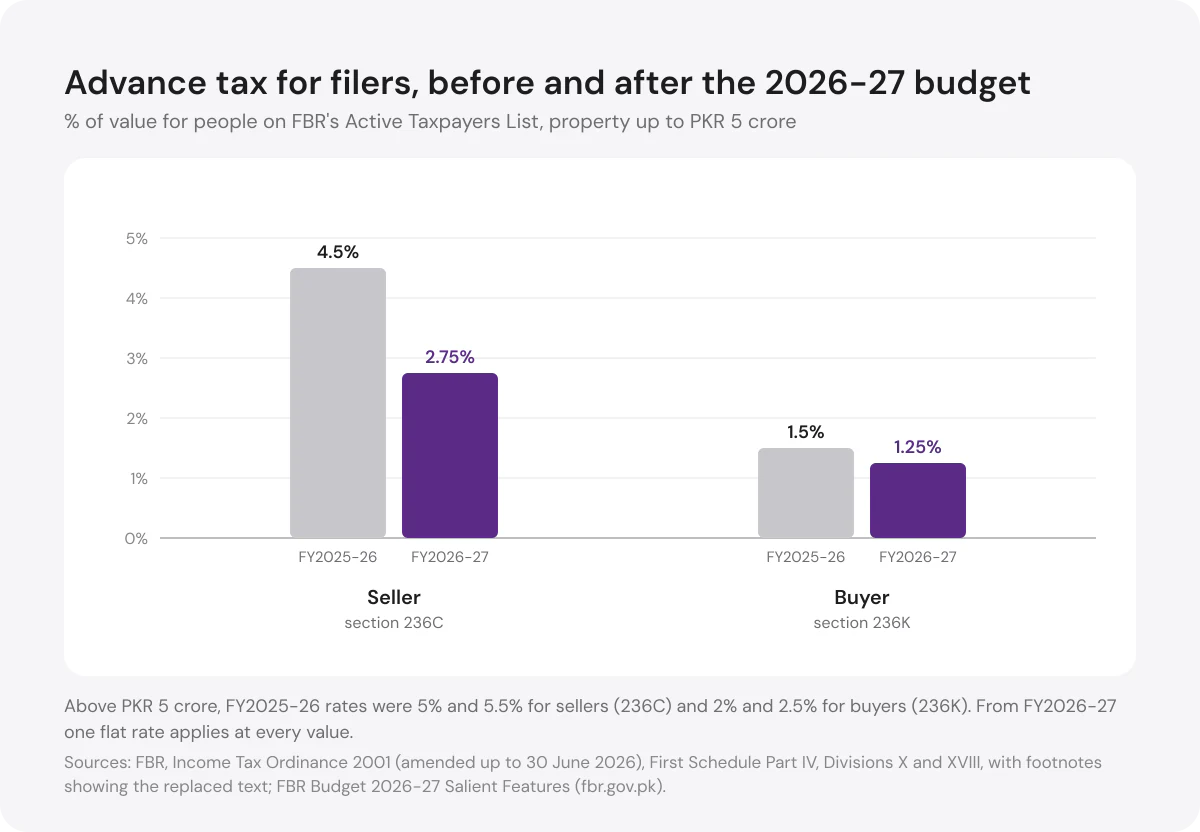
Advance tax for filers before and after the 2026-27 budget, property up to PKR 5 crore. Source: FBR.
Section 7E is gone
Section 7E, in force since tax year 2022, treated 5% of the fair market value of property you owned as income, and taxed that at 20%. In practice that was a yearly charge of about 1% of value on second and further properties, with exemptions such as one home you own, business premises you use and property in its first year after purchase. Sellers also needed proof that 7E was paid before a transfer could be registered.
FBR's Salient Features say: "Section 7E, relating to taxation of deemed income from capital assets situated in Pakistan, has been omitted." Business Recorder reported that this followed a ruling by the newly established Federal Constitutional Court declaring the provision unconstitutional. The same report said participants at the budget briefing asked how tax already collected under 7E would be handled. FBR's Circular No. 2 of 2026-27 (8 September 2026) confirms that tax on deemed income under section 7E "has been abolished by omission" and that its rate in Division VIIIC was omitted too. The circular says nothing about 7E for tax years 2022 to 2026. Section 236C(2A), which tells registrars not to record a transfer until the seller shows 7E has been discharged, is still printed in FBR's consolidated Ordinance, so carry proof that 7E was paid or did not apply for past years. We found no FBR instruction on 7E for tax years 2022 to 2026, so before you sell ask the Sub-Registrar or society whether they still want 7E evidence, and ask a tax adviser how any unpaid 7E for those years will be treated.
Other changes worth knowing
- Capital Value Tax on foreign assets. The Salient Features said Capital Value Tax charged on resident Pakistanis' foreign movable and immovable assets "is proposed to be abolished." It was enacted: section 8 of the Finance Act 2026 omits the clause of the Finance Act 2022 that charged it, and PwC's Pakistan tax summary lists the CVT on resident individuals' foreign assets as abolished. This does not affect property in Pakistan.
- Inherited property. The Salient Features say the law "has been clarified regarding determination of cost basis of inherited immovable property and tax treatment of family settlements after death." KPMG's brief of the Finance Act 2026 explains the result: the cost of property an individual inherits is its fair market value on the date it is transferred to the heir (the Bill had proposed the date of death), and that cost is used to work out the gain when the heir later sells. A transfer through a family settlement among legal heirs after a death now also counts as transmission on death.
- Capital gains tax. The Salient Features list no change to section 37 rates on property. For property bought on or after 1 July 2024, the consolidated Ordinance still shows a 15% rate for filers. Our taxes when you buy guide covers the holding-period table for older purchases.
What it means on a real deal
Take a house sold for PKR 2 crore in Lahore, where both buyer and seller are filers.
| Item | FY2025-26 | FY2026-27 | | --- | --- | --- | | Seller's 236C | PKR 9 lakh (4.5%) | PKR 5.5 lakh (2.75%) | | Buyer's 236K | PKR 3 lakh (1.5%) | PKR 2.5 lakh (1.25%) | | Punjab stamp duty, buyer | PKR 2 lakh (1%) | PKR 2 lakh (1%) |
If the buyer were a non-filer, 236K alone would be PKR 21 lakh (10.5%). This is why becoming a filer before you buy matters more than ever. Our guide to becoming a filer and checking the ATL explains how.
For 236K, the Ordinance uses "fair market value" (section 2(22AA)), meaning the value as provided in section 68, which is where FBR's valuation tables come from. So budget on FBR's valuation for the area, not only the agreed price. Registration fees and local charges come on top.
Stamp duty is a provincial matter
The federal budget does not set stamp duty. In Punjab, the Stamp (Amendment) Act 2026 (Act XXIV of 2026, Punjab Gazette 6 May 2026) fixed stamp duty on a sale at 1% for both urban and rural property, removing the old 3% rural rate; it made permanent an ordinance of 10 April 2026. Sindh, Khyber Pakhtunkhwa, Balochistan and Islamabad set their own rates. Our stamp duty by province guide compares them.
Overseas Pakistanis
FBR's overseas FAQ says a NICOP or POC holder who is non-resident (in Pakistan for fewer than 183 days in the tax year) can pay 236C and 236K at the filer rate without filing a return. The registering authority or housing society creates the payment slip (PSID) through the "Overseas Pakistanis" link on FBR's portal. The Commissioner checks the documents and approves it, and the buyer or seller then pays at the filer rate. With the filer rate now 1.25% instead of 10.5% or more, this step is worth doing.
Red flags
- A dealer quotes "old" tax figures to justify a higher total cost. Ask for the FBR calculation.
- Someone offers to "save tax" by under-declaring the price. Advance tax on purchase is worked out on FBR's valuation, and under-declaring creates problems when you sell.
- You are told a non-filer gets the new low rate. The cuts apply only to people on the Active Taxpayers List.
If something goes wrong
If tax was collected at the wrong rate, keep the challan and the registration papers. Advance tax under 236C and 236K is generally adjustable against your final tax for the year, so a tax adviser can claim it in your return. For disputes, contact your Regional Tax Office.
How Pakizzle helps
Pakizzle's area price pages show asking prices by City, Area and Block, which helps you sanity-check a deal before you work out the tax. Overseas mode shows prices in your currency. We do not calculate your tax or give tax advice.
Tax law changes every budget. For a large purchase or sale, confirm the rates with FBR or a qualified tax adviser before you pay.
Questions
What is the 236K tax rate in 2026-27?
For a buyer on FBR's Active Taxpayers List, 1.25% of the property's fair market value, according to the Income Tax Ordinance as amended by the Finance Act 2026 and FBR's rate card. FBR's budget-day Salient Features mentioned 1.5%, but the enacted text says 1.25%. A non-filer buyer pays 10.5%, 14.5% or 18.5% depending on value.
Is the 7E tax abolished?
Yes. FBR's Salient Features for Budget 2026-27 say section 7E, the tax on deemed income from property, "has been omitted", and the consolidated Income Tax Ordinance shows it omitted by the Finance Act 2026. Business Recorder reported this followed a Federal Constitutional Court ruling. FBR has not said how 7E for tax years 2022 to 2026 will be treated; check with a tax adviser.
Non-filer property tax 2026: did it go down?
No. The cuts apply to people on the Active Taxpayers List (filers). For non-filers the Tenth Schedule still sets 11.5% on sale under 236C and 10.5% to 18.5% on purchase under 236K. On a PKR 2 crore purchase that is PKR 2.5 lakh for a filer at 1.25%, against PKR 21 lakh for a non-filer at 10.5%.
Do overseas Pakistanis pay the filer rate?
They can, even without filing, if they hold a NICOP or POC and are non-resident (in Pakistan for fewer than 183 days in the tax year). FBR's overseas FAQ says the registering authority or society creates the payment slip through the 'Overseas Pakistanis' link on FBR's portal, and the Commissioner approves it before payment at the filer rate.
Did stamp duty change in the federal budget?
No. Stamp duty is provincial. In Punjab, the Stamp (Amendment) Act 2026 set stamp duty at 1% for both urban and rural property, removing the old 3% rural rate. Sindh, Khyber Pakhtunkhwa, Balochistan and Islamabad set their own rates, so check your own province's rate before you pay.
Sources
- FBR: Salient Features, Budget 2026-27 (Income Tax Ordinance relief measures)
- FBR: Income Tax Ordinance 2001, consolidated up to Finance Act 2026
- FBR: Withholding Income Tax Rate Card, updated as per Finance Act 2026
- FBR: FAQs on filer rate under section 236C or 236K for overseas Pakistanis
- Business Recorder: The labyrinthine Finance Bill 2026 explained (16 Jun 2026)
- ProPakistani: Govt faces IMF resistance over real estate tax concessions (17 Jun 2026)
- FBR: Circular No. 2 of 2026-27, Finance Act 2026 explanation (8 Sep 2026, scanned PDF)
- Gazette of Pakistan: Finance Act 2026 (26 Jun 2026), section 8 amends the Finance Act 2022 (CVT)
- PwC Worldwide Tax Summaries: Pakistan, individual, significant developments
- KPMG Taseer Hadi & Co.: A Brief of Finance Act, 2026 (July 2026)
- FBR: Frequently Asked Questions and Answers for Overseas Pakistanis (PDF, 3 Jul 2025; procedure only, rates out of date)
- Punjab Gazette: The Stamp (Amendment) Act 2026 (Act XXIV of 2026), 6 May 2026
Tools for this
Related guides
- Property tax calculator: advance tax, CVT and stamp duty Taxes & fees
Pakizzle's property tax calculator works out the taxes on a property transfer line by line, each with its legal source.
- Filer vs non-filer property tax rates in Pakistan Taxes & fees
Under the Finance Act 2026, a buyer on FBR's Active Taxpayers List pays 1.25% advance tax (section 236K) and a seller pays 2.75% (section…
- Declaring property in your FBR wealth statement Taxes & fees
If you are a resident individual filing an income tax return, Section 116(2) requires a wealth statement and wealth reconciliation with it.
- Gift deed (hiba) in Punjab: no stamp duty for close family Taxes & fees
Under Punjab's Stamp (Second Amendment) Ordinance 2026, gift deeds (hiba) between spouses, parents and children, grandparents and…