Transfer process · Guide
Bahria Town transfer process: what to bring
By Pakizzle Editorial Team · Checked against official sources on
Published · Updated on · 11 min read

The short answer
A Bahria Town plot or house is transferred at Bahria Town's own transfer office. The seller gets a No Demand Certificate (NDC) showing dues are clear, both parties attend with original CNICs and the allotment letter, the buyer pays the transfer fee, and the society collects advance tax under sections 236C and 236K.
Key facts
| Fact | Value | Source | As of |
|---|---|---|---|
| Advance tax on the seller under section 236C for an Active Taxpayer List (ATL) filer, for tax year 2027. | 2.75% of gross consideration (11.50% if not on ATL) | Federal Board of Revenue: Withholding Income Tax Rate Card (Finance Act 2026) | |
| Advance tax on the buyer under section 236K for an ATL filer; non-ATL rate rises with value. | 1.25% (non-ATL 10.50% / 14.50% / 18.50%) | Federal Board of Revenue: Withholding Income Tax Rate Card (Finance Act 2026) | |
| The Explanation to sections 236C(1) and 236K(1) says the person recording a transfer includes a housing society, so the society collects both taxes. | Housing societies are collecting agents | FBR: Income Tax Ordinance 2001, amended up to 30 June 2026 | |
| Bahria Town's official website lists a 24/7 toll-free helpline but no transfer checklist or fee schedule. | 0800 00100 | Bahria Town: official website |
A plot or house in Bahria Town does not change hands at the patwari or the land record centre. It changes hands at Bahria Town's own transfer office, which updates the society's record and issues a new allotment letter in the buyer's name. Most failed transfer days come down to one missing paper, so this guide is about what to bring and what to check before you go.
Quick facts
Bahria Town runs separate offices for its projects in Rawalpindi and Islamabad, Lahore and Karachi, and each office sets its own fees and paperwork. The company's official website lists a 24/7 toll-free helpline, 0800 00100, and its contacts page lists customer support centres in Karachi, Lahore and Nawabshah, plus other offices including Rawalpindi, Islamabad and Peshawar. As of 11 November 2026, it does not publish a transfer checklist or a transfer fee schedule. So treat any fee table you see online, including old blog posts with 2019 figures, as unverified until the office confirms it.
Two things do not depend on Bahria. Advance income tax applies to every transfer: 2.75% on the seller under section 236C and 1.25% on the buyer under section 236K, for people on the Active Taxpayer List (ATL), as of the FBR rate card updated to 30 June 2026. And the Explanation to sections 236C and 236K of the Income Tax Ordinance says the person who records a transfer includes a "housing society", so Bahria collects these taxes when it records the transfer.
Before you start: three checks
- Which Bahria, which phase. Bahria Town Rawalpindi and Islamabad, Bahria Enclave, Bahria Town Lahore and Bahria Town Karachi are separate projects with separate approvals. In Islamabad, the CDA's private housing schemes register shows each Bahria phase separately, with its layout plan (LOP) and No Objection Certificate (NOC) status. When we checked on 11 November 2026 it listed "Bahria Town (Phase-VII-E)" as LOP "Approved" and NOC "Issued" (its CDA page gives the LOP date as 14 May 2012 and the NOC date as 20 March 2015), and "Bahria Town (Phase-III-E- IV)" as LOP "Approved" and NOC "Not Issued". Check the live register for the phase you are buying in. Our society status page quotes official lists with dates.
- Any freeze or court order. Before you pay token money, ask the transfer office in writing whether any authority or court order stops transfers on that plot or phase, and check the relevant authority's public notices.
- Whether the office is processing transfers. Call the helpline before you fix a date and ask whether the transfer office for your project is processing transfers that week.
What the seller brings
Bahria Town does not publish its transfer checklist online (checked 11 November 2026). The lists below are the papers transfers usually need, so call 0800 00100, ask for your project's transfer office and get its current written list before your visit.
- Original allotment letter, or the transfer receipt if no allotment letter was issued after the last transfer
- Original CNIC, plus attested photocopies
- The NDC (No Demand Certificate), issued in the seller's name
- Paid receipts for any dues shown on the NDC
- For a built house, flat or shop: proof that utility and maintenance bills are clear
- Recent passport-size photographs
- If someone else signs for the seller: the original registered power of attorney (a general or special attorney)
- Tax proof: the paid 236C challan (Computerized Payment Receipt, CPR) or the office's own collection slip
- Non-resident seller: FBR's Circular 3 of 2023-24 asked non-resident sellers to give the transferring authority a filled Form-B (a declaration of non-residency for the section 7E tax on deemed income) with a scanned copy of their valid passport, plus a copy of their CNIC, NICOP or POC for non-resident Pakistanis. Section 7E was abolished from tax year 2027 by the Finance Act 2026 (FBR Circular 2 of 2026-27), but section 236C(2A), which asks for 7E evidence, is still printed in the Ordinance, so ask the office whether it still wants Form-B or 7E proof for past years
What the buyer brings
- Original CNIC, plus attested photocopies
- Recent passport-size photographs
- Nominee details and a copy of the nominee's CNIC, if the office asks for a nominee (Bahria does not say online whether it still does)
- The transfer fee, paid at the bank counter or by the method the office names
- Tax proof: the paid 236K challan (CPR) or the office's collection slip
- The pay order or bank transfer proof for the balance owed to the seller
- Your copy of the signed sale agreement and the bayana (token money) receipt
Keep everything in one folder, in the same order as the lists above. It saves time at the counter.
How the NDC works
The NDC is the society's statement that the seller owes nothing on the property. It normally lists the transfer fee and any unpaid instalments, development or possession charges, or maintenance dues. Only once the NDC is clear can the transfer go ahead.
- Apply a few working days before the transfer date. Bahria does not publish the NDC processing time, fee or validity online, so ask the transfer office for its written NDC form and fee slip, and whether an urgent NDC costs more.
- Note the validity period printed on it. An expired NDC usually means a fresh application.
- Read every line. If a charge looks wrong, settle it with the office before transfer day, not at the counter.
Transfer day, step by step
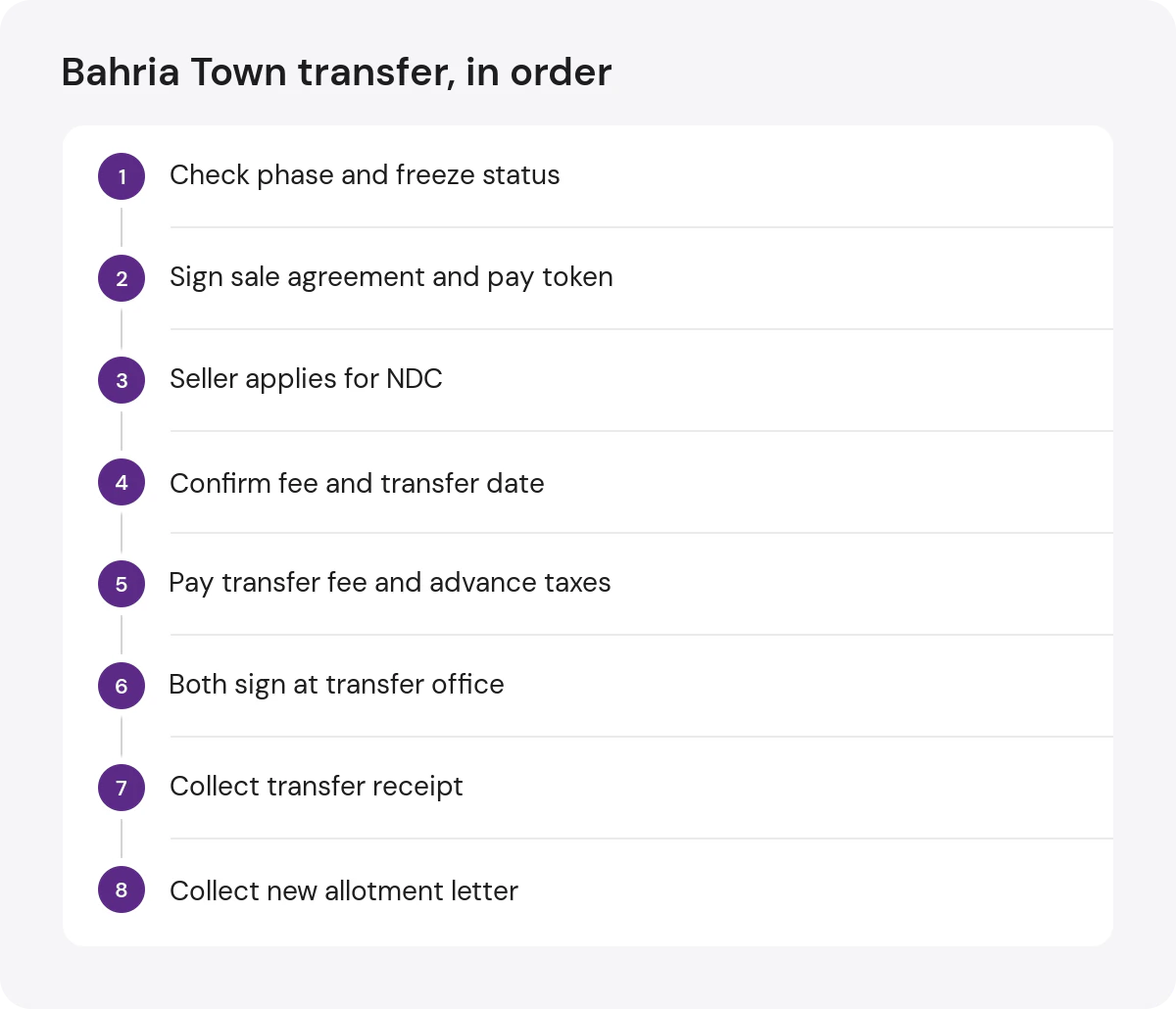
The usual sequence; confirm each step with Bahria's transfer office.
- Book the date. Confirm the date and time with the transfer office, and check whether an appointment or token is needed.
- Both parties attend in person, or through a registered attorney.
- Pay the fees. The buyer pays the transfer fee, and the seller clears any dues on the NDC. Pay advance taxes as the office directs.
- Submit documents at the counter and wait for verification.
- Sign the transfer papers. The seller signs first, then the buyer, with photographs and biometric or thumb impressions as the office requires. Ask the office beforehand whether witnesses must attend, and how many.
- Hand over payment. The buyer gives the seller the agreed pay order once the office confirms the papers.
- Collect the transfer receipt. Keep it safe; it proves the transfer while the new allotment letter is printed.
- Collect the new allotment letter on the date the office gives you.
Fees and taxes
| Item | Who pays | Amount | Source | | --- | --- | --- | --- | | Bahria Town transfer fee | Usually buyer (by agreement) | Not published online (checked 11 Nov 2026); depends on project, size and category | Written fee slip from the transfer office (0800 00100) | | Dues on the NDC | Seller | As shown on the NDC | Bahria Town | | Advance tax, section 236C | Seller | 2.75% (ATL); 11.50% (not on ATL) | FBR rate card, as of November 2026 | | Advance tax, section 236K | Buyer | 1.25% (ATL); 10.50% up to PKR 5 crore, 14.50% up to PKR 10 crore, 18.50% above (not on ATL) | FBR rate card, as of November 2026 |
236C is worked out on the gross amount the seller receives, and 236K on the fair market value. Tax rates change with each budget, so check the FBR card on the day. Our guides to 236C and 236K explain how the values are set. For a large deal, speak to a tax adviser before you sign.
Red flags
- The seller cannot produce the original allotment letter or the last transfer receipt.
- The seller asks you to pay in full before the NDC is issued.
- The NDC is in a different name from the CNIC in front of you.
- Someone offers to "do the transfer without the seller" without a registered power of attorney.
- The plot is in a precinct or extension that is the subject of a freeze order, a court case or an authority notice.
- The fee you are quoted is far below what the office later confirms. It may be a sign the dealer plans to collect the difference.
If something goes wrong
- Stop further payments until the office confirms the problem in writing.
- Get the reason in writing from the transfer office: unpaid dues, a missing document or a legal hold.
- Use the complaint channel. Bahria's official contacts page lists customer support centres in Karachi, Lahore and Nawabshah, other offices in cities including Rawalpindi, Islamabad and Peshawar, and the toll-free number.
- Speak to a property lawyer if a freeze order or court case is involved. For a disputed society approval, contact the authority for that area (CDA, RDA, LDA or SBCA).
How Pakizzle helps
On Pakizzle you can search by City, then Area, then Block, and see which listings carry a dated "Documents checked" or "Visited" signal, and which sellers have an ID verified blue tick or a phone number verified by call-back. Our token money checklist lists what to agree in writing before you pay bayana, and the society status page quotes the official approval lists with their dates. These checks help you decide whom to call. They are not a title check, and they do not replace a written confirmation from Bahria's transfer office.
For a large purchase, speak to a qualified property lawyer or the relevant development authority before you pay.
Questions
Bahria Town NDC kya hota hai aur kitne din valid hota hai?
NDC means No Demand Certificate. Bahria Town issues it to the seller to show that no instalments, development charges or maintenance dues are outstanding, and it states the transfer fee. Bahria does not publish the validity period on its website, so ask the transfer office when you apply and make sure the transfer date falls inside it. If it expires, you will usually need a fresh NDC.
Can the seller transfer a Bahria Town plot from abroad?
Usually yes, through a power of attorney, but Bahria does not publish its overseas procedure, so confirm it on 0800 00100. For tax, a non-resident NICOP or POC holder pays 236C at the ATL rate. FBR's 2023 circular also asked non-resident sellers for a Form-B declaration for the old section 7E tax, which was abolished from tax year 2027, so ask whether Bahria still wants it.
Who pays the Bahria Town transfer fee, buyer or seller?
There is no law fixing this. In most deals the buyer pays the society's transfer fee and the seller clears all dues shown on the NDC, but it is a matter for your sale agreement. Write it into the agreement before you pay token money, along with who pays the 236C and 236K advance taxes.
Is a Bahria Town transfer the same as a registry?
No. A transfer at Bahria Town changes the name on the society's own record and allotment letter. A registry is a sale deed registered with the government Sub-Registrar. For a plot that has not been separately registered, the society's transfer is the record buyers rely on. Ask a property lawyer whether a registry is needed for your property.
How do I know the plot is not under a freeze order?
Ask the transfer office in writing whether any court or authority order affects the plot or its precinct, and read the relevant authority's recent public notices. A fresh NDC alone does not prove a plot is free of such orders.
Sources
- Bahria Town: official website (helpline)
- Bahria Town: Contacts (customer support centres)
- Federal Board of Revenue: Withholding Income Tax Rate Card, updated to 30 June 2026
- Federal Board of Revenue: Circular No. 03 of 2023-24 (sale or transfer of immovable property)
- FBR: Circular No. 02 of 2026-27, Finance Act 2026 explained (omission of section 7E)
- FBR: Income Tax Ordinance 2001, amended up to 30 June 2026 (sections 236C and 236K)
- Capital Development Authority: Private housing schemes register (letter B)
- Capital Development Authority: Bahria Town (Phase-VII-E) scheme page
- Dawn: NAB freezes four more Bahria Town properties in Karachi (8 May 2026)
Tools for this
Related guides
- Society transfer fees and how they're charged Transfer process
A society transfer fee is what a housing society or authority charges to move a property into the buyer's name.
- Biometric verification for a property transfer Transfer process
Biometric verification matches each party's thumbprint, and in Sindh their face, against NADRA's records before a property document is…
- Succession certificate from NADRA: how legal heirs get one Transfer process
NADRA's Succession Facilitation Units issue succession certificates and letters of administration without a court case when all legal heirs…
- Buying or transferring a house in North Nazimabad: KDA steps and costs Transfer process
To transfer a house or plot in North Nazimabad, register the sale deed with the Sub-Registrar, then apply to KDA for mutation so its record…