Taxes & fees · Explainer
Stamp duty on property by province (as of November 2026)
By Pakizzle Editorial Team · Checked against official sources on
Published · Updated on · 12 min read

The short answer
Stamp duty on a property sale is set by each province. As of November 2026, Punjab charges 1% in urban and rural areas under its Stamp (Amendment) Act 2026, and Islamabad charges a flat 1% under the Finance Act 2025. Sindh's Board of Revenue schedule charges 2% of the valuation-table value, and Khyber Pakhtunkhwa charges 1% (FY 2025-26).
Key facts
| Fact | Value | Source | As of |
|---|---|---|---|
| Punjab's Stamp (Amendment) Act 2026 made conveyance stamp duty 1% in urban and rural areas; rural property previously paid 3%. | 1% (urban and rural) | Punjab Gazette: Stamp (Amendment) Act 2026 (Act XXIV of 2026) | |
| Punjab's Stamp (Amendment) Act 2026 adds an 'assignable deed' (Article 11-AA): 1% per assignment within 12 months, 2% after that. | 1% within 12 months; 2% after | Punjab Gazette: Stamp (Amendment) Act 2026 (Act XXIV of 2026) | |
| Punjab's Stamp (Second Amendment) Ordinance 2026 exempts gift deeds between close relatives and cuts duty on other gift deeds from 2% to 1%. | Close family: exempt; others: 1% | The News | |
| Sindh's stamp schedule on the Board of Revenue's site charges conveyance at 2% of the value in the valuation table. | 2% of valuation-table value | Board of Revenue Sindh: Schedule, stamp duty on instruments | |
| KP's Board of Revenue lists, for FY 2025-26, stamp duty 1%, registration fee 0.5%, capital value tax 1% and local council tax 1%. | Stamp duty 1% (KP) | Board of Revenue Khyber Pakhtunkhwa: Taxes/Fees | |
| Islamabad's Finance Act 2025 set ICT conveyance stamp duty at 1% of the property's value, with no separate non-filer rate. | 1% flat | National Assembly: Finance Bill 2025 as passed (s.2, Stamp Act for ICT) |
Stamp duty is the provincial tax you pay on the deed when property changes hands. Because each province sets its own rate, the same sale can cost very different amounts in Lahore, Karachi, Peshawar or Islamabad. Rates changed more than once in 2026, so every figure below carries the date and source we found it in.
Quick facts
Stamp duty is charged under the Stamp Act 1899 as amended by each province, and paid through e-stamp paper before registration. It is separate from the federal advance taxes under sections 236C (seller) and 236K (buyer), which FBR set at 2.75% and 1.25% for people on the Active Taxpayers' List from the Finance Act 2026. It is also separate from fees charged by development authorities, such as the CDA transfer fee in Islamabad. Duty is usually worked out on the official valuation (often called the DC rate or valuation table), not only on the price you agree.
The rates at a glance
| Province or territory | Sale (conveyance) rate | Source and date | Confidence | | --- | --- | --- | --- | | Punjab | 1%, urban and rural | Stamp (Amendment) Act 2026 (Act XXIV of 2026), Punjab Gazette 6 May 2026 | Official text | | Sindh | 2% of valuation-table value (BoR schedule); one other official copy says 4% | BoR Sindh schedule, Article 16 (opened 10 Nov 2026); Sindh Judicial Academy text (to 2023) | BoR text; confirm on estamps.gos.pk | | Islamabad (ICT) | 1% of value, flat | Finance Act 2025, s.2 (Article 23 for ICT) | Official text | | Khyber Pakhtunkhwa | 1%, plus 0.5% registration fee, 1% CVT and 1% local council tax | KP Board of Revenue, Taxes/Fees, FY 2025-26 | Official page | | Balochistan | Not confirmed | Only the 2021 Finance Act's gift rates found | Ask BoR Balochistan or the Sub-Registrar |
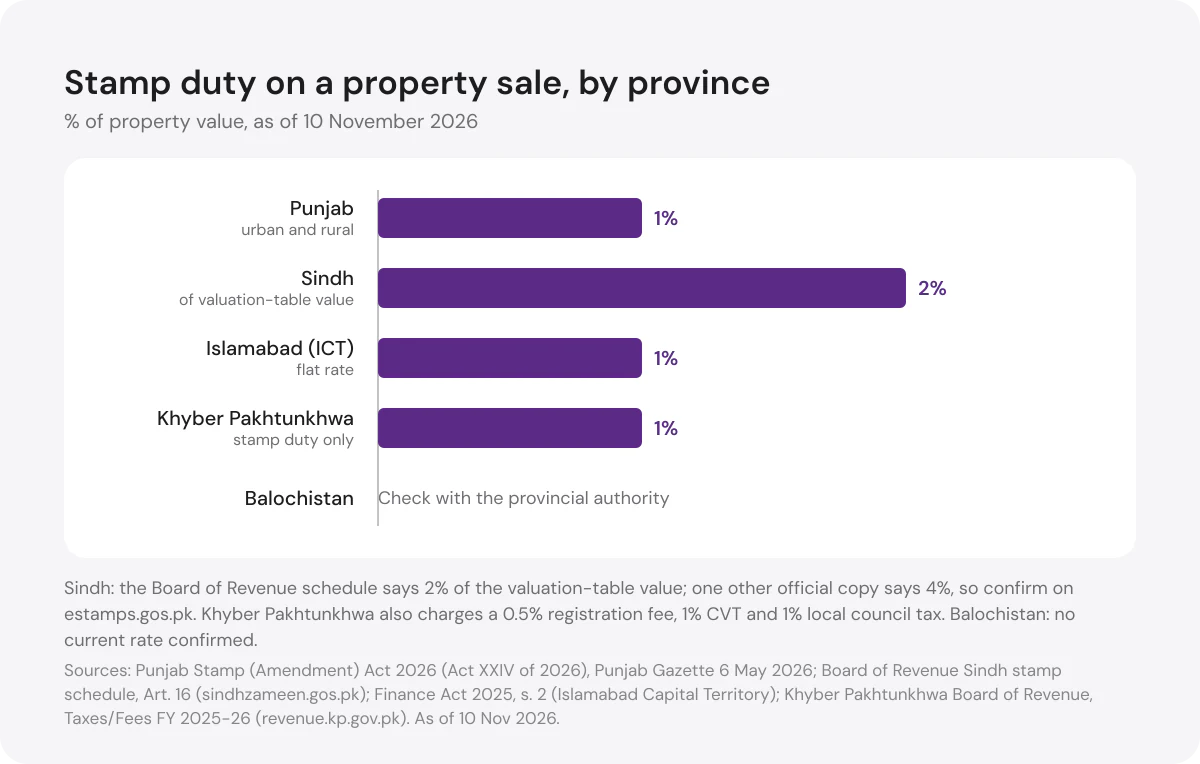
Stamp duty on a property sale by province, as of 10 November 2026. Sources: Punjab Stamp (Amendment) Act 2026; Board of Revenue Sindh stamp schedule; Finance Act 2025 (ICT); Khyber Pakhtunkhwa Board of Revenue, FY 2025-26. Balochistan: check with the provincial authority.
Punjab
Sales. The Nation reported on 11 April 2026 that the Punjab Governor assented to an ordinance under which stamp duty "has been made uniform across urban and rural areas and fixed at one percent". Rural property previously paid 3%. On 23 April 2026 The Nation reported that the Punjab Assembly had passed the Stamp (Amendment) Bill 2026, reducing stamp duty on rural immovable property from 3% to 1%. It became the Stamp (Amendment) Act 2026 (Act XXIV of 2026), published in the Punjab Gazette on 6 May 2026 and in force at once. In Schedule I it changes "Three" to "One" in Article 23(b), the conveyance rate, so sale stamp duty is 1% of value across Punjab. It also repealed the April ordinance and saved actions taken under it.
Assignable deed. Pakistan Today reported that an April 10 notification introduced an "assignable deed", described by an official as a limited-duration transfer of rights. It carries 1% duty for up to one year and 2% if it runs longer. The same official said that after one year "all FBR related taxes will have to be paid". The enacted Act adds Article 11-AA for the assignable deed: 1% of value for each assignment within 12 months, and 2% beyond 12 months.
Gifts, exchanges and leases. The News (23 October 2026) and Minute Mirror (28 October 2026) reported the Stamp (Second Amendment) Ordinance 2026:
- gift deeds between spouses, parents and children, grandparents and grandchildren, siblings, and wives or widows of the same husband are exempt;
- other gift deeds pay 1% of the property's value instead of 2%;
- an exchange of properties of equal value pays a fixed PKR 1,000, and an unequal exchange pays 1% of the excess value;
- residential leases pay fixed amounts by annual rent, from PKR 3,000 (annual rent up to PKR 3 lakh) to PKR 25,000 (annual rent above PKR 20 lakh), and commercial, industrial or agricultural leases pay 3.25% of rent;
- inheritance mutations are exempt from fees and stamp duty (Minute Mirror).
That ordinance (Ordinance XIV of 2026) is now before the Assembly as the Stamp (Second Amendment) Bill 2026 (Bill 68 of 2026), which would repeal the ordinance and re-enact its changes; the Bill's text confirms the gift, exchange and lease changes above. The Assembly's bills page shows the Bill introduced on 28 October 2026 and sent to the Revenue Committee, and it was not on the list of passed bills when we checked on 11 November 2026. Until it is passed, the ordinance's changes apply, so check the position with the Sub-Registrar when you register.
CVT. We found no Board of Revenue Punjab notification saying whether a separate capital value tax applies to urban property in 2026-27, and KPMG's July 2026 summary of the Punjab Finance Act 2026 lists no CVT change. Ask the Sub-Registrar or BoR Punjab whether CVT will appear on your challan before you budget.
Sindh
The stamp schedule published on the Sindh Board of Revenue's land records site sets conveyance (Article 16) at "2 percent of the value in accordance with the valuation table". Transfers to and from REITs pay 2% of the valuation-table value or 0.25% of the transaction value, whichever is higher. An affidavit confirming an oral gift to someone other than a legal heir pays 2%, while a gift to a spouse, parent, child, grandparent, grandchild, brother or sister pays one-fifth of the conveyance duty. The PDF carries no date. The Sindh Judicial Academy's consolidated Stamp Act (updated to Sindh Act XXVI of 2023), however, shows conveyance at "Four percent of the value of the property". Neither later Finance Act changes the conveyance rate: the Sindh Finance Act 2025 amended only an insurance entry in the schedule, and KPMG's July 2026 summary of the Sindh Finance Act 2026 lists no Stamp Act change. We use the Board of Revenue's own 2% figure, but check it on BoR Sindh's e-stamping portal (estamps.gos.pk), which issues the challan and has a valuation calculator, before you pay.
Khyber Pakhtunkhwa
The KP Finance Act 2024 (KP Act I of 2024, in force 1 July 2024) halved the conveyance duty in Article 23, changing "Two rupees" to "One rupee", which on the earlier per-hundred-rupees wording means 1%. It also set duty on allotment orders and their transfer by developers and housing societies, for open plots, at "two percent (2%) of the value of the plot as per Valuation Table of the Federal Board of Revenue or Deputy Commissioner, as the case may be, whichever is higher". The Express Tribune reported that the KP Finance Act 2025 cut that allotment rate to 1%; we could not find the 2025 gazette. The KP Finance Act 2026 made no Stamp Act change. KP's Board of Revenue confirms the result on its Taxes/Fees page for FY 2025-26: stamp duty 1%, registration fee 0.5%, capital value tax 1% and local council tax 1%. We could not confirm the 2025 cut in the allotment rate from an official text, so ask KP's Board of Revenue which rate applies before you buy an allotment.
Islamabad Capital Territory
Dawn reported on 12 June 2025 that the Finance Bill 2025 would cut stamp duty on immovable property in Islamabad from 4% to "one per cent of the value of the immovable property" for filers and "two per cent for non-filers". On 4 July 2025 Dawn reported that the federal government had "abolished" the 4% stamp duty and 1% registration fee in Islamabad. The Finance Act 2025 as passed settles it: for Islamabad, Article 23 charges conveyance at "one percent of the value of the immovable property", with no separate non-filer rate. The Finance Act 2026 made no further Stamp Act change, so 1% applies as of November 2026. The Islamabad property tax calculator adds this 1% to the federal advance taxes.
The CDA transfer fee is separate. Dawn reported that CDA raised it from 1% to 3% from 1 July 2025, and ProPakistani reported on 9 April 2026 that the CDA board cut it back to 1% of the property's value, with immediate effect.
How to pay and check
- Find the official value. Ask the registry office or check the district valuation table for your area.
- Buy e-stamp paper for the correct amount in the buyer's name, and keep the challan.
- Verify the e-stamp before signing. In Sindh, the e-stamping portal (estamps.gos.pk) has a "Verify your e-Stamps" option. In Punjab, e-stamps come from the PITB-run e-Stamping system, which keeps a central database for verification; its portal did not load for us on 10 November 2026, so ask the Sub-Registrar to verify the e-stamp number before you sign.
- Register the deed within four months of signing, as the Registration Act 1908 requires.
- Keep copies of the e-stamp, tax receipts and registered deed together.
Red flags
- Someone quotes "stamp duty" as a single round figure without showing the valuation used.
- You are asked to pay stamp duty in cash to an agent rather than through an e-stamp challan.
- The deed is drawn on old manual stamp paper where e-stamping is required.
- A gift between relatives is recorded as a sale, or the reverse, to change the duty.
What to do if something goes wrong
If you paid the wrong amount, ask the sub-registrar in writing how to correct it before registration. If a dealer took cash for stamp duty and no e-stamp exists, keep the receipt and report it to the district administration or police. For big transactions, have a lawyer check the deed and duty before you sign.
How Pakizzle helps
Our /prices area pages show recent asking prices by City, Area and Block, so you can compare the price you agree with what nearby listings ask. Overseas mode shows prices in your own currency. Our stamp duty calculator, transfer cost calculator and property tax calculator give you an estimate, but Pakizzle does not collect stamp duty, and our figures are not a substitute for the registry office's own calculation.
For a large purchase, confirm the stamp duty with the provincial Board of Revenue or the sub-registrar, and speak to a tax adviser.
Questions
Punjab mein stamp duty kitni hai 2026 mein?
Punjab's stamp duty on a sale (conveyance) is 1% of value in both urban and rural areas under the Stamp (Amendment) Act 2026 (Act XXIV of 2026). Rural property used to pay 3%. Confirm the exact amount on your e-stamp challan before you pay.
Is stamp duty paid on the DC rate or the actual price?
Usually on the official valuation, or the declared price if the law says whichever is higher. Sindh's schedule charges conveyance at 2% of the value in the valuation table. Punjab's Land Revenue Act refers to the valuation table notified by the District Collector under the Stamp Act for mutation fees. Ask the registry office which value applies to your property.
Do I pay stamp duty on a gift (hiba) to my children in Punjab?
Under Punjab's Stamp (Second Amendment) Ordinance 2026, as reported by The News and Minute Mirror in October 2026, gift deeds between spouses, parents and children, grandparents and grandchildren, siblings, and co-wives of the same husband are exempt. Other gift deeds now pay 1% instead of 2%. The Assembly is considering it as Bill 68 of 2026, not yet passed on 11 November 2026, so check its status when you register.
Is the CDA transfer fee the same as stamp duty in Islamabad?
No. Stamp duty is a tax collected by the ICT revenue department on the deed. The CDA transfer fee is CDA's own charge for transferring property in its sectors. ProPakistani reported in April 2026 that the CDA board cut that fee from 3% to 1% of the property's value. Budget for both if you buy in a CDA sector.
Who pays stamp duty, the buyer or the seller?
In practice the buyer usually pays stamp duty, and DHA Lahore's transfer forms say the purchaser pays it after the transfer. The law does not stop the parties agreeing otherwise, so write it into your sale agreement. Federal advance taxes are separate: the seller pays under section 236C and the buyer under section 236K.
Sources
- The Nation: Punjab governor assents Ord to curtail stamp duty on rural property (11 Apr 2026)
- The Nation: PA slashes traffic fines, stamp duty on rural property (23 Apr 2026)
- Pakistan Today: Punjab property law changes aim to revive real estate sector (13 Apr 2026)
- The News: Punjab ordinance proposes fixed stamp duties, tax relief on family gifts (23 Oct 2026)
- Minute Mirror: Punjab abolishes inheritance transfer fees, reduces stamp duty (28 Oct 2026)
- Board of Revenue Sindh: Schedule, stamp duty on instruments (PDF)
- Provincial Assembly of Khyber Pakhtunkhwa: Finance Bill 2024 extract (PDF)
- Dawn: Reduction of stamp duty in Islamabad to give boost to real estate sector (12 Jun 2025)
- Dawn: CDA increases property transfer fee threefold (4 Jul 2025)
- ProPakistani: CDA notifies huge decrease in property transfer tax for Islamabad (9 Apr 2026)
- Board of Revenue Punjab: The Punjab Land Revenue Act 1967 (PDF)
- FBR: Circular No. 02 of 2026-27, Finance Act 2026 explained
- DHA Lahore: Regular Transfer, documents required and forms (PDF)
- Punjab Gazette: The Stamp (Amendment) Act 2026 (Act XXIV of 2026), 6 May 2026
- Provincial Assembly of the Punjab: The Stamp (Second Amendment) Bill 2026 (Bill No. 68 of 2026)
- Sindh Judicial Academy: Stamp Act 1899 as applicable in Sindh (updated to Sindh Act XXVI of 2023)
- Khyber Pakhtunkhwa Finance Act 2024 (KP Act No. I of 2024), Gazette 12 Jun 2024
- National Assembly: Finance Bill 2025 as passed (s.2, Stamp Act amendment for ICT)
- Board of Revenue Khyber Pakhtunkhwa: Taxes/Fees, FY 2025-26
- KPMG Taseer Hadi & Co.: A Brief of Provincial Tax Laws 2026 (July 2026)
- Government of Sindh: eStamping Citizen Portal (challan, valuation, verification)
- Punjab Information Technology Board: e-Stamping
- Provincial Assembly of the Punjab: Bills (status of Bill No. 68 of 2026, checked 11 Nov 2026)
Corrections
- : We updated the status of Punjab's Stamp (Second Amendment) Bill 2026 (Bill 68 of 2026): it was introduced on 28 October 2026, sent to the Revenue Committee, and had not been passed when we checked on 11 November 2026. We also gave the residential lease thresholds in lakh.
Tools for this
Related guides
- Property tax calculator: advance tax, CVT and stamp duty Taxes & fees
Pakizzle's property tax calculator works out the taxes on a property transfer line by line, each with its legal source.
- Filer vs non-filer property tax rates in Pakistan Taxes & fees
Under the Finance Act 2026, a buyer on FBR's Active Taxpayers List pays 1.25% advance tax (section 236K) and a seller pays 2.75% (section…
- Declaring property in your FBR wealth statement Taxes & fees
If you are a resident individual filing an income tax return, Section 116(2) requires a wealth statement and wealth reconciliation with it.
- Gift deed (hiba) in Punjab: no stamp duty for close family Taxes & fees
Under Punjab's Stamp (Second Amendment) Ordinance 2026, gift deeds (hiba) between spouses, parents and children, grandparents and…