Transfer process · Guide
Property transfer in Pakistan, step by step
By Pakizzle Editorial Team · Checked against official sources on
Published · Updated on · 13 min read

The short answer
To transfer property in Pakistan, agree terms in writing, verify the seller's title and any society dues, pay the FBR withholding taxes (236K for the buyer, 236C for the seller) and provincial stamp duty, sign and register the sale deed, then complete mutation (intiqal) or the society's own transfer before taking possession.
Key facts
| Fact | Value | Source | As of |
|---|---|---|---|
| Buyers on FBR's Active Taxpayers List pay advance tax under section 236K at a flat rate of the property's fair market value. | 1.25% (filer); 10.5% to 18.5% (non-filer) | FBR: Income Tax Ordinance 2001, amended up to 30 June 2026 | |
| Sellers pay advance tax under section 236C on the gross sale consideration. | 2.75% (filer); 11.5% (non-filer) | FBR: Income Tax Ordinance 2001, amended up to 30 June 2026 | |
| Punjab's Stamp (Amendment) Act 2026 set conveyance stamp duty at 1% in urban and rural areas, replacing the April 2026 ordinance. | 1% of property value | Punjab Gazette: Stamp (Amendment) Act 2026 (Act XXIV of 2026) | |
| PLRA's e-registration service fee for sale and purchase in FY2026-27 is 0.1% of land value, with a minimum charge. | 0.1%, minimum PKR 3,600 | Associated Press of Pakistan | |
| Immovable property worth more than PKR 50 lakh must be bought through a crossed banking instrument or digital means, or the cost is not recognised for tax. | Above PKR 5 million (PKR 50 lakh) | FBR: Income Tax Ordinance 2001, section 75A |
Buying property in Pakistan is not finished when you hand over the money. It is finished when the official record shows your name. This guide walks through each step in the order it should happen, with the taxes and fees as of November 2026.
Quick facts
There are two common routes. For land and houses outside a managed society, the seller and buyer sign a sale deed (the registry) at the sub-registrar, and the revenue record is then updated through mutation, called intiqal. For plots and houses in large societies such as DHA, the society keeps its own ownership record and transfers it at its own office. Both routes involve federal withholding tax under sections 236K (buyer) and 236C (seller) of the Income Tax Ordinance 2001. Registry deeds also attract provincial stamp duty.
In Punjab, the rules changed a lot in 2026. In February, ProPakistani reported two ordinances under which "all property transfers will now be processed through e-registration", and the patwari's role was limited to inheritance mutations. In April, Punjab set stamp duty at 1% for both urban and rural property. In Lahore, the Punjab government said in July 2026 that the Property Certificate would serve as legal proof of ownership in public and private housing schemes.
The steps, in order
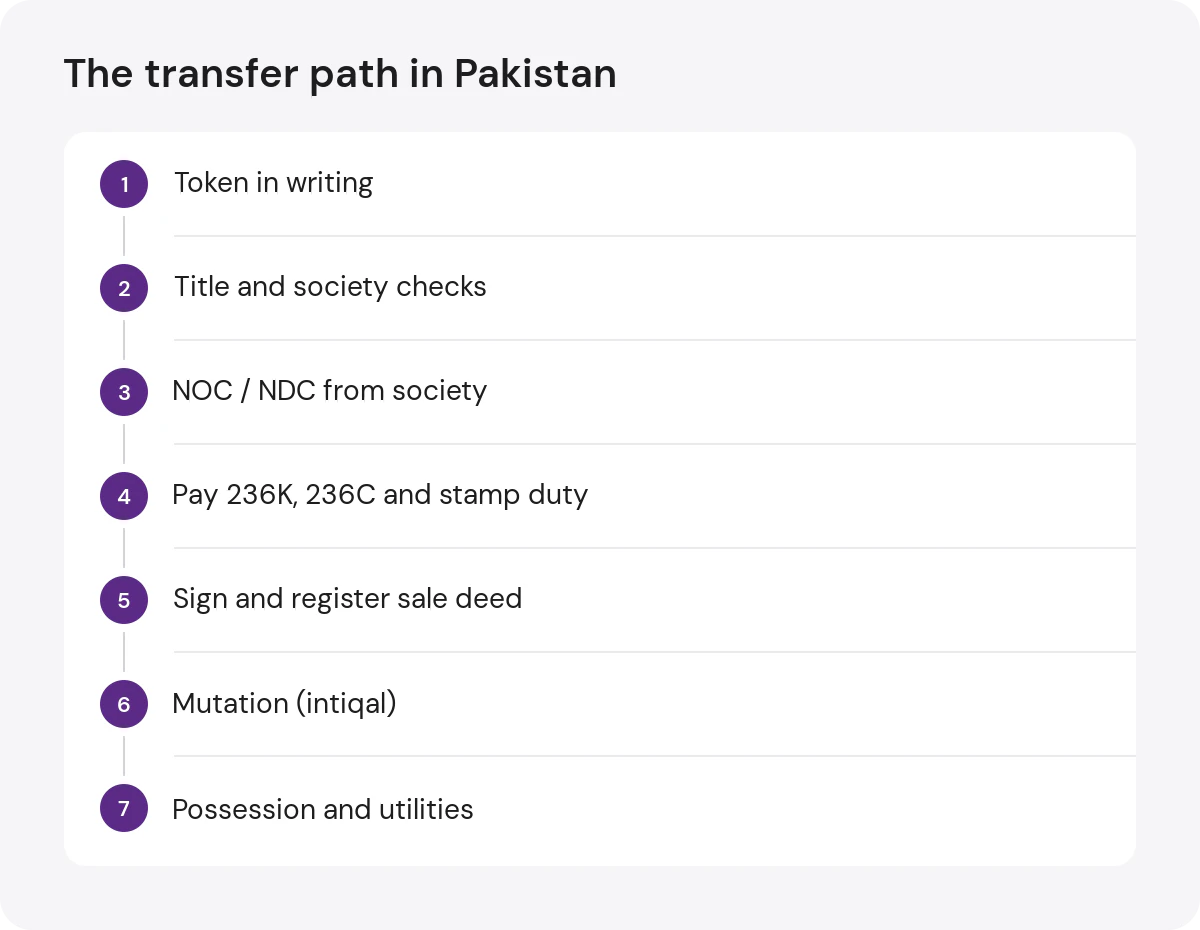
Each step depends on the one before it. Do not skip ahead to payment.
- Agree the deal in writing. Write down the price, the token (bayana) amount, the deadline for the balance, and what happens if either side backs out. Pay the token only after the first checks below. Our token money checklist covers what to write down.
- Check the seller's title. For revenue land in Punjab, get a current fard (the record-of-rights extract) and match the owner's name, CNIC and share (khasra numbers) with the seller. For a society property, ask the society to verify the file or plot in the seller's name. Check that the society itself is approved: the society's authority (CDA, RDA, LDA or SBCA) publishes approved and illegal lists, and our society status page quotes them with dates.
- Clear dues and get the NOC or NDC. Societies and development authorities usually issue a No Demand Certificate (NDC) or No Objection Certificate (NOC) confirming that no dues are outstanding. Utility bills should also be cleared to date.
- Agree the value for tax. FBR taxes are charged on the fair market value. For immovable property this is tied to the FBR valuation table and the provincial value used for stamp duty. Section 2(22AA) of the Ordinance defines "fair market value" as the value provided in section 68, which is where FBR's valuation tables come from. Section 68(6) says the consideration for 236C and the value for 236K "shall not be less than" that value; where FBR has not notified an area, section 68(5) uses the provincial stamp-duty value (the DC rate). Stamp duty itself is provincial: FBR's FAQ says its rates are "for the purpose of Federal taxes only". Ask the registering office which values it will apply before you sign.
- Pay the taxes. The buyer pays 236K and the seller pays 236C, through an FBR payment slip (PSID). The person registering or attesting the transfer, whether a sub-registrar, development authority or housing society, must collect them before recording the transfer. Stamp duty and the registration fee are paid on the provincial side.
- Pay by bank. Under section 75A, property with a fair market value above PKR 50 lakh must be bought by crossed cheque, pay order, demand draft or digital transfer between bank accounts. Keep copies.
- Sign and register the sale deed. Both parties, or their attorneys, appear with original CNICs. In Punjab this now runs through PLRA's e-registration. Each person executing the deed is identified by NADRA biometrics (fingerprint or face) or an electronic signature (Registration Act 1908, s.4 as substituted in 2026), and the parties record statements before the Sub-Registrar. Ask the Sub-Registrar or PLRA's helpline (042-111-22-22-77) in advance whether witnesses must attend and how many: PLRA's e-registration papers still mention witnesses, while press reports in December 2025 said the new Punjab process had dropped them.
- Complete mutation (intiqal) or the society transfer. After registration, the revenue record or the society record must be changed to the buyer's name. Get the mutation number or the society's transfer letter.
- Take possession. Get the keys, the original documents chain, and transfer the utility connections to your name.
By province and authority
The steps above are the same everywhere, but the office that records the transfer differs.
| Where | Who records the transfer | Notes (as of November 2026) | | --- | --- | --- | | Punjab, revenue land and houses | Sub-Registrar through PLRA e-registration, then mutation at a PLRA land record centre | Biometric or e-signature identification; stamp duty 1%; PLRA e-registration fee 0.1% (minimum PKR 3,600) | | Punjab, housing schemes | The scheme's own office; Lahore schemes issue a Property Certificate through PLRA's Housing Society Management System | Property Transfer System fee PKR 3,000 | | Islamabad (ICT) | Sub-Registrar for registered land; CDA for its own sector plots; the society for private schemes | Stamp duty 1% for filers. For a CDA sector plot sold by registered sale deed, apply to the Director Estate Management at CDA's One Window front office with the original sale deed, the original allotment or transfer letter, a Building Control NOC and a property tax clearance; CDA's procedures page gives the fee as PKR 7,500 (residential) or PKR 10,000 (commercial), but lists other rates for other transfer types, so confirm at the counter | | Sindh (Karachi and others) | Sub-Registrar for registered deeds; DHA Karachi transfers non-leased plots itself, while leased property goes through Sub-Registrar-I Clifton and then the Cantonment Board | Conveyance stamp duty 2% of the valuation-table value (Board of Revenue Sindh schedule) | | Khyber Pakhtunkhwa | Sub-Registrar and the revenue record; societies through their own office | For FY 2025-26, KP's Board of Revenue lists stamp duty 1%, registration fee 0.5%, capital value tax 1% and local council tax 1% on registration | | DHA, Bahria and other large societies | The society's transfer office | NDC first, taxes collected by the society as withholding agent; DHA Lahore charges PKR 10,500 per marla for a Phase I-XII plot |
FBR's FAQ confirms that a society which attests a transfer collects 236C from the seller and 236K from the buyer, just like a sub-registrar.
Documents you will usually need
- Original CNICs of buyer and seller (NICOP or POC for overseas Pakistanis)
- Recent passport-size photographs
- Current fard, or the society's allotment letter and previous transfer letters
- The chain of earlier sale deeds or transfer letters, so you can trace ownership back
- NOC or NDC from the society or development authority
- Proof of payment of 236K and 236C, stamp duty and fees
- Power of attorney, if anyone signs on behalf of the owner
- Witnesses with their CNICs, if the registering office or society asks for them (DHA Islamabad-Rawalpindi's transfer form, for example, has two)
Taxes and fees (as of November 2026)
| Item | Who pays | Rate or fee | Source | | --- | --- | --- | --- | | Advance tax, section 236K | Buyer | 1.25% of fair market value if on the Active Taxpayers List; 10.5% (up to PKR 5 crore), 14.5% (PKR 5-10 crore), 18.5% (above PKR 10 crore) if not | FBR Ordinance, amended to 30 June 2026 | | Advance tax, section 236C | Seller | 2.75% of gross consideration if on the Active Taxpayers List; 11.5% if not | FBR Ordinance, amended to 30 June 2026 | | Stamp duty, Punjab | Usually buyer | 1% of property value (urban and rural), under the Stamp (Amendment) Act 2026 (Act XXIV of 2026) | Punjab Gazette, 6 May 2026 | | Stamp duty, other provinces and ICT | Usually buyer | Islamabad: 1% of value for filers (non-filers pay more). Sindh: 2% of the valuation-table value. KP: 1% (FY 2025-26), plus 0.5% registration fee, 1% capital value tax and 1% local council tax | Finance Act 2025 (ICT); Sindh BoR schedule; KP Board of Revenue | | PLRA e-registration service fee | Per transaction | 0.1% of land value, minimum PKR 3,600 | APP, July 2026 | | Mutation fee, Punjab | Per mutation | PKR 1,200 regular; PKR 2,100 through a bank; PKR 11,200 express | APP, July 2026 | | Property Transfer System, societies and authorities (Punjab) | Per transaction | PKR 3,000 | APP, July 2026 | | Society transfer fee (example) | As agreed | DHA Lahore, residential, Phase I-XII: PKR 10,500 per marla (PKR 2.1 lakh for 1 kanal) from 1 July 2026 | DHA Lahore dues schedule |
Two 2026 changes are worth knowing. The Finance Act 2026 removed the separate, higher "late filer" rates for 236C and 236K, and omitted section 7E, the tax on deemed income from property. In October 2026, Punjab also said the price written in an agreement to sell would not decide the stamp duty on the final transfer deed, and made inheritance mutations free of fees and stamp duty.
Overseas Pakistanis who hold a NICOP or POC and stayed in Pakistan for fewer than 183 days in the year are charged the filer rate under 236C and 236K, according to FBR's overseas FAQ.
For a large purchase, confirm the final figures with the registering office or a tax adviser before you pay.
Red flags
- The seller cannot produce an original CNIC, or the name on the fard or society record differs.
- Someone other than the owner signs, and the power of attorney is old, unregistered or a photocopy.
- You are asked to pay the full price before the NDC or the society's verification.
- The dealer asks you to pay into his own account, not the owner's.
- The value in the deed is far below the price you are paying. This can expose you to tax problems and weakens your proof of what you paid.
- The seller pushes you to skip mutation "because the registry is enough".
If something goes wrong
- Stop further payments until the problem is clear.
- Collect your proof: the written agreement, bank records, tax challans and the deed.
- Ask the office for written status. The sub-registrar, PLRA service centre or society can tell you where the file is stuck.
- Report fraud early. If someone else claims the same property, approach the registering office and the police straight away.
- Take legal advice before filing any case. Courts look closely at whether each side kept to the agreed deadlines.
A note on the law
The core laws are the Transfer of Property Act 1882, the Registration Act 1908 and the Stamp Act 1899, which Punjab lists among its provincial laws, plus the Income Tax Ordinance 2001 for the federal taxes. Section 54 of the Transfer of Property Act says a sale of tangible immovable property worth PKR 100 or more "can be made only by a registered instrument", and that a contract for sale "does not, of itself, create any interest in or charge on such property". Section 17(1)(b) of the Registration Act makes such instruments compulsorily registrable; in Punjab, section 17(1)(bb) adds powers of attorney and agreements to sell.
How Pakizzle helps
On Pakizzle you can see which listings carry "Documents checked", "Video checked" or "Visited" labels, each with a date, and whether the advertiser is ID verified. These labels tell you what we reviewed. They are not a title search and do not replace the checks above. Use our token money checklist before you pay anything, and our transfer cost calculator, 236K calculator, 236C calculator and stamp duty calculator to estimate costs. Our guide to the 236C advance tax on selling explains the seller's side.
For a large purchase, speak to a property lawyer or the registering authority before you sign.
Questions
What is the difference between registry and intiqal?
The registry is the sale deed that the buyer and seller sign and register with the sub-registrar. Intiqal (mutation) is the change of owner's name in the revenue record, such as the fard. In Punjab, both now run through the Punjab Land Records Authority's systems. A buyer should finish both: a registered deed whose mutation is never entered leaves the official record in the seller's name.
How much tax does a filer pay when buying property in 2026?
As of the Finance Act 2026, a buyer on FBR's Active Taxpayers List pays 1.25% advance tax under section 236K on the property's fair market value. A non-filer pays 10.5%, 14.5% or 18.5%, depending on value. Stamp duty, registration fees and society charges are extra. Check the current rates before you pay, as they change every budget.
Property transfer kitne din mein hoti hai?
There is no single legal timeline. A registry can be done in a day once documents and payments are ready, but mutation and society transfers depend on the office and on whether dues are clear. PLRA offers an express mutation service at a higher fee. Ask the office for the expected date in writing and keep every receipt.
Can I transfer property in a society like DHA without a registry?
Many large societies keep their own ownership record and transfer through their office, with their own fees and forms. DHA Lahore, for example, charges a transfer fee per marla. Federal withholding taxes still apply, because societies collect 236C and 236K at the time of transfer. Ask the society for its current transfer checklist.
Is cash payment allowed for a property purchase?
Under section 75A of the Income Tax Ordinance, property with a fair market value above PKR 50 lakh must be bought by crossed cheque, pay order, demand draft or digital transfer between bank accounts. If you pay in cash, the amount is not treated as your cost when you later calculate gain on sale. Paying through a bank also gives you proof.
Which value is the tax charged on: DC rate or FBR value?
Both, for different taxes. Federal advance taxes (236K and 236C) and capital gains use FBR's valuation table as a floor, under section 68 of the Income Tax Ordinance; where FBR has not notified an area, the DC rate is used. Provincial stamp duty and registration fees follow the provincial value. Ask the registering office to show you the values it applied.
Sources
- FBR: Income Tax Ordinance 2001 (amended up to 30 June 2026)
- KPMG Taseer Hadi & Co.: A Brief of Finance Act 2026
- Dawn: Changes to Punjab property law expected to revive real estate
- APP: Land Record Authority notifies revised service charges for current fiscal year
- ProPakistani: Punjab introduces major reforms to land laws through new ordinances
- Minute Mirror: Punjab abolishes inheritance transfer fees, reduces stamp duty on property transactions
- ProPakistani: Punjab orders private housing societies to upload property records
- DHA Lahore: Revision in Dues w.e.f. 01 Jul 2026 (PDF)
- FBR: Overseas Pakistanis FAQ on filer rate under 236C and 236K
- Punjab Gazette: The Stamp (Amendment) Act 2026 (Act XXIV of 2026), 6 May 2026
- Punjab Gazette: The Registration (Amendment) Act 2026 (Act XL of 2026), 14 May 2026
- National Assembly: Finance Bill 2025 as passed (s.2, Stamp Act amendment for ICT)
- Punjab Laws Online: Transfer of Property Act 1882 (as applied in Punjab)
- Punjab Laws Online: Registration Act 1908 (as applied in Punjab, updated for Act XL of 2026)
- FBR: FAQs on determination of valuation of immovable property by FBR (5 Aug 2016)
- DHA Karachi: Transfer of Plot (Normal)
- CDA: Procedures, transfer by sale and other transfers (checked 10 Nov 2026)
- Board of Revenue Sindh: Stamp schedule, conveyance at 2% of valuation-table value (checked 10 Nov 2026)
- Board of Revenue Khyber Pakhtunkhwa: Taxes and fees on property transfer, FY 2025-26 (checked 10 Nov 2026)
- PLRA: E-Registration
- Daily Pakistan: Powers of patwaris slashed as Punjab introduces new process for land transactions (31 Dec 2025)
Corrections
- : We corrected PLRA's helpline number to 042-111-22-22-77, as listed on punjab-zameen.gov.pk; we had given 1100. Punjab's 1% stamp duty is now cited to the Stamp (Amendment) Act 2026 (Act XXIV of 2026, Punjab Gazette 6 May 2026), not an April notification.
Tools for this
Related guides
- Society transfer fees and how they're charged Transfer process
A society transfer fee is what a housing society or authority charges to move a property into the buyer's name.
- Bahria Town transfer process: what to bring Transfer process
A Bahria Town transfer happens at the society's own office, not the patwari.
- Biometric verification for a property transfer Transfer process
Biometric verification matches each party's thumbprint, and in Sindh their face, against NADRA's records before a property document is…
- Succession certificate from NADRA: how legal heirs get one Transfer process
NADRA's Succession Facilitation Units issue succession certificates and letters of administration without a court case when all legal heirs…