Taxes & fees · Explainer
Advance tax on selling property (236C), explained
By Pakizzle Editorial Team · Checked against official sources on
Published · 9 min read

The short answer
Section 236C of the Income Tax Ordinance 2001 is an advance tax collected from the seller when a property transfer is registered or recorded. From 1 July 2026 it is a flat 2.75% of the sale price for people on FBR's Active Taxpayers List, and 11.5% for those not on it. It is normally adjustable against your final tax.
Key facts
| Fact | Value | Source | As of |
|---|---|---|---|
| Finance Act 2026 replaced the slab rates under 236C with one flat rate on the gross sale consideration for people on the Active Taxpayers List. | 2.75% (was 4.5% to 5.5%) | FBR Circular No. 02 of 2026-27 | |
| Sellers not on the Active Taxpayers List pay the higher rate in rule 1 of the Tenth Schedule. | 11.5% of gross consideration | FBR: Income Tax Ordinance 2001, amended up to 30 June 2026 | |
| The separate late-filer rates (7.5% to 9.5% under 236C) in rule 1A of the Tenth Schedule were omitted by the Finance Act 2026. | Late-filer tier removed | FBR: Income Tax Ordinance 2001, amended up to 30 June 2026 | |
| If you buy and sell the same property within one tax year, the 236C tax becomes a minimum tax rather than simply adjustable. | Minimum tax, same tax year | FBR: Income Tax Ordinance 2001, s.236C(2) proviso | |
| Builders taxed under section 7F with no other taxable income may ask their Commissioner for a 236C exemption certificate under section 159. | Circular 07 of 2025-26, 31 Mar 2026 | FBR Circular No. 07 of 2025-26 (IR-Policy) |
When you sell a house, flat or plot in Pakistan, the office that records the transfer will not complete it until you pay an advance income tax under section 236C. The Finance Act 2026 cut this tax sharply for filers. This explainer covers the rates as of November 2026, who collects the tax, the exemptions in the law, and what happens to the money afterwards.
Quick facts
Section 236C sits in the Income Tax Ordinance 2001. It is a federal tax collected by FBR, separate from the provincial stamp duty, registration fee and capital value tax (CVT) that the buyer usually pays. It applies to the seller (or "transferor"), and it is worked out on the gross sale price.
Your rate depends on whether you appear on FBR's Active Taxpayers List (ATL) on the transfer date. People on the list are often called filers; people not on it are called non-filers.
The rates from 1 July 2026
FBR's Circular No. 02 of 2026-27, dated 8 September 2026, explains that the Finance Act 2026 substituted Division X of Part IV of the First Schedule. The advance tax under 236C "shall be a flat rate of 2.75% of the gross amount of the consideration received."
| Seller | 236C rate (as of November 2026) | | --- | --- | | On the Active Taxpayers List | 2.75% of gross sale price | | Not on the Active Taxpayers List | 11.5% of gross sale price |
Two points are worth knowing.
- The slabs are gone. Before July 2026 the rate for filers depended on the sale value: 4.5% up to PKR 5 crore, 5% from PKR 5 crore to PKR 10 crore, and 5.5% above that. Now one rate applies whatever the price. Dawn reported the change in June 2026 as the seller rate being cut "from 5.5pc to 2.75pc".
- The late-filer tier is gone. From 2024 there was a middle rate for people on the ATL who had filed late (most recently 7.5% to 9.5% for 236C). The Finance Act 2026 omitted that rule (rule 1A of the Tenth Schedule).
The higher rate for people not on the ATL sits in rule 1 of the Tenth Schedule. FBR's consolidated Ordinance, amended up to 30 June 2026, still shows 11.5% there. Some websites quote 11%, but the official text says 11.5%.
A worked example. You sell a 10 Marla house for PKR 3 crore. If you are on the ATL, 236C is 2.75% of PKR 3 crore, which is PKR 8.25 lakh. If you are not on the ATL, it is 11.5%, which is PKR 34.5 lakh. The difference, PKR 26.25 lakh, is often far more than the cost of filing a return.
Who collects it
Section 236C says the person "responsible for registering, recording or attesting transfer" collects the tax from the seller at that time. The law spells out that this includes local authorities, housing authorities, housing societies, cooperative societies, public and private real estate projects, joint ventures, and the registrar of properties.
So the tax applies whether you sell through a registry at the sub-registrar's office or through a transfer inside DHA, Bahria Town or another society. The transfer office will normally ask for the paid challan (the CPR, or computerised payment receipt) before it proceeds.
Is it adjustable, minimum or final?
- Normally adjustable. Section 236C(2) says the tax "shall be adjustable". You declare it in your income tax return and set it against your actual tax for the year, including capital gains tax on the sale.
- Minimum tax for quick flips. If you buy and sell the same property in the same tax year, the tax collected under 236C becomes a minimum tax. You cannot get any of it back, even if your actual tax is lower.
- Final for some overseas sellers. If the seller is a non-resident holding a POC (Pakistan Origin Card), NICOP or CNIC, and bought the property through a Foreign Currency Value Account (FCVA) or NRP Rupee Value Account (NRVA), the 236C tax is the final discharge of tax instead of capital gains tax. A Roshan Digital Account is opened as an FCVA (foreign currency) and/or NRVA (rupee) account under SBP's framework, but neither the Ordinance nor FBR's Circular No. 2 of 2026-27 names the Roshan Digital Account. Ask your bank to confirm in writing that your Roshan Digital Account counts as an FCVA or NRVA for section 236C.
Capital gains tax is a separate calculation. For property bought on or after 1 July 2024, the Ordinance sets capital gains tax at 15% for people on the ATL, whatever the holding period. Older property follows the earlier holding-period table. Our capital gains tax calculator works out both cases for your own figures.
Exemptions in the law
These are the main exemptions written into the Ordinance. Each needs paperwork.
- Your home of fifteen years. Under section 159(1B), the Commissioner issues an exemption certificate for a residential property that has been in your personal use for the last fifteen years, declared in your wealth statement for those fifteen years, and shown as your residence in your tax record. It can be issued once in fifteen years.
- Shuhada families and service personnel. 236C does not apply to the first sale of property allotted by the federal or provincial government in recognition of service, by the dependants of a shaheed of the armed forces, people who died in government service, war-wounded personnel, and serving and retired armed forces and government employees, as listed in the section.
- Exempt income. A seller who produces a certificate from the Commissioner that their income for the tax year is exempt.
- Builders under section 7F. FBR's Circular No. 07 of 2025-26 (31 March 2026) says builders and developers who have paid tax under the section 7F regime, and have no other taxable income, may apply to their Commissioner Inland Revenue under section 159 for a certificate allowing non-collection of 236C.
Steps before you sell
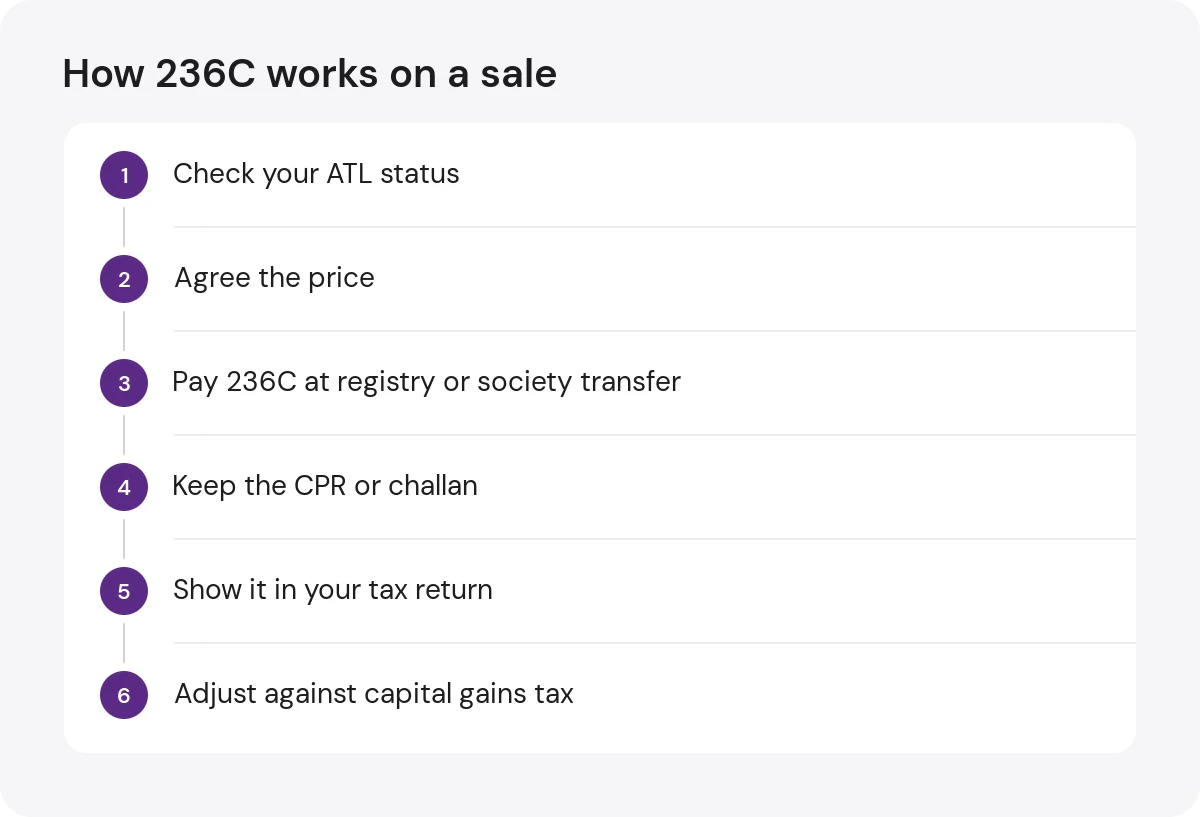
From agreement to your tax return.
- Check your ATL status. Search your CNIC on FBR's Active Taxpayers List. If you are not on it, filing a return before the transfer can cut your rate from 11.5% to 2.75%. Our guide on how to become a filer explains the steps.
- Agree who pays what. 236C is the seller's tax. 236K, stamp duty and the registration fee are usually the buyer's. Write this into the sale agreement.
- Generate the challan. Pay through FBR's system against your CNIC and keep the CPR.
- Bring the CPR to the transfer. The sub-registrar or society will want it.
- Claim it in your return. Enter the tax as advance tax paid, so it is adjusted against your liability.
Red flags
- A dealer offers to "save" 236C by showing a lower price on the deed. Under-declaring the price is a risk for both sides, and the deed is your legal proof of what was paid.
- Someone asks you to pay the tax in cash to them rather than through a challan in your own name.
- A buyer insists that the seller pays 236K or stamp duty without saying so in the agreement.
If something goes wrong
If you paid at the wrong rate, for example the non-ATL rate when you were on the list, keep every receipt and raise it with your Regional Tax Office, or claim the excess as advance tax in your return. For an exemption certificate, apply to your Commissioner Inland Revenue before the transfer, not after.
For a large sale, speak to a tax adviser or your Regional Tax Office before you sign.
How Pakizzle helps
Our area price pages show recent asking prices by City, Area and Block, so you can price your property realistically before you work out the tax. When you list, buyers see whether your listing has been through our checks. For the buyer's side of the bill, see our guide to taxes when you buy property.
Questions
236C tax kitna hai 2026 mein? What is the 236C rate now?
From 1 July 2026 the rate is a flat 2.75% of the gross sale price if you are on FBR's Active Taxpayers List (ATL) on the transfer date. If you are not on the ATL, the rate is 11.5%. The old slabs of 4.5%, 5% and 5.5% and the separate late-filer rates no longer apply.
Who collects 236C, and when?
The person who registers, records or attests the transfer collects it from the seller at that moment. That includes the sub-registrar and also housing authorities, housing societies, cooperative societies and registered real estate projects. The transfer is not completed until the tax is paid.
Is 236C the final tax on my sale?
Usually not. Section 236C says the tax is adjustable, so you show it in your income tax return and set it against your actual tax, including capital gains tax. It becomes a minimum tax if you bought and sold within the same tax year. For overseas sellers who bought through an FCVA or NRVA account, it is the final tax instead of capital gains tax.
I have lived in my house for years. Can I avoid 236C?
Section 159(1B) lets the Commissioner issue an exemption certificate for a residential property that has been in your personal use for the last fifteen years, has been declared in your wealth statement for those fifteen years, and shows as your residence in your tax record. The certificate can be issued once in fifteen years.
What is the difference between 236C and 236K?
236C is collected from the seller. 236K is collected from the buyer. FBR's Circular 2 of 2026-27 says 236K became a flat 1.25% of fair market value for ATL buyers from July 2026. Both are separate from provincial stamp duty and registration fees.
Sources
- FBR: Circular No. 02 of 2026-27, Finance Act 2026, explanation of important amendments (8 Sep 2026)
- FBR: Income Tax Ordinance 2001, amended up to 30 June 2026
- FBR: Circular No. 07 of 2025-26, applicability of 236C to persons under section 7F (31 Mar 2026)
- Dawn: Property tax halved for filers to revive realty sector (13 Jun 2026)
- Dawn: Budget offers tax break to salaried class, businesses (13 Jun 2026)
- ProPakistani: Major changes in new approved budget 2026-27 (23 Jun 2026)
Tools for this
Related guides
- Property tax calculator: advance tax, CVT and stamp duty Taxes & fees
Pakizzle's property tax calculator works out the taxes on a property transfer line by line, each with its legal source.
- Filer vs non-filer property tax rates in Pakistan Taxes & fees
Under the Finance Act 2026, a buyer on FBR's Active Taxpayers List pays 1.25% advance tax (section 236K) and a seller pays 2.75% (section…
- Declaring property in your FBR wealth statement Taxes & fees
If you are a resident individual filing an income tax return, Section 116(2) requires a wealth statement and wealth reconciliation with it.
- Gift deed (hiba) in Punjab: no stamp duty for close family Taxes & fees
Under Punjab's Stamp (Second Amendment) Ordinance 2026, gift deeds (hiba) between spouses, parents and children, grandparents and…