Taxes & fees · Explainer
Taxes when you buy property in Pakistan: the full list
By Pakizzle Editorial Team · Checked against official sources on
Published · Updated on · 10 min read

The short answer
When you buy property in Pakistan you pay FBR advance tax under section 236K (1.25% of fair market value for filers, 10.5% to 18.5% for non-filers, as of the Finance Act 2026), provincial stamp duty (1% in Punjab since April 2026), registration or e-registration fees, and any society transfer fee. The seller separately pays 236C.
Key facts
| Fact | Value | Source | As of |
|---|---|---|---|
| Section 236K advance tax for buyers on the Active Taxpayers List is a flat rate of fair market value under the Finance Act 2026. | 1.25% | FBR: Income Tax Ordinance 2001, amended up to 30 June 2026 | |
| Buyers not on the Active Taxpayers List pay 236K at 10.5% up to PKR 5 crore, 14.5% up to PKR 10 crore and 18.5% above that. | 10.5% / 14.5% / 18.5% | FBR: Income Tax Ordinance 2001, Tenth Schedule | |
| Sellers pay section 236C advance tax on the gross consideration. | 2.75% (filer); 11.5% (non-filer) | FBR: Income Tax Ordinance 2001, amended up to 30 June 2026 | |
| Punjab's Stamp (Amendment) Act 2026 fixed conveyance stamp duty at 1% for urban and rural areas, replacing the April 2026 ordinance. | 1% | Punjab Gazette: Stamp (Amendment) Act 2026 (Act XXIV of 2026) | |
| The Finance Act 2026 omitted section 7E (tax on deemed income from property) and abolished the higher late-filer rates for 236C and 236K. | 7E removed; late-filer band removed | FBR: Income Tax Ordinance 2001, amended up to 30 June 2026 |
The price on a listing is not what a purchase costs you. On top of it come federal taxes, provincial stamp duty, registration fees and, in many societies, a transfer fee. This guide lists each one, who collects it, and what changed in the 2026 budget. Rates are as of November 2026.
Quick facts
Pakistan's property taxes come from three layers. The federal government, through FBR, collects advance income tax when property changes hands: section 236K from the buyer and section 236C from the seller. Provinces charge stamp duty and registration fees and run the land record. Housing societies and development authorities charge their own transfer fees.
The Finance Act 2026 made the federal part simpler. FBR's consolidated Income Tax Ordinance, amended up to 30 June 2026, sets 236K at a flat 1.25% and 236C at a flat 2.75% for people on the Active Taxpayers List (ATL). KPMG's brief of the Act says it also abolished the separate, higher "late filer" rates and omitted section 7E, the tax on deemed income from property.
The full list for a buyer
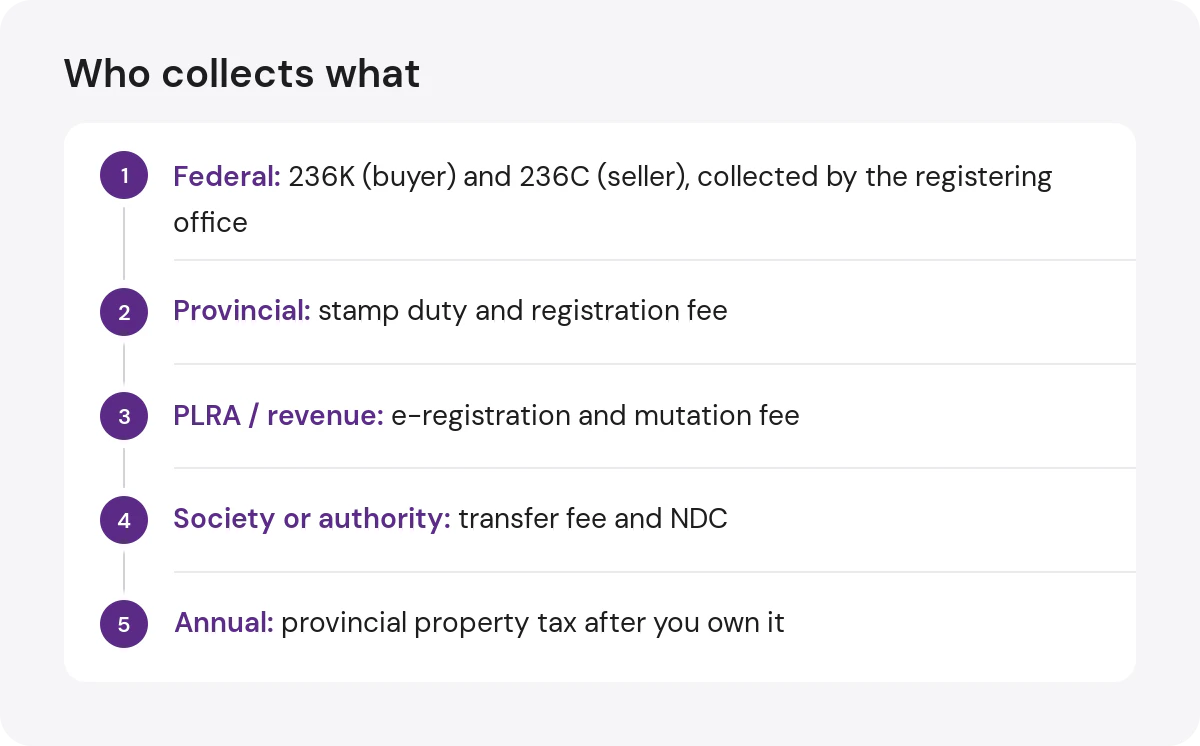
Three layers of charges on one purchase.
| Charge | Level | Rate as of November 2026 | Notes | | --- | --- | --- | --- | | Advance tax, section 236K | Federal (FBR) | 1.25% of fair market value if on the ATL | Collected by whoever registers or records the transfer, including societies | | 236K for people not on the ATL | Federal (FBR) | 10.5% up to PKR 5 crore; 14.5% from PKR 5 to 10 crore; 18.5% above PKR 10 crore | Tenth Schedule of the Ordinance | | Stamp duty, Punjab | Provincial | 1% of value, urban and rural | Stamp (Amendment) Act 2026 (Act XXIV of 2026) | | Stamp duty, Islamabad (ICT) | Federal territory | 1% of value, flat | Finance Act 2025; no separate non-filer rate | | Stamp duty, Sindh | Provincial | 2% of the valuation-table value (BoR Sindh schedule; one other official copy says 4%, so confirm on estamps.gos.pk) | Sindh began bank-based collection of property transfer taxes in April 2026 | | Stamp duty and other charges, KP | Provincial | Stamp duty 1%, registration fee 0.5%, CVT 1%, local council tax 1% (KP Board of Revenue, FY 2025-26) | Ask the Sub-Registrar for the current challan | | Capital value tax (CVT), Punjab and ICT | Provincial / ICT | No official 2026-27 figure found; ask the Sub-Registrar whether CVT appears on your challan | Often bundled into the same challan as stamp duty | | E-registration service fee, Punjab | PLRA | 0.1% of land value, minimum PKR 3,600 | FY2026-27 schedule | | Mutation fee, Punjab | PLRA | PKR 1,200 regular; PKR 2,100 via bank; PKR 11,200 express | FY2026-27 schedule | | Society transfer fee | Society | Varies. Example: DHA Lahore, residential Phase I-XII, PKR 10,500 per marla from 1 July 2026 | Ask for the current schedule |
What the seller pays
The seller pays 236C at 2.75% of the gross sale price if on the ATL, or 11.5% if not. A seller may also owe capital gains tax under section 37. KPMG's brief shows that for property bought on or after 1 July 2024, the rate is 15% for people on the ATL, whatever the holding period, and higher for people who are not. Older property follows a table that falls with each year held. Sellers sometimes try to pass these costs on, so agree in writing who pays what.
A worked example
Say a buyer on the ATL buys a house in Lahore for PKR 1 crore, and the official value matches the price.
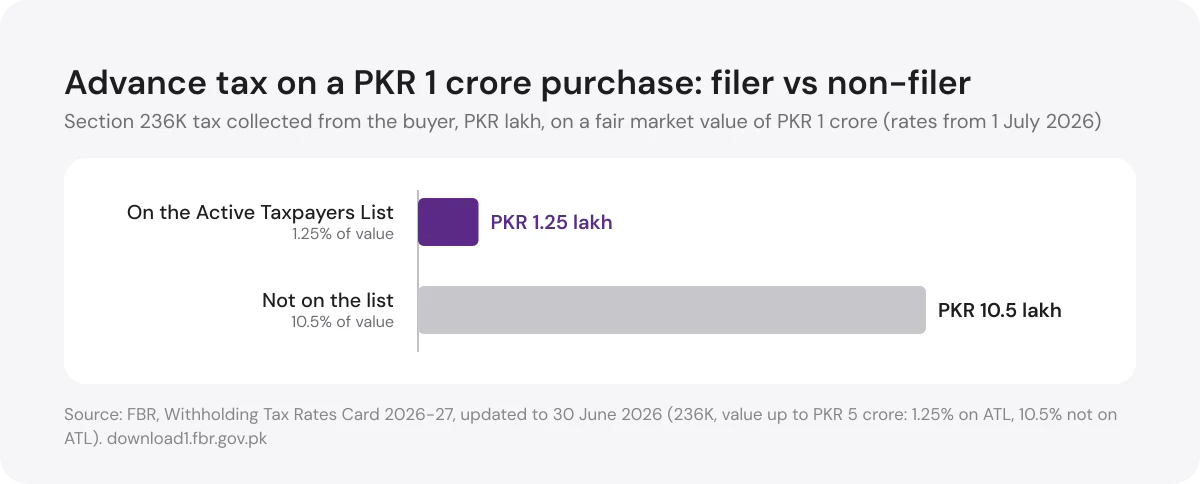
236K advance tax on a PKR 1 crore purchase, rates from 1 July 2026. Source: FBR Withholding Tax Rates Card 2026-27.
- 236K at 1.25%: PKR 1.25 lakh
- Punjab stamp duty at 1%: PKR 1 lakh
- PLRA e-registration fee at 0.1%: PKR 10,000
- Regular mutation fee: PKR 1,200
That is about PKR 2.36 lakh before any society fee. If the same buyer is not on the ATL (check your filer status), 236K alone rises to PKR 10.5 lakh. This is a simplified illustration; the property tax calculator runs the same sums for your own price. The value used for tax can differ from the price, and other fees may apply. For 236K, the Ordinance uses fair market value as provided in section 68, which is the FBR valuation table value where one is notified (s.2(22AA)). For stamp duty, section 27-A of the Stamp Act as applied in Punjab values property by the Collector's valuation table (the DC rate), but uses the price written in the deed if that is higher; Sindh's schedule charges conveyance on the valuation-table value. Ask the Sub-Registrar which value will go on your challan. The stamp duty calculator, 236K calculator and transfer cost calculator let you try your own figures.
What changed in 2026
- 236K and 236C became flat rates. Before the Finance Act 2026, both were charged in value bands. The consolidated text now shows single rates for filers.
- Late filers no longer pay a middle rate. KPMG's brief says the Act omitted Rule 1A of the Tenth Schedule.
- Section 7E was omitted. This was the 1% effective tax on deemed income from property. PwC's summary, reviewed on 24 August 2026, also says it was abolished.
- Punjab cut rural stamp duty to 1% and introduced an "assignable" conveyance. Under the Stamp (Amendment) Act 2026 (Act XXIV of 2026, Article 11-AA), each assignment pays 1% stamp duty within 12 months and 2% after that.
- Punjab's October 2026 amendment said the price in an agreement to sell will not decide the stamp duty on the final transfer deed, exempted inheritance mutations from fees and stamp duty, and abolished stamp duty on gift deeds (hiba) between close relatives, according to Minute Mirror.
Some budget-day reports gave 236K for filers as 1.5%, the figure proposed in the Finance Bill. The enacted text in FBR's consolidated Ordinance shows 1.25%.
Rules that affect how you pay
- Pay through a bank. Section 75A requires property with a fair market value above PKR 50 lakh to be bought by crossed cheque, pay order, demand draft or digital transfer. If you do not, the amount is not counted as your cost when you later work out your gain.
- Non-filers may be blocked from large purchases. Section 114C lets the government bar registering offices from processing transfers above PKR 10 crore for people who have not filed a return and cannot show sufficient resources. It takes effect from a date the government notifies, and does not apply to non-residents. We found no commencement notification when we checked again on 10 November 2026, so the restriction is law but not yet in force. Check FBR's website (fbr.gov.pk) for a notification before a large purchase.
- Overseas Pakistanis get the filer rate. FBR's overseas FAQ says NICOP or POC holders who stayed in Pakistan for fewer than 183 days in the year pay the filer rate under 236C and 236K even if they are not filers.
After you buy
Owning property brings an annual provincial property tax. Punjab moved to a capital-value based system, and in June 2026 APP reported that the Punjab Finance Bill 2026-27 proposed a 20% cap on capital value assessments for existing taxpayers and a 5% discount for self-assessed properties. The Punjab Finance Act 2026 (Act L of 2026), as enacted, brought e-payment and quarterly due dates (30 September, 31 December, 31 March and 30 June) for urban immovable property tax. KPMG's July 2026 summary of the enacted Act lists only those two property tax changes and does not mention the 20% cap or the 5% discount, so confirm with the Excise, Taxation and Narcotics Control Department Punjab before you count on either.
Red flags
- Someone offers to "save tax" by writing a much lower price in the deed.
- A dealer asks you to pay FBR tax to him in cash rather than through a PSID challan.
- You receive a lump-sum "transfer charges" figure with no breakdown.
- An office charges 7E or FED without naming the rule.
How Pakizzle helps
Pakizzle's area price pages help you sanity-check the price before you work out the tax, and Overseas mode shows prices in your currency. Our transfer guide shows where each payment fits in the process.
Tax rates change every budget. For a large purchase, confirm the figures with a tax adviser or the registering office before you pay.
Questions
Filer aur non-filer ke liye property tax mein kitna farq hai?
The gap is large. On a PKR 1 crore property, a buyer on FBR's Active Taxpayers List pays 1.25% under section 236K, or PKR 1.25 lakh. A buyer not on the list pays 10.5%, or PKR 10.5 lakh. That difference alone is usually far more than the cost of filing a return, so check your ATL status before you buy.
Is 236K tax refundable or adjustable?
Section 236K says the advance tax collected is adjustable, which means a filer can claim it against the income tax due in their annual return. The Ordinance also contains conditions under which it can become final for some non-filers. Ask a tax adviser how it applies to your return before you count on getting it back.
Is the 7E tax still payable on property?
No, according to the Finance Act 2026. KPMG's brief of the Act says section 7E, the tax on deemed income from immovable property, was omitted, and PwC's Pakistan tax summary, reviewed in August 2026, says it was abolished. If a registering office asks for a 7E certificate, ask it to confirm in writing which rule it is relying on.
Do I still pay federal excise duty on a plot?
No. The FED on property transfers introduced by the Finance Act 2024 was removed by the Finance Act 2025 from 1 July 2025; FBR's consolidated Federal Excise Act shows that entry omitted. Ask for an itemised receipt to be sure none is charged.
Can a non-filer still buy property?
Section 114C, added in 2025, lets the government stop registering offices from processing a transfer worth more than PKR 10 crore for an 'ineligible person', meaning someone who has not filed and cannot show sufficient resources. It applies only from a date the government notifies, and we found no notification as of 10 November 2026. It does not apply to non-residents. Non-filers also pay much higher 236K.
Sources
- FBR: Income Tax Ordinance 2001 (amended up to 30 June 2026)
- KPMG Taseer Hadi & Co.: A Brief of Finance Act 2026
- PwC Worldwide Tax Summaries: Pakistan, individual, other taxes
- FBR: Overseas Pakistanis FAQ on filer rate under 236C and 236K
- Dawn: Changes to Punjab property law expected to revive real estate
- Dawn: Budget 2025-26 (federal excise duty on property, ICT stamp duty)
- Minute Mirror: Punjab abolishes inheritance transfer fees, reduces stamp duty on property transactions
- The News: Punjab introduces Stamp Ordinance 2026
- APP: Land Record Authority notifies revised service charges for current fiscal year
- APP: Punjab proposes tax reforms, revenue measures in Finance Bill 2026-27
- Board of Revenue Sindh: Stamp Act schedule, Article 16 conveyance (opened 10 Nov 2026)
- Board of Revenue Khyber Pakhtunkhwa: Taxes/Fees, FY 2025-26
- KPMG Taseer Hadi & Co.: A Brief of Provincial Tax Laws 2026 (July 2026)
- Nasir Law Site: Stamp Act 1899, section 27-A (unofficial text)
- Business Recorder: Tax on property transfer, Sindh govt inks deals with three banks
- DHA Lahore: Revision in Dues w.e.f. 01 Jul 2026 (PDF)
- Punjab Gazette: The Stamp (Amendment) Act 2026 (Act XXIV of 2026), 6 May 2026
- National Assembly: Finance Bill 2025 as passed (s.2, Stamp Act amendment for ICT)
- Sindh Judicial Academy: Stamp Act 1899 as applicable in Sindh (updated to Sindh Act XXVI of 2023)
- Khyber Pakhtunkhwa Finance Act 2024 (KP Act No. I of 2024), Gazette 12 Jun 2024
- FBR: Federal Excise Act 2005, amended up to 30 June 2025 (Table III, S.No.1 omitted)
- Punjab Gazette: Punjab Finance Act 2026 (Act L of 2026), 1 Jul 2026
Corrections
- : We corrected the "assignable" conveyance rule using the Stamp (Amendment) Act 2026 itself: stamp duty is 1% on each assignment within 12 months and 2% after that. We had quoted a news report of the April 2026 ordinance (1% plus a 0.1% service charge for 12 months).
Tools for this
Related guides
- Property tax calculator: advance tax, CVT and stamp duty Taxes & fees
Pakizzle's property tax calculator works out the taxes on a property transfer line by line, each with its legal source.
- Filer vs non-filer property tax rates in Pakistan Taxes & fees
Under the Finance Act 2026, a buyer on FBR's Active Taxpayers List pays 1.25% advance tax (section 236K) and a seller pays 2.75% (section…
- Declaring property in your FBR wealth statement Taxes & fees
If you are a resident individual filing an income tax return, Section 116(2) requires a wealth statement and wealth reconciliation with it.
- Gift deed (hiba) in Punjab: no stamp duty for close family Taxes & fees
Under Punjab's Stamp (Second Amendment) Ordinance 2026, gift deeds (hiba) between spouses, parents and children, grandparents and…