Scam Watch · Guide
Advance-fee rental scams: how they work and how to stop them
By Pakizzle Editorial Team · Checked against official sources on
Published · 10 min read

The short answer
An advance-fee rental scam is when someone advertises a home to rent and asks for advance rent, a deposit, a token or a 'visit fee' before you have seen the property and checked who owns it. Never pay before a viewing and a written agreement. If you have paid, call your bank and the NCCIA helpline 1799 at once.
Key facts
| Fact | Value | Source | As of |
|---|---|---|---|
| Citizens are told to report cybercrime, including online fraud, through the NCCIA helpline 1799 or at the nearest NCCIA circle office. | Helpline 1799 | APP | |
| The NCCIA helpline 1799 was inaugurated by the Interior Minister and declared fully operational. | Operational since June 2025 | Press Information Department | |
| In an August 2026 Punjab crackdown, NCCIA said suspects posed as relatives, officials and bank staff to demand money for prizes, customs or taxes. | 28 arrested | Dawn | |
| Write to your bank first; with no satisfactory reply in 45 days (or a decline letter), complain free to the Banking Mohtasib within the next 45 days. | 45 days, then 45 days; free | Banking Mohtasib Pakistan: FAQs |
You find a well-priced flat in a good area. The "landlord" is friendly, says many people are interested, and asks for a month's rent in advance to hold it for you. You pay. The number then goes quiet. This is the advance-fee rental scam, and it works because people looking for a home are often in a hurry.
This guide explains how the scam works, the signs to look for, and what to do if you have already paid.
Quick facts
The scam has one core move: getting you to pay before you have seen the home and confirmed who owns it. The payment may be called advance rent, a security deposit, a token, a "visit fee" or a "file charge". It is usually sent to a personal bank account or mobile wallet. We found no official statistics on rental scams in Pakistan specifically, but the National Cyber Crime Investigation Agency (NCCIA) regularly reports arrests for the same methods used in them: impersonation, fake fees and demands for one-time passwords. The NCCIA's helpline is 1799.
How the scam works
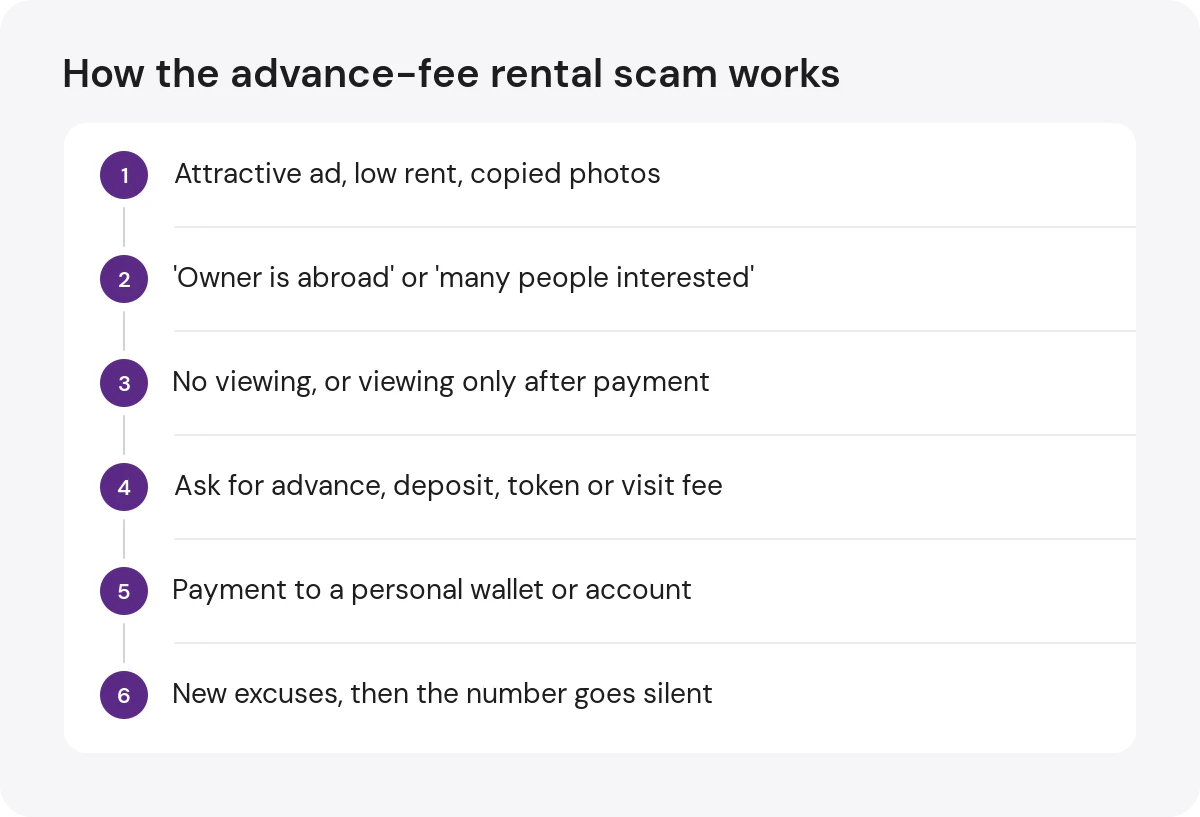
The usual sequence. Breaking any link, especially the viewing, stops it.
Most advance-fee rental scams follow the same pattern.
- The bait. An ad on social media, a classifieds site or a WhatsApp group shows a home at a rent below the area's usual level. Photos are often copied from a real listing or a hotel or furnished-apartment site.
- The story. The "owner" is abroad, or in another city, or too busy to meet. Or there are "ten families interested" and the home will go today.
- No real viewing. You are told the keys are with someone who is unavailable, or that viewing is only possible after you pay.
- The ask. You are asked for money: advance rent, a deposit, a token to hold the home, or a small visit fee.
- The payment. The account is a personal one, often in a different name from the "owner".
- The disappearance. More excuses follow, sometimes a second fee ("for the agreement", "for police registration"), and then silence.
Common variations
- The landlord abroad. The "owner" says they work in the Gulf or the UK, and will courier the keys after you pay. A real owner abroad almost always has someone local who can show the home.
- The visit fee. A fake agent collects a small "visit" or "registration" fee from many people for a home that does not exist, or that the agent has no right to rent.
- The double let. Someone who has rented a home, or has access to it, shows it to several people and takes an advance from each.
- The OTP trick. The "landlord" says they have sent you a code to "confirm the booking" and asks you to read it back. That code may approve a payment or a wallet change on your account. NCCIA has run awareness sessions specifically on OTP scams, and its Director General has told people not to share personal or financial information with anyone.
The NCCIA's own case reports show the same building blocks. In August 2026 Dawn reported that NCCIA arrested 28 suspects in Punjab who had posed as relatives, visa agents, government officials and bank employees and demanded money for prizes, customs clearance, taxes and visa renewal.
Red flags
- Rent well below similar homes in the same block. Compare on area price pages before you call.
- No viewing until you pay, or the viewing keeps being postponed.
- Pressure: "pay now or lose it."
- The account name does not match the owner's name.
- The person will not share a CNIC, or the CNIC name does not match the property papers.
- The same photos appear in another ad with a different phone number or a different city.
- Requests for a one-time password, PIN or "verification code".
- Payment requested through a personal mobile wallet rather than a bank transfer to the owner.
- The agreement is offered only as a picture, with no names, CNIC numbers or property address.
How to rent safely: steps in order
- See the home first. In person, or by a live video call where the person walks through the home and shows the street and a landmark you can check on a map. A recorded video can be copied; a live one is harder to fake.
- Confirm who owns it. Ask for the ownership document (registry, allotment or transfer letter) and the owner's CNIC, and check that the names match. If an agent or relative is renting it out, ask for a written authority from the owner.
- Check the agent. Ask for the agency's name, office address and a landline. Visit the office if you can.
- Sign before you pay. Put the rent, deposit, notice period and condition of the home in a written rent agreement, with both parties' names and CNIC numbers. Our rent agreement guide lists what to include.
- Pay by bank transfer to the owner. Use an account in the owner's name, and keep the receipt. Avoid cash and personal wallets in third-party names.
- Register with the police. Most cities require tenant registration. Our tenant police registration guide explains how. A real landlord will usually ask you for this.
What to do if you have already paid
Speed matters most.
- Call your bank or mobile wallet provider immediately. Use the helpline on your card or in your app. Report the transaction as fraud, give the transaction ID, and ask them to try to hold or block the receiving account.
- Report to the NCCIA. Call the helpline 1799, or visit the nearest NCCIA circle office. APP reported on 9 November 2026 that NCCIA again urged citizens to report any cybercrime this way. NCCIA's website did not load for us on 11 November 2026, so we do not link an online complaint form; ask the 1799 helpline how to lodge a written complaint. In October 2026 APP reported that NCCIA's Director General had ordered all public complaints to be registered digitally.
- Keep the evidence. Save screenshots of the ad, chats, call logs, phone numbers, account numbers and receipts. Do not delete the conversation.
- Stop paying. Scammers often come back with a "refund fee". Do not pay it.
- Warn others. Report the ad to the platform where you found it.
- If your bank does not help. Banking Mohtasib Pakistan handles complaints against banks free of charge. Its FAQ says you must first write to your bank; if you get no satisfactory reply within 45 days, you can complain to the Mohtasib within the next 45 days, or at once if the bank sends you a decline letter. The same FAQ says the Mohtasib does not hear complaints against microfinance banks, so if your mobile wallet is run by one, ask the wallet provider in writing how to escalate an unresolved fraud complaint.
For larger losses, a lawyer can advise on a police case alongside the NCCIA complaint.
If you are a landlord
Scammers also copy real landlords' ads. If you rent out a home, watermark your photos, never post the exact house number publicly, and tell callers that you never ask for money before a viewing. If tenants tell you they paid someone else for your property, ask them to report it to the NCCIA, and report the copied ad to the platform. A short line in your ad, "No payment before viewing and agreement", helps genuine tenants spot a fake.
How Pakizzle helps
On Pakizzle, phone numbers on listings are verified by call-back, so you know the number belongs to the person who posted the ad. Owners and agents can be ID verified (the blue tick), and businesses can be Business verified (the gold tick). Listings can carry dated checks such as "Video checked" or "Visited", and you can ask for a video viewing before you travel. These signals reduce the risk; they do not replace your own checks. Our rule of thumb is simple: no viewing, no payment.
If you have lost money, contact your bank and the NCCIA first. For a large loss or a dispute with a landlord, speak to a lawyer.
Questions
Landlord abroad hai aur keh raha hai pehle advance bhejo, chabi courier kar dunga. Is it real?
Treat it as a scam until proven otherwise. A real landlord who lives abroad will have a relative, caretaker or agent who can show you the home. Do not send advance rent or a deposit for keys by courier. Ask for a live video walk-through, check the owner's name on the property papers against their CNIC, and pay only after you sign an agreement.
Is a 'visit fee' or 'registration fee' normal before seeing a house?
Be very careful. Asking for money just to see a home, or to put your name on a list, is a common way to collect small sums from many people. If a genuine agent charges a fee, it should be agreed in writing, with a receipt and their business details. Never pay through a personal mobile wallet to a number you cannot verify.
I sent money on JazzCash or Easypaisa to a fake landlord. Can I get it back?
Act within minutes. Call your bank or wallet provider's helpline, report the transaction as fraud and ask them to try to block the receiving account. Then report it to the NCCIA on 1799 and keep every screenshot, number and transaction ID. Recovery is not guaranteed, but speed improves the chance.
The 'landlord' sent me a code and asked me to read it back to confirm my booking. Should I?
No. A one-time password (OTP) sent to your phone is for you alone. NCCIA runs awareness sessions on OTP scams and has told people not to share personal or financial information with anyone. A landlord never needs your OTP to confirm a rental.
How can I tell if the person renting the home is the owner?
Ask to see the ownership papers (registry, allotment or transfer letter) and the owner's CNIC, and check that the names match. If someone else is renting it out, ask for a written authority from the owner. For a flat in a building or society, the management office can often confirm who the owner is.
Sources
- APP: NCCIA recovers Rs1.4m in Rs21m fraud through WhatsApp group (9 Nov 2026)
- Press Information Department: Interior Minister visits NCCIA, inaugurates helpline 1799 (3 Jun 2025)
- Dawn: NCCIA arrests 28 suspects for online fraud (9 Aug 2026)
- Dawn: Dozens arrested as NCCIA intensifies 'cyber crackdown' (9 Oct 2026)
- ProPakistani: NCCIA educates students on OTP scams and online fraud (28 Oct 2026)
- Banking Mohtasib Pakistan: home page
- Banking Mohtasib Pakistan: FAQs (complaint steps, free service, institutions not covered)
- APP: DG NCCIA orders 100pc digital registration of complaints (27 Oct 2026)
Tools for this
Related guides
- Checking ownership: fard, registry and records Scam Watch
To check who owns a property, first identify its record: the fard for revenue land, the registered deed for leased or built property, or…
- Fake society files: the warning signs Scam Watch
Fake or excess plot files are files sold with no land behind them.
- Fake "overseas quota" plots Scam Watch
A genuine overseas quota is announced by the authority itself, such as OPF or CDA, paid into that body's own account, and comes with…
- Double-sold plots: how the scam works Scam Watch
One plot, two buyers. Here is how double sales happen with bayana agreements, open files, oversold files and powers of attorney, and the…