Renting · Guide
Rent agreement in Pakistan: what to include
By Pakizzle Editorial Team · Checked against official sources on
Published · 12 min read

The short answer
A rent agreement (kiraya nama) in Pakistan should name both parties with CNICs, describe the property, and state the tenancy period, monthly rent, yearly increase, due date, payment method, advance and security amounts, use of the premises, repairs, subletting and notice. Punjab, Sindh and Islamabad rent laws all expect tenancies to be written down.
Key facts
| Fact | Value | Source | As of |
|---|---|---|---|
| Punjab Rented Premises Act 2009, s.5: a landlord shall not let premises except by a tenancy agreement, and must present it to the Rent Registrar. | Written agreement + Rent Registrar | Punjab Rented Premises Act 2009, s.5 (Punjab Laws Online) | |
| Punjab Act s.6(2): if the agreement gives no rate of increase, the rent is deemed to stay the same for the whole tenancy. | No clause = no increase | Punjab Rented Premises Act 2009, s.6(2) (Punjab Laws Online) | |
| Sindh Rented Premises Ordinance 1979, s.9(2): a rent increase shall not exceed ten percent a year on the existing rent. | 10% a year cap | Sindh Judicial Academy: Sindh Rented Premises Ordinance 1979 | |
| Islamabad Rent Restriction (Amendment) Act 2021: rent rises 10% each year automatically unless agreed otherwise in writing (s.10). | 10% a year, by default | Gazette of Pakistan: Islamabad Rent Restriction (Amendment) Act 2021 | |
| Tenant registration with Punjab Police (station or Khidmat Markaz) is free under the Punjab Information of Temporary Residents Act 2015. | Free | Lahore Police: Tenants Registration |
Most rent disputes in Pakistan start with an agreement that was too short, too vague or never signed. A clear kiraya nama (rent agreement) protects both sides: the tenant knows what they will pay and for how long, and the landlord can prove the terms if things go wrong.
This guide lists the clauses to include, explains what the rent laws of Punjab, Sindh and Islamabad say about them, and ends with the red flags to watch for.
Quick facts
Each part of the country has its own rent law. Punjab has the Punjab Rented Premises Act 2009. Sindh has the Sindh Rented Premises Ordinance 1979. Islamabad has the Islamabad Rent Restriction Ordinance 2001, amended in 2021. All three expect the tenancy to be written down. Punjab's Act says a landlord "shall not let out a premises to a tenant except by a tenancy agreement", and defines that as "an agreement in writing". Sindh's Ordinance says the agreement "shall be in writing" and, where it is not compulsorily registrable, attested by the Rent Controller, a Civil Judge or a First Class Magistrate.
Rent increases are where the laws differ most, so the increase clause matters more than any other line in the agreement (details below).
The clauses to include
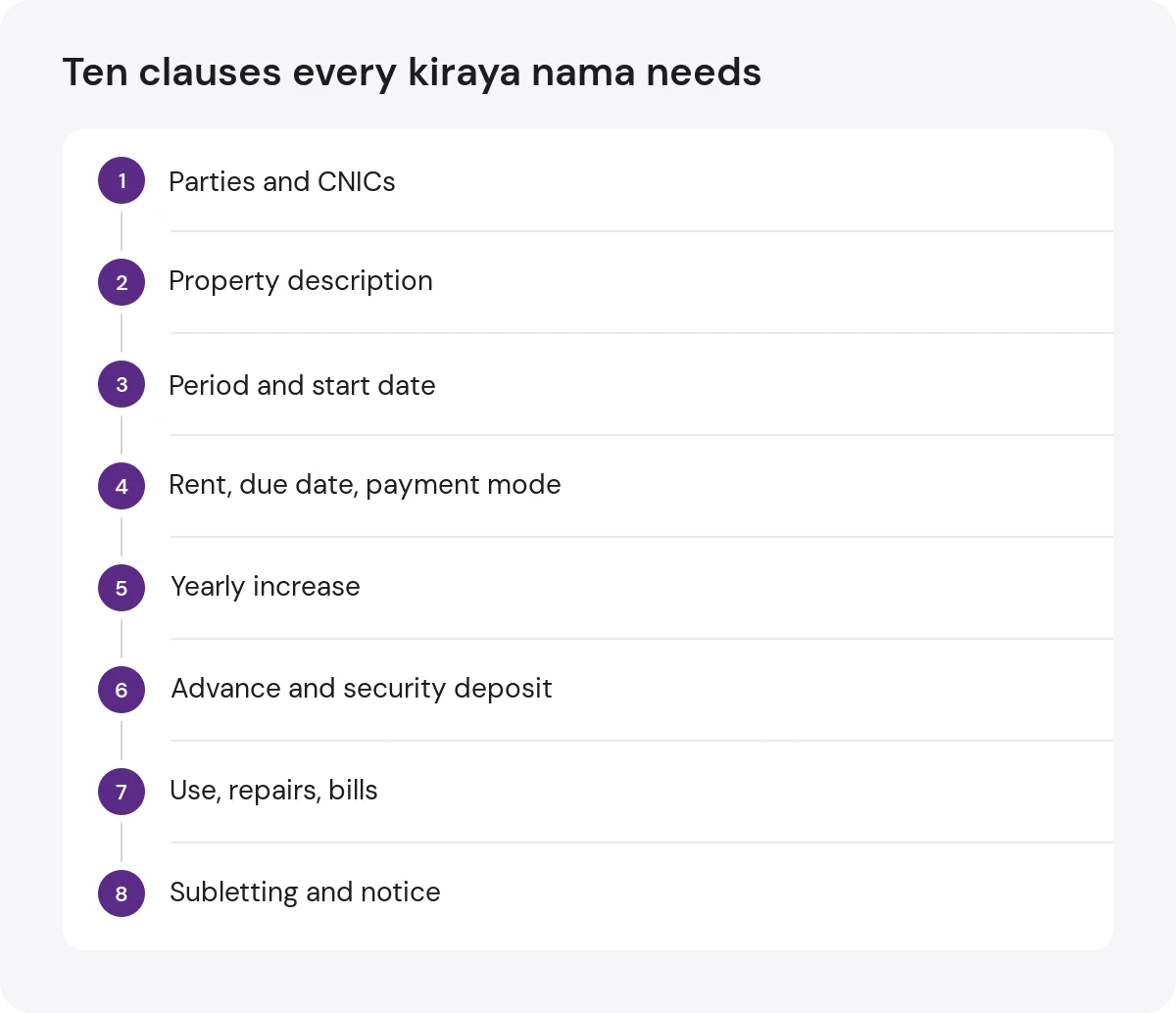
Work through these in order before anyone signs or pays an advance.
Punjab's Act lists what a tenancy agreement should contain "as far as possible" (section 6). It is a good checklist for anywhere in Pakistan, and we have added the points that most often cause disputes.
- The parties. Full names, father's or husband's name, CNIC numbers and current addresses of the landlord and every adult tenant. For an overseas landlord, name the attorney and attach the power of attorney.
- The property. House or flat number, street, block, phase and society, the floor or portion being let, and what is included (parking, roof, servant quarter, fixtures such as ACs, geysers and kitchen cabinets). Attach a short inventory signed by both sides.
- The period. Start date and end date. An 11-month or 1-year term is common. Say what happens at the end: renewal on new terms, or vacating.
- Rent, due date and payment mode. The monthly amount in figures and words, the day it is due, and how it is paid. If paid into a bank, include the landlord's account title and number (Punjab's Act lists bank details as a standard item).
- Yearly increase. A fixed percentage, for example "rent increases by X% on each anniversary". See the next section for why this clause matters.
- Advance rent and security deposit. The amount of each, what the deposit covers, when it is returned, and what may be deducted. Punjab's Act specifically lists "advance rent, security or pagri" as items to record.
- Use of the premises. Residential only, family use, or a named business. Using the property for a different purpose is a ground for eviction under Punjab's Act.
- Bills and charges. Who pays electricity, gas, water, society maintenance and property tax. Under Punjab's Act, taxes and charges on the premises are the landlord's duty unless the agreement says otherwise.
- Repairs and alterations. Who handles minor repairs, who handles major ones, and a rule that the tenant makes no structural change without written consent (Punjab's Act already requires this).
- Subletting. Whether the tenant may sublet or take paying guests. Punjab's Act bars subletting without the landlord's prior written consent.
- Entry and inspection. How much notice the landlord gives before visiting. Punjab's Act says the landlord shall not enter without reasonable notice.
- Notice and early exit. How many months' notice either side gives to end early, and whether any advance is forfeited.
- Signatures and witnesses. Both parties and two witnesses sign every page, with CNIC copies attached.
Rent increases: the clause that matters most
- Punjab. Section 6(2) of the Act says that if the agreement does not mention a rate of increase, "the rent shall be deemed to remain the same for the whole of the tenure". So if you are a landlord, write the yearly increase in. If you are a tenant, check the figure before signing.
- Sindh. Section 9(2) of the 1979 Ordinance says an increase "shall not, in any case, exceed ten percent per annum on the existing rent". The provision sits in the section on fair rent, so how the cap applies to a tenancy where no fair rent has been fixed is a legal question; if a large increase is in dispute, ask a lawyer in Karachi before you agree or refuse it.
- Islamabad. Dawn reported in November 2021 that the Islamabad Rent Restriction (Amendment) Bill set an automatic 10% yearly increase for residential and non-residential buildings unless the parties agree otherwise in writing. The Act as enacted (Islamabad Rent Restriction (Amendment) Act 2021, Act XLVII of 2021) says rent "shall stand automatically increased at the end of every one year of its tenancy by ten percent" unless landlord and tenant agree otherwise in writing. It also requires the agreement to be presented to the Rent Controller within 30 days of signing, and payments "through crossed cheques or with proper receipt or acknowledgement".
Rent payments and receipts
- Due date. If no date is agreed, rent is due by the tenth of the following month in both Punjab (section 7) and Sindh (section 10).
- Mode. Punjab's Act says that if no mode is agreed, rent is paid by money order or into the landlord's bank account. Dawn reported that Islamabad's 2021 amendment requires tenancy payments by crossed cheque.
- Receipts. Sindh's Ordinance says the landlord shall acknowledge rent in writing. If a landlord refuses rent, a Sindh tenant may send it by postal money order or deposit it with the Rent Controller.
A bank transfer with the month written in the reference is the simplest proof for both sides.
Registering the agreement
- Punjab: the landlord must present the agreement before the Rent Registrar, who enters it in a register, seals it, keeps a copy and returns the original (section 5). Under section 9, if this is not done, the Rent Tribunal will not hear the landlord's case until a fine of 10% of the annual rent is deposited (5% for a tenant). We checked sections 5 and 9 against the official consolidated text on Punjab Laws Online (punjablaws.gov.pk/lawspdf/498.pdf), which carries no amendments since 2009.
- Sindh: an agreement that does not have to be registered under the registration law must be attested by the Rent Controller, a Civil Judge or a First Class Magistrate (section 5).
- Islamabad: Dawn reported that the 2021 amendment requires every agreement to be presented to the rent controller for record keeping.
Stamp paper. Rent agreements are normally printed on e-stamp paper. In Punjab, a lease with fixed rent, no premium and a term under 20 years pays 3.25% of the average annual rent (Stamp Act, Article 35). The Stamp (Second Amendment) Ordinance 2026, which the Assembly is re-enacting as Bill 68 of 2026, sets fixed amounts for residential leases of one year or less: PKR 3,000 for annual rent up to PKR 3 lakh, PKR 5,000 up to 5 lakh, PKR 7,000 up to 12 lakh, PKR 15,000 up to 20 lakh and PKR 25,000 above that. An ordinance lapses unless the Assembly passes it, and as of 10 November 2026 we found no report that Bill 68 had been passed, so confirm the current amount with the e-stamp vendor or a Sub-Registrar before you buy the paper.
In Sindh, the two official copies of the Stamp Act schedule we read differ. The Board of Revenue Sindh's schedule (Article 21(iii)) charges an ordinary lease 1.5% of the total rent payable, including any advance rent, plus 2% of any premium. The Sindh Judicial Academy's consolidated text (updated to 2023) gives 2%. The Sindh Finance Act 2025 changed only an insurance entry in the schedule, and KPMG's July 2026 summary of the Sindh Finance Act 2026 lists no Stamp Act change. Check the figure on BoR Sindh's e-stamping portal (estamps.gos.pk) before you pay.
Police registration of the tenant
Separate from the agreement, Punjab and Sindh require the tenant to be registered with the police.
- Punjab: at the police station, a Police Khidmat Markaz, or online at trs.punjabpolice.gov.pk, under the Punjab Information of Temporary Residents Act 2015. Lahore Police lists the fee as free, and the documents as the owner's and tenant's CNICs, the rent agreement, an affidavit and the tenant's photo.
- Sindh: Karachi Police lists the same documents, a free fee, and online registration at tenantregister.sindhpolice.gov.pk. ProPakistani reported in April 2026 that South Karachi police registered 39 cases and arrested 54 people in a drive against unregistered tenants.
- Islamabad: apply online on ICT Police's tenant registration page (islamabadpolice.gov.pk/srv-tr.php), or at a Police Khidmat Markaz or the nearest police station. The fee is PKR 500 and processing takes one working day. Registration has historically been enforced through two-month section 144 orders by the District Magistrate. We found no tenant-specific order reported in 2026, but ICT Police still treats registration as required, so register anyway.
Our guide to tenant police registration covers the steps.
Red flags
- The landlord or agent asks for an advance before you have seen the property or the owner's CNIC.
- The person signing is not the owner and has no power of attorney.
- The rent, deposit or increase written in the agreement differs from what was said.
- No increase clause (a problem for the landlord in Punjab) or an open-ended "as decided by the owner" clause (a problem for the tenant).
- A deposit clause with no return date or no list of allowed deductions.
- Cash-only payment with no receipts.
If something goes wrong
- Talk first, in writing. Send a WhatsApp or letter that states the problem and the clause involved.
- Keep your proof. The signed agreement, receipts or bank records, the inventory and photos taken on move-in day.
- Use the rent forum. Disputes go to the Rent Tribunal in Punjab, the Rent Controller in Sindh, and the rent controller in Islamabad, where Dawn reported the 2021 amendment added a Mediation Council step.
- Do not withhold rent or lock anyone out yourself. Eviction has to go through the forum. Punjab's Act lists the grounds, including expiry of the tenancy, unpaid rent, breach of the agreement and unauthorised subletting.
For a large or commercial tenancy, ask a property lawyer to review the agreement before you sign.
How Pakizzle helps
Rental listings on Pakizzle can show dated checks such as "Video checked" or "Visited", and the owner's phone number can be verified by call-back, so you know more about who you are dealing with before you pay any advance. Owners must reconfirm a listing within 30 days or it leaves search, which cuts down on stale "available" ads. Our how we check page explains what each check covers. These checks are about the listing; the agreement itself is between you and the other party.
Questions
Is a verbal rent agreement valid in Pakistan?
The rent laws expect it in writing. Punjab's Rented Premises Act 2009 says a landlord shall not let premises except by a tenancy agreement, defined as an agreement in writing. Sindh's 1979 Ordinance also says the agreement shall be in writing. Without a written kiraya nama, proving the rent, the deposit and the agreed period becomes much harder if a dispute reaches the Rent Tribunal or Controller.
How much can a landlord increase rent each year?
It depends on the province and on what you signed. In Punjab, the agreement should state the rate of increase; if it does not, the Act says the rent stays the same for the whole tenancy. Sindh's Ordinance caps an increase at 10% a year on existing rent. In Islamabad, the Islamabad Rent Restriction (Amendment) Act 2021 sets a 10% yearly rise unless both sides agree otherwise in writing.
Kiraya nama kis stamp paper par banta hai?
Rent agreements are usually printed on e-stamp paper bought from the provincial e-stamping system. In Punjab a lease under 20 years with fixed rent pays 3.25% of the average annual rent, and under the Stamp (Second Amendment) Ordinance 2026 residential leases of up to a year pay fixed amounts from PKR 3,000 to PKR 25,000 by annual rent. In Sindh, the Board of Revenue's schedule charges an ordinary lease 1.5% of the total rent payable, including advance rent, though another official copy says 2%. Ask the e-stamp vendor or the provincial Board of Revenue for the value that applies to your agreement before you sign.
Does the tenant need to register with the police?
Yes, in Punjab and Sindh. Lahore Police and Karachi Police both say registration is required whenever a house or hostel room is rented, and both list the service as free. You need the owner's and tenant's CNICs, the rent agreement, an affidavit and the tenant's photo. Punjab also offers online registration at trs.punjabpolice.gov.pk.
Should rent be paid in cash?
Bank transfer or crossed cheque is safer because it leaves a record. Punjab's Act says that if the agreement does not state a mode, rent is paid by money order or into the landlord's bank account. Sindh's Ordinance says the landlord shall acknowledge rent in writing. If you pay cash, insist on a signed receipt every month.
Sources
- Sindh Judicial Academy: Sindh Rented Premises Ordinance 1979 (updated text, PDF)
- Nasir Law Site: The Punjab Rented Premises Act 2009 (VII of 2009), unofficial text
- Dawn: Joint session passes six bills related to Islamabad (18 Nov 2021)
- Lahore Police: Tenants Registration
- Punjab Police: Tenant Registration System
- Karachi Police: How to apply for Tenant Registration
- ProPakistani: Sindh starts arresting tenants and landlords who fail to register (25 Apr 2026)
- Punjab Laws Online: The Punjab Rented Premises Act 2009 (Act VII of 2009), consolidated text
- Gazette of Pakistan: Islamabad Rent Restriction (Amendment) Act 2021 (Act XLVII of 2021)
- Punjab Code: Stamp Act 1899 as applied in Punjab (updated for Act XXIV of 2026)
- Provincial Assembly of the Punjab: The Stamp (Second Amendment) Bill 2026 (Bill No. 68 of 2026)
- Sindh Judicial Academy: Stamp Act 1899 as applicable in Sindh (updated to Sindh Act XXVI of 2023)
- Board of Revenue Sindh: Stamp Act schedule, Article 21 Lease (opened 10 Nov 2026)
- KPMG Taseer Hadi & Co.: A Brief of Provincial Tax Laws 2026 (July 2026)
- Islamabad Capital Territory Police: Tenant Registration
Tools for this
Related guides
- Ending a tenancy: notice, deposit and disputes Renting
End a tenancy in writing, following the notice clause in your agreement.
- Renting a portion in North Nazimabad: tenant and landlord rights under Sindh law Renting
Portions and houses in North Nazimabad are rented under the Sindh Rented Premises Ordinance.
- Water in North Nazimabad: KW&SC connection, tanker booking and complaints Renting
In North Nazimabad, water comes from the Karachi Water and Sewerage Corporation (KW&SC).
- New gas connection for a house in North Nazimabad: SSGC RLNG fees and documents Renting
New domestic gas connections in North Nazimabad come on RLNG from SSGC.