Scam Watch · Guide
Double-sold plots: how the scam works
By Pakizzle Editorial Team · Checked against official sources on
Published · 9 min read

The short answer
A double-sold plot is one that a seller, dealer or developer sells to two or more buyers. It usually happens in the gap between paying a token and getting your name on the official record. The fix is to verify ownership with the society or land record office before paying, and to complete the transfer in your name quickly.
Key facts
| Fact | Value | Source | As of |
|---|---|---|---|
| DHA Lahore's transfer affidavit requires the seller to declare no sale agreement with anyone else, and to repay the full price with profit if false. | Seller affidavit on PKR 300 e-stamp paper | DHA Lahore: Regular Transfer document set | |
| DHA Lahore's transfer checklist requires an NDC, attested CNIC copies of both parties, and CVT-1 and IT-5 forms. | NDC, CNICs, CVT-1 and IT-5 | DHA Lahore: Regular Transfer document set (form 4433032) | |
| Punjab's Board of Revenue stopped mutations based on oral transactions (except inheritance); a registered deed is required. | Notified 30 Dec 2025, immediate effect | APP | |
| In Lahore's public and private housing schemes, the PLRA Property Certificate is to serve as legal proof of ownership; societies had to upload records to HSMS. | Upload deadline 31 August 2026 | ProPakistani |
A double sale is simple: the same plot, house or file is sold to two people, and only one of them can end up as the owner. It rarely needs forged stamps or fake offices. It works because most deals in Pakistan have a gap of days or weeks between the token payment and the moment the buyer's name goes on the official record. This guide explains the common patterns and where to close that gap.
Quick facts
Official transfer forms already guard against it. DHA Lahore's regular transfer affidavit makes the seller declare that "neither I have entered into an agreement for the sale of plot in question with any other person except the above said purchaser", and that if this is false they "shall pay the entire sale consideration with profit etc. to the purchaser".
Record systems are tightening. Since January 2026 Punjab enters a sale mutation only on a registered deed, and Lahore schemes are moving to a PLRA Property Certificate as proof of ownership.
Five ways the same plot gets sold twice
1. Two bayana agreements
The seller signs an agreement to sell (iqrarnama) with Buyer A and takes a bayana (token money). Before the transfer date, Buyer B offers more or pays faster, and the seller signs again. Whoever reaches the society or registrar first gets the transfer. The other is left with a piece of paper and a claim for their money.
2. Open files changing hands
Dealers trade "open files": files where the buyer's name is not recorded with the society. Dawn described the rule of thumb in this market: "The one who holds the file is actually the owner." If the file is copied, stolen or simply sold twice, two people can each hold what looks like the same file.
3. Oversold files
A developer sells more files than the land can hold. Dawn gave the example of selling 1,500 files for land that fits 1,000 plots. When balloting happens, some buyers get no plot, or two files point at one plot number.
4. Power of attorney misuse
An owner abroad gives a relative or dealer a general power of attorney. The attorney sells the plot, and the owner, unaware, sells it again. Or the owner cancels the power of attorney privately but never tells the society, and the attorney keeps selling. See our guide on power of attorney for overseas owners.
5. Sold, then re-sold after a transfer stalls
A transfer is started but not completed, for example because dues were unpaid or a document was missing. The seller's name stays on the record, and they sell again. Until the buyer's name is on the society's record, the door stays open for a second sale.
Where to break the chain, step by step
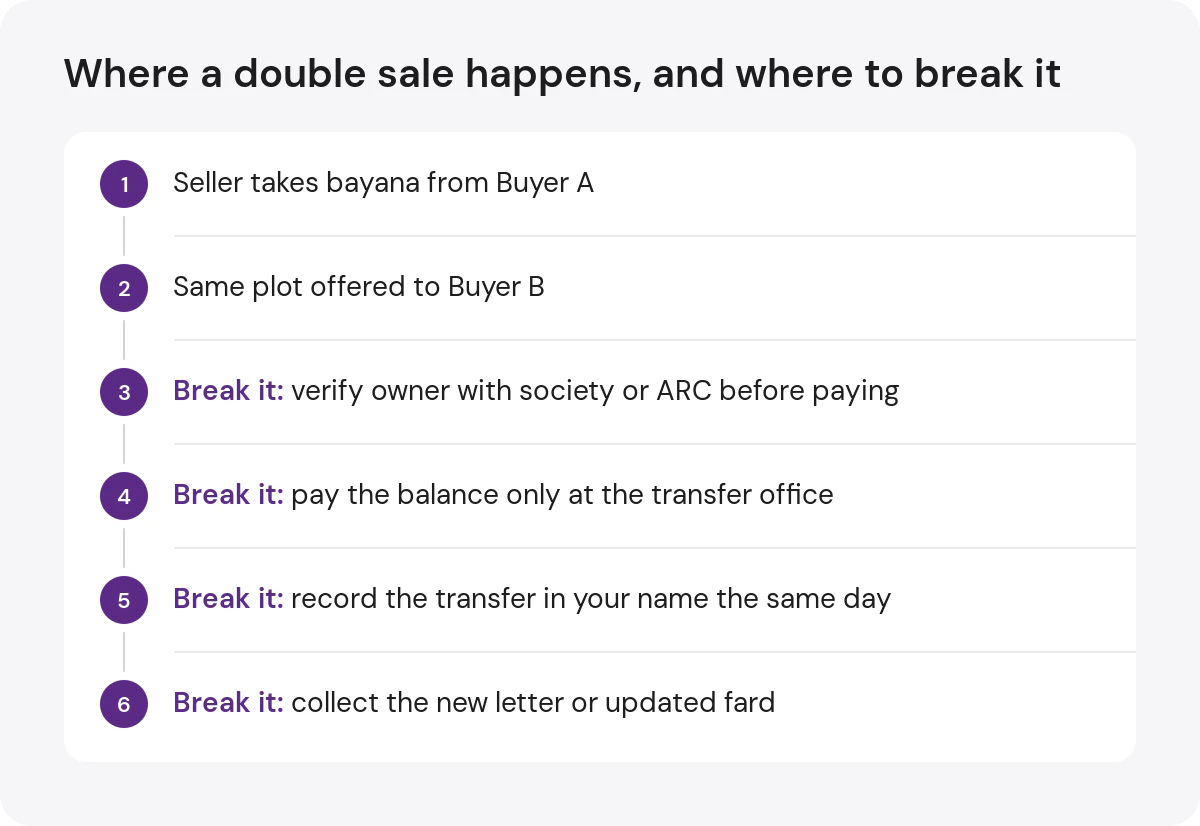
The risk sits between the token and the official record. Each step on the right closes part of the gap.
- Verify before any token. Ask the society's transfer office (or, for revenue land, the Arazi Record Centre) who the current owner is. Use the plot number, not the dealer's description. Our token money checklist lists what to bring.
- See originals. Ask for the original allotment or transfer letter. DHA Lahore requires the original letter to be surrendered for cancellation at transfer, so a seller who cannot produce it is a warning sign.
- Keep the token small and documented. Pay by bank transfer to the owner named on the record, never to a dealer's personal account, and get a receipt that names the plot. See how to pay bayana safely.
- Check again just before the balance. Re-verify ownership on the day, not last week.
- Pay the balance at the transfer. Pay at, or immediately before, the transfer appointment, with both parties present and identities checked.
- Record the transfer the same day. DHA Lahore's purchaser undertaking asks for transfer papers to be submitted within 30 days, with a penalty for late submission. Do it sooner.
- Collect proof in your name. For a society plot, the new transfer letter. For revenue land, the updated fard. In Lahore schemes, the PLRA Property Certificate.
Documents that protect you
- Original allotment or transfer letter (not a photocopy).
- NDC from the society, within its validity period.
- Seller's affidavit that the plot has not been agreed for sale to anyone else (DHA Lahore's standard form includes this).
- Bank record of every payment, with the plot number in the reference.
- For revenue land: a fresh fard and, since January 2026, a registered deed before any mutation.
- If an attorney is selling: the original registered power of attorney, checked with the registrar or society. In Punjab a power of attorney to sell must be registered (Registration Act 1908, s.17(1)(bb)), so get a certified copy of the registered deed from the Sub-Registrar or PLRA (PKR 1,400 as of July 2026). Elsewhere, ask the Sub-Registrar's office that registered or authenticated the deed how to get a certified copy.
Red flags
- "Open file, no need to go to the society."
- The seller wants the full amount before the transfer appointment.
- Original letters are "with the bank" or "with another dealer".
- The price is clearly below others in the same block.
- The seller is abroad and only an attorney or dealer is involved.
- The society says a transfer is "already in process" for this plot.
What to do if it happens to you
- Stop paying. Do not pay any further amount, and do not sign a new agreement or settlement before advice.
- Write to the society or registrar. Tell them in writing that you have a claim on the plot and ask them to record it. DHA Lahore lists a "Temp Caution by the Owner" fee (PKR 15,750) but publishes no procedure. PLRA has no general caution service: it publishes new survey, mutation and transaction-certificate records online for 15 days so the public can object, and a stay on a sale otherwise needs a court order, which PLRA records. Ask your society's transfer branch whether it accepts a written objection and how to file it.
- Collect evidence. Agreements, receipts, bank records, WhatsApp messages, the dealer's details and any witnesses.
- File a police complaint for cheating. A lawyer can advise which sections of the Pakistan Penal Code apply.
- Go to civil court. A civil case decides who has the stronger right to the plot and whether your money must be returned. Section 48 of the Transfer of Property Act 1882 says each later-created right shall "be subject to the rights previously created", and a registered deed takes effect against unregistered documents for the same property (Registration Act 1908, s.50), so register quickly.
- For housing society fraud at scale, watch the development authority's public notices and lists.
How Pakizzle helps
Pakizzle cannot see society or land records, and no listing label means a plot is free of other sales. What we do: sellers can verify their ID (blue tick), businesses can verify (gold tick), phone numbers are verified by call-back, and listings show dated labels such as "Documents checked", "Video checked" and "Visited". Saved searches and alerts help you compare prices, so a suspiciously cheap plot stands out. Always verify ownership yourself with the society or land record office before paying.
For a large purchase, or if you think a plot has been sold twice, speak to a property lawyer straight away.
Questions
Ek plot do logon ko bech diya gaya, ab kis ka haq hai?
It depends on the facts: who paid, what each buyer signed, whose transfer was recorded first and whether either buyer knew about the other. As a general rule of property law, a later transfer is subject to rights created earlier, but courts look at each case. Collect every document and speak to a property lawyer quickly, because delays can weaken your position.
How can I check that a plot has not already been sold?
Ask the seller for the original allotment or transfer letter, then confirm the current owner directly with the society's transfer office or, for revenue land, with a fresh fard from the Arazi Record Centre. In Lahore schemes, ask for the PLRA Property Certificate. Do not rely on photocopies or the dealer's word, and check again just before you pay the balance.
Is an 'open file' safe to buy?
An open file is a market term for a file traded without the buyer's name recorded with the society. Dawn has described open files as ones where 'the one who holds the file is actually the owner', even if that file was stolen. That is exactly the gap a double sale uses. Insist that the society records your name before you pay in full.
Can a power of attorney be used to sell my plot twice?
Yes, this is a known risk. An attorney can sell after you have already sold, or keep using a power of attorney you thought you had cancelled. Give a special power of attorney limited to one property and one purpose, cancel it formally when it is no longer needed, and tell the society or registrar in writing that it has been cancelled.
Should I file an FIR or go to court?
Often both, but in the right order. A police complaint deals with the cheating, and a civil case decides who owns the plot and whether money must be returned. A lawyer can also advise on asking the society to stop any further transfer while the dispute is decided. Do not sign any new agreement with the seller before taking advice.
Sources
- DHA Lahore: Regular Transfer document set (documents required, seller affidavit, undertakings, NDC request and validity)
- Dawn: Real estate's fictitious file system (16 Jan 2023)
- Profit (Pakistan Today): Punjab bans land transfers based on oral transactions to ensure transparency (1 Jan 2026)
- ProPakistani: Punjab orders private housing societies to upload property records (21 Jul 2026)
- ProPakistani: Punjab introduces major reforms to land laws through new ordinances (18 Feb 2026)
- Profit (Pakistan Today): Punjab raises property transaction and land record service fees for FY2026-27 (14 Jul 2026)
- Punjab Land Records Authority: Punjab Zameen portal
- Punjab Laws Online: Transfer of Property Act 1882 (as applied in Punjab)
- Punjab Laws Online: Registration Act 1908 (as applied in Punjab, updated for Act XL of 2026)
- PLRA: Schedule of PLRA Service Charges for FY 2026-27 (notification PLRA/BM/288S, 8 July 2026)
- APP: Board of Revenue Punjab bars mutations on oral transactions (31 Dec 2025)
- DHA Lahore: Dues on Services w.e.f. 01 Jul 2026 (Anx A, PDF)
Tools for this
Related guides
- Checking ownership: fard, registry and records Scam Watch
To check who owns a property, first identify its record: the fard for revenue land, the registered deed for leased or built property, or…
- Fake society files: the warning signs Scam Watch
Fake or excess plot files are files sold with no land behind them.
- Fake "overseas quota" plots Scam Watch
A genuine overseas quota is announced by the authority itself, such as OPF or CDA, paid into that body's own account, and comes with…
- Token money (bayana): how to pay it safely Scam Watch
Bayana is where most property deals go wrong.