Transfer process · Guide
Mutation (intiqal) in Punjab: process and documents
By Pakizzle Editorial Team · Checked against official sources on
Published · 13 min read

The short answer
A mutation (intiqal) records a change of ownership in Punjab's revenue record, so the new owner appears on the fard. Since a 30 December 2025 Board of Revenue notification, a sale, gift or exchange mutation needs a registered deed; only inheritance is exempt. As of November 2026 PLRA charges PKR 1,200 for an ordinary mutation, plus government taxes.
Key facts
| Fact | Value | Source | As of |
|---|---|---|---|
| Punjab's Board of Revenue ordered that no mutation be entered or sanctioned on oral transactions, statements or claims, except inheritance. | Registered deed required (notified 30 Dec 2025) | APP | |
| The Punjab Land Revenue (Amendment) Act 2026 sends sales, gifts and mortgages through the Registering Authority; inheritance is reported to the patwari. | Act XLII of 2026, in force 21 May 2026 | Punjab Gazette: Punjab Land Revenue (Amendment) Act 2026 | |
| PLRA service fee for an ordinary mutation in FY2026-27 (bank mutation PKR 2,100; express mutation PKR 11,200). | PKR 1,200 | PLRA: Schedule of Service Charges FY 2026-27 (8 Jul 2026) | |
| PLRA e-registration service fee in FY2026-27, charged in addition to government fees notified by the Board of Revenue. | 0.1% of land value, minimum PKR 3,600 | PLRA: Schedule of Service Charges FY 2026-27 (8 Jul 2026) | |
| Punjab's Stamp (Amendment) Act 2026 made conveyance stamp duty 1% across urban and rural areas; rural property paid 3% before. | 1% of property value | Punjab Gazette: Stamp (Amendment) Act 2026 (Act XXIV of 2026) |
A mutation, or intiqal, is the step that puts your name in Punjab's land revenue record. Until it is done, the fard (the official record of rights for a piece of land) still shows the seller, even if you have paid in full. The rules changed twice in early 2026, so older advice about "zabani intiqal" and the patwari's role is now out of date.
This guide covers Punjab revenue land. Plots in DHA, Bahria Town and other housing societies are transferred in the society's own records, which we cover in separate guides.
Quick facts
Since a notification of 30 December 2025, with immediate effect, Punjab's Board of Revenue has told revenue officers that "no mutation shall be entered or sanctioned based on oral transactions, statements, or claims, except in cases of inheritance", according to Profit (Pakistan Today). A sale, gift, exchange or mortgage mutation now needs a deed registered under the Registration Act 1908 and the Transfer of Property Act 1882.
In February 2026 the Punjab Governor promulgated the Punjab Land Revenue (Amendment) Ordinance. ProPakistani and The Nation reported that it limits patwaris to inheritance mutations and says all property transfers will be processed through e-registration. The Assembly then replaced it with the Punjab Land Revenue (Amendment) Act 2026 (Act XLII of 2026, in force 21 May 2026). Under the Act, sales, gifts and mortgages are reported to the Registering Authority (the Sub-Registrar or e-registration), which has the mutation entered through the Arazi Record Centre, while inheritance is reported to the patwari (or, once notified, to the ARC official).
In April 2026 Punjab set stamp duty on property conveyances at a uniform 1% in urban and rural areas. Rural property had been charged 3%.
Registry and intiqal: two different things
People often use the two words as if they mean the same thing. They do not.
- Registry (registered deed). The legal document of sale, gift or exchange, signed by both parties and registered with the government.
- Intiqal (mutation). The entry in the revenue record that follows the registered deed. Once it is sanctioned, the fard shows the new owner.
Under the 2026 rules, the order matters: register the deed first, then the mutation follows. A sale with a mutation but no registered deed should make you stop and ask questions. Our guide on registry vs mutation goes into more detail.
Step by step: a sale mutation in Punjab
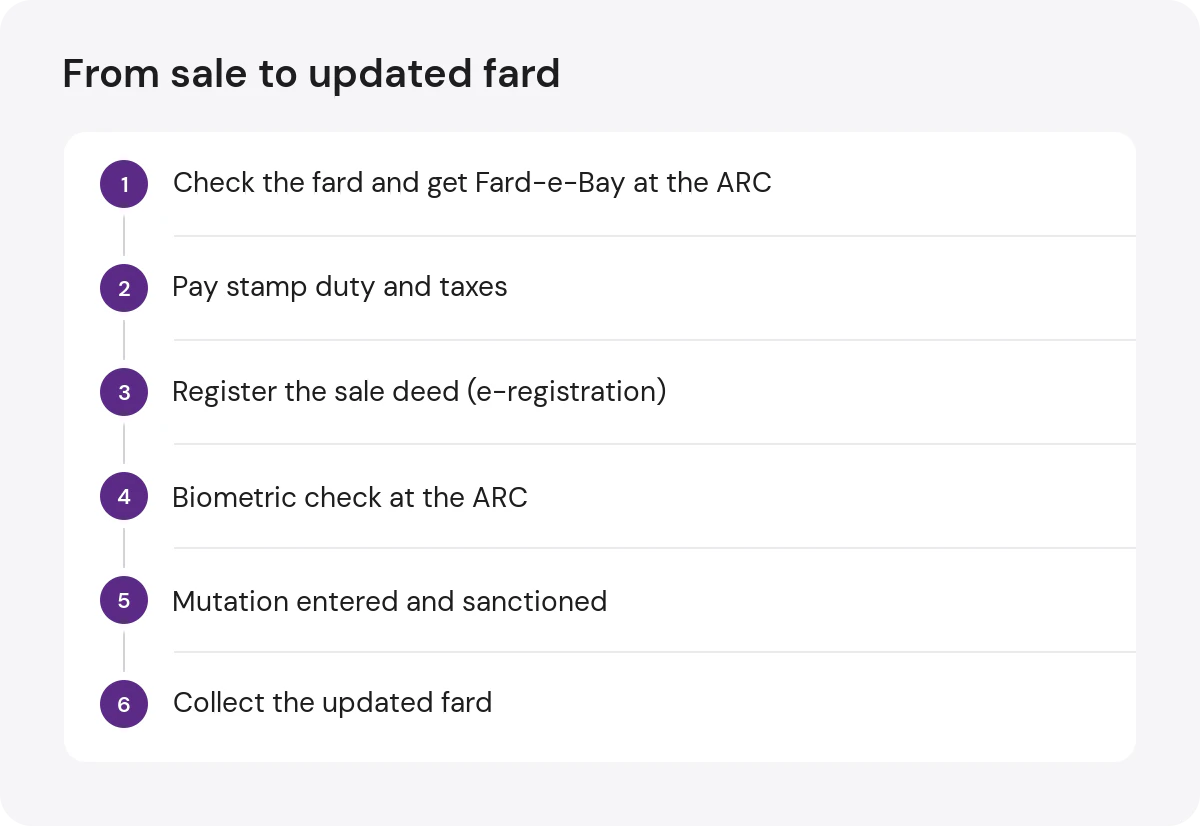
Sale, gift and exchange mutations in Punjab now follow a registered deed. Inheritance follows its own route.
- Check the fard before you pay anything. Get a current copy of the fard for the exact khasra (field) numbers. Confirm that the seller's name, share and area match what you are buying. Our token money checklist covers what to check before a bayana (token payment).
- Get the Fard-e-Bay (sale fard). This is issued at an Arazi Record Centre (ARC, PLRA's land record service centre) or an e-Facility Centre for the land being sold, as described in the Board of Revenue's January 2026 instructions.
- Pay stamp duty and taxes. Stamp duty is paid on e-stamp paper. The buyer usually pays federal advance tax under section 236K and the seller under section 236C (see the fees table below).
- Register the deed. Under the 2026 law all transfers go through e-registration. Both parties' identities are checked. PLRA says it uses NADRA biometric verification to stop impersonation. Under the Registration (Amendment) Act 2026, each person executing a deed is identified by NADRA biometrics (fingerprint or face) or an electronic signature, and both parties give their statements in person before the Sub-Registrar or ADLR; an overseas party can do so through a Pakistani mission appointed as commission.
- Mutation is entered and sanctioned. The registered documents go to the tehsildar. Profit reported that the tehsildar approves the registration the same day once legal requirements are met, and that the old requirement for witnesses has been removed.
- Collect the updated fard. Ask for a copy of the fard after the mutation. Check that your name, share and area are correct. A copy costs PKR 900 (ordinary) or PKR 4,000 (express) in FY2026-27.
Inheritance mutation (warasat)
Inheritance is the one case that still runs through the patwari and does not need a registered deed. Heirs apply for the inheritance mutation at the ARC, and the land is divided according to the heirs' legal shares.
PLRA's mutation guide says any legal heir can apply at the ARC with:
- the death certificate;
- the NADRA Family Registration Certificate (FRC) form;
- an affidavit;
- the property details;
- CNIC copies of all legal heirs.
Field staff then verify the family tree (shajra nasab), and after their report the inheritance mutation is attested at the ARC. If an heir is a minor, the Punjab Land Revenue (Amendment) Act 2026 says the guardian, or the person in charge of the minor's property, makes the report (section 42-A(2)). The ARC may ask for more papers in some cases, such as guardianship papers, so confirm the full list with the Arazi Record Centre or PLRA's helpline 042-111-22-22-77 before you go.
If any heir is abroad, they may need a power of attorney. See our guide on power of attorney for overseas owners.
Documents for a sale mutation
- Original CNICs of buyer and seller (both attend, or an attorney with a valid, registered power of attorney).
- The current fard and the Fard-e-Bay.
- The registered sale deed and its e-stamp paper.
- Proof of tax paid: 236K (buyer) and 236C (seller), or the CPR (payment receipt) numbers.
- Photographs are taken at the ARC itself. PLRA's mutation guide says your photograph is taken with the biometric check when you get your token, and the ADLR photographs and biometrically verifies the parties before confirming the mutation. The guide does not ask you to bring printed photos, but confirm with the Arazi Record Centre whether your case needs any.
Fees and taxes (Punjab, as of November 2026)
| Item | Amount | Who usually pays | Source | | --- | --- | --- | --- | | Ordinary mutation (PLRA service charge) | PKR 1,200 | Buyer | Profit, 14 Jul 2026 | | Bank mutation | PKR 2,100 | Buyer | Profit, 14 Jul 2026 | | Express mutation | PKR 11,200 | Buyer | Profit, 14 Jul 2026 | | E-registration service fee | 0.1% of land value, minimum PKR 3,600 | Buyer | Profit, 14 Jul 2026 | | Fard copy | PKR 900 ordinary, PKR 4,000 express | Whoever applies | ProPakistani, 8 Jul 2026 | | Stamp duty on conveyance | 1% of value (urban and rural) | Buyer | Pakistan Today, 13 Apr 2026 | | Federal advance tax, buyer (236K) | 1.25% of fair market value (active taxpayers) | Buyer | FBR, ITO 2001 as amended to 30 Jun 2026 | | Federal advance tax, seller (236C) | 2.75% of gross consideration (active taxpayers) | Seller | FBR, ITO 2001 as amended to 30 Jun 2026 | | Registration fee and CVT (Punjab government fees) | Rates set by the Board of Revenue; we found no official 2026-27 schedule. The e-Stamp system works them out for your property | Varies | PLRA FY2026-27 schedule; PLRA e-Stamp guide |
PLRA's July 2026 notification gives no figures for government fees; it lists them only as "As notified by Board of Revenue, Punjab from time to time". We could not find that schedule on the Board of Revenue's website. PLRA's e-Stamp guide says the e-Stamp system calculates stamp duty, capital value tax (CVT) and other charges from the property type and location, and that CVT, stamp duty and the registration fee can be paid together on one Challan Form 32-A. Generate that challan, or ask the ARC or a Sub-Registrar for a written fee slip, before you pay. Gift deeds between close family members (spouses, parents and children, grandparents and grandchildren, siblings) were exempted from stamp duty by a further ordinance reported on 23 October 2026.
People not on the FBR's Active Taxpayers List pay much higher 236K and 236C rates. See our explainer on advance tax on buying property (236K).
Red flags
- Anyone offering a "zabani" (verbal) intiqal for a purchase. Since January 2026 that route is closed for sales.
- A seller who will not let you see a fresh fard, or whose name or share differs from the fard.
- A mutation already "done" on the basis of an unregistered agreement or a stamp paper alone.
- A power of attorney you have not seen in original, or one that does not name this land.
- Pressure to pay a patwari or middleman to "speed things up". Use the ARC and get an official receipt.
- Land under a court case or stay order. Ask the seller in writing and check with the ARC.
If something goes wrong
- Get a fresh fard. It shows what the record says today.
- Ask the ARC in writing. If the mutation was refused or entered wrongly, ask for the reason in writing.
- Correct a record error. If the computerised record has a mistake, apply for correction at your Arazi Record Centre. PLRA's Correction of Records page says corrections cover data entry, manual record, mutation and name errors, are approved by the ADLR or Land Record Officer after verification, and in most cases need you to attend for a biometric check. PLRA's FY2026-27 schedule of service charges does not list a separate correction fee, so ask the ARC what you will pay, if anything, before you apply.
- Appeal. Revenue decisions can be appealed to higher revenue officers. The 2026 Act gives the Board of Revenue sole power to remand a case (section 164-A), and sets 30 days to file an appeal (section 162) and 30 days for a review application (section 163). Under section 161 of the Land Revenue Act 1967, an appeal against an order of an Assistant Collector goes to the Collector of the district, an appeal against a Collector's order goes to the Commissioner, and an appeal against a Commissioner's order goes to the Board of Revenue only on a point of law. If the first appeal confirms the original order, no further appeal lies. The 2026 Act changed section 161 only for partition cases, where an appeal lies to the district Collector, whose decision is final. Check the order to see which officer passed it, and confirm the right forum with the ARC or a revenue lawyer. PLRA charges PKR 3,500 per case filed through its Revenue Courts Management System (RCMS) in FY2026-27.
- Get legal advice if someone else claims the same land or you suspect fraud.
How Pakizzle helps
Pakizzle does not check land records and cannot tell you whether a mutation is valid. What we do is help you start with better listings: "Documents checked" and "Visited" labels show what was reviewed and when, phone numbers are verified by call-back, and ID-verified sellers carry a blue tick. Use our token money checklist before you pay any bayana, then check the fard yourself at the ARC.
For a large purchase, speak to the Arazi Record Centre and a qualified property lawyer before you pay.
Questions
What is an intiqal, and how is it different from a registry?
A registry (registered sale deed) is the legal document of sale, signed by both parties and registered with the government. The intiqal (mutation) is the entry in the revenue record that shows the new owner, so the fard then carries the buyer's name. In Punjab, since 30 December 2025, a sale mutation needs a registered deed first, so you now need both, in that order.
Can a mutation still be done on a verbal (zabani) sale?
No, not for a sale, gift, exchange or mortgage. Punjab's Board of Revenue told revenue officers in a notification of 30 December 2025, with immediate effect, that no mutation is to be entered or sanctioned on oral transactions, statements or claims. Inheritance is the exception and continues under the existing law. If anyone offers you a 'zabani intiqal' for a purchase, treat it as a red flag.
What is the mutation fee in Punjab in 2026-27?
PLRA's revised service charges for FY2026-27 are PKR 1,200 for an ordinary mutation, PKR 2,100 for a bank mutation and PKR 11,200 for an express mutation, under its notification of 8 July 2026. These are service charges only. Government fees and taxes, such as stamp duty and federal advance tax, are charged separately, so ask the Arazi Record Centre for a full fee slip before you pay.
How long does intiqal take?
We could not find an official time limit for a sale mutation on a PLRA or Board of Revenue page. Press reports describe same-day approval by the tehsildar once the registered documents are complete. Ask the Arazi Record Centre for the expected date when you submit, keep your token or receipt, and check the fard afterwards to confirm the change.
Does a plot in DHA or a private housing society need an intiqal?
Usually not in the same way. Housing societies and authorities keep their own transfer records, and Lahore's public and private schemes now issue a Property Certificate through PLRA's Housing Society Management System. The revenue mutation described here applies to land recorded in the Punjab revenue record. Ask the society which record it keeps and where your name will appear.
Sources
- Profit (Pakistan Today): Punjab bans land transfers based on oral transactions to ensure transparency (1 Jan 2026)
- ProPakistani: Punjab introduces major reforms to land laws through new ordinances (18 Feb 2026)
- The Nation: Punjab introduces sweeping reforms to land laws through new ordinances (17 Feb 2026)
- Profit (Pakistan Today): Punjab raises property transaction and land record service fees for FY2026-27 (14 Jul 2026)
- ProPakistani: Punjab increases fees for land record services (8 Jul 2026)
- Pakistan Today: Punjab property law changes aim to revive real estate sector (13 Apr 2026)
- The News: Punjab ordinance proposes fixed stamp duties, tax relief on family gifts (23 Oct 2026)
- ProPakistani: Punjab orders private housing societies to upload property records (21 Jul 2026)
- FBR: Income Tax Ordinance 2001, amended up to 30 June 2026 (sections 236C and 236K)
- Punjab Land Records Authority: Punjab Zameen portal
- Punjab Gazette: The Punjab Land Revenue (Amendment) Act 2026 (Act XLII of 2026), 21 May 2026
- Punjab Gazette: The Registration (Amendment) Act 2026 (Act XL of 2026), 14 May 2026
- Punjab Gazette: The Stamp (Amendment) Act 2026 (Act XXIV of 2026), 6 May 2026
- PLRA: Schedule of PLRA Service Charges for FY 2026-27 (notification PLRA/BM/2885, 8 July 2026)
- APP: Board of Revenue Punjab bars mutations on oral transactions (31 Dec 2025)
- PLRA: Mutation (Intiqal) service page, How it works and FAQs (read 12 Nov 2026)
- PLRA: The Punjab Land Revenue Act 1967 (section 161, Appeals)
- PLRA: Correction of Land Records service page and FAQs (read 12 Nov 2026)
- PLRA: e-Stamp service page and FAQs (read 12 Nov 2026)
- Board of Revenue Punjab: Notifications (checked 12 Nov 2026)
Tools for this
Related guides
- Society transfer fees and how they're charged Transfer process
A society transfer fee is what a housing society or authority charges to move a property into the buyer's name.
- Bahria Town transfer process: what to bring Transfer process
A Bahria Town transfer happens at the society's own office, not the patwari.
- Biometric verification for a property transfer Transfer process
Biometric verification matches each party's thumbprint, and in Sindh their face, against NADRA's records before a property document is…
- Succession certificate from NADRA: how legal heirs get one Transfer process
NADRA's Succession Facilitation Units issue succession certificates and letters of administration without a court case when all legal heirs…