Scam Watch · Guide
Token money (bayana): how to pay it safely
By Pakizzle Editorial Team · Checked against official sources on
Published · Updated on · 9 min read

The short answer
Pay token money (bayana) only after checking the seller's title and the society's approval. Pay by pay order or bank transfer to the registered owner, never in cash to a dealer. Get a signed agreement stating the price, token amount, balance deadline, and what happens if either side backs out. Keep every receipt.
Key facts
| Fact | Value | Source | As of |
|---|---|---|---|
| Property with a fair market value above PKR 50 lakh must be bought by crossed cheque, pay order, demand draft or digital bank transfer. | Above PKR 5 million | FBR: Income Tax Ordinance 2001, section 75A | |
| In June 2026 the Supreme Court upheld the dismissal of a buyer's suit after he missed the balance deadline in an agreement with a forfeiture clause. | PKR 8 lakh earnest money; balance deadline missed | ProPakistani | |
| Punjab's October 2026 stamp amendment says the price in an agreement to sell will not determine stamp duty on the final transfer deed. | Agreement price not used for final stamp duty | Minute Mirror | |
| Punjab's Stamp (Amendment) Act 2026 added an 'assignable deed': 1% stamp duty on each assignment within 12 months, 2% after that. | 1% within 12 months; 2% after (each assignment) | Punjab Gazette: Stamp (Amendment) Act 2026 (Act XXIV of 2026), Art. 11-AA |
Token money, or bayana, is the first money you pay on a property, and the money most often lost. It is usually paid in a hurry, in cash, to the wrong person, on a slip of paper that says very little. This guide sets out what to check first, what to write down, how to pay, and what happens if the deal breaks.
Quick facts
A token is a part-payment that shows you are serious and holds the property for you while the rest of the deal is completed. In Pakistan it is usually backed by an agreement to sell (iqrarnama), which sets out the price, the balance and the deadline.
We found no law that fixes how much the token should be, or that a seller who backs out must pay back "double". Both are market customs. Your rights depend mainly on what your written agreement says, so the agreement matters more than the custom. If a deal falls through, ask a property lawyer what the Contract Act 1872 and the Specific Relief Act 1877 allow in your case before you accept or refuse any refund.
Courts take deadlines seriously. In June 2026 the Supreme Court upheld the rejection of a buyer's claim to a Sialkot property. He had paid PKR 8 lakh as earnest money under a 2014 agreement that said it would be forfeited if the balance was not paid on time, and he missed the deadline. Reports of the judgment say courts should not mechanically apply the old idea that time is not essential in property deals, because prices now rise fast.
Before you pay anything
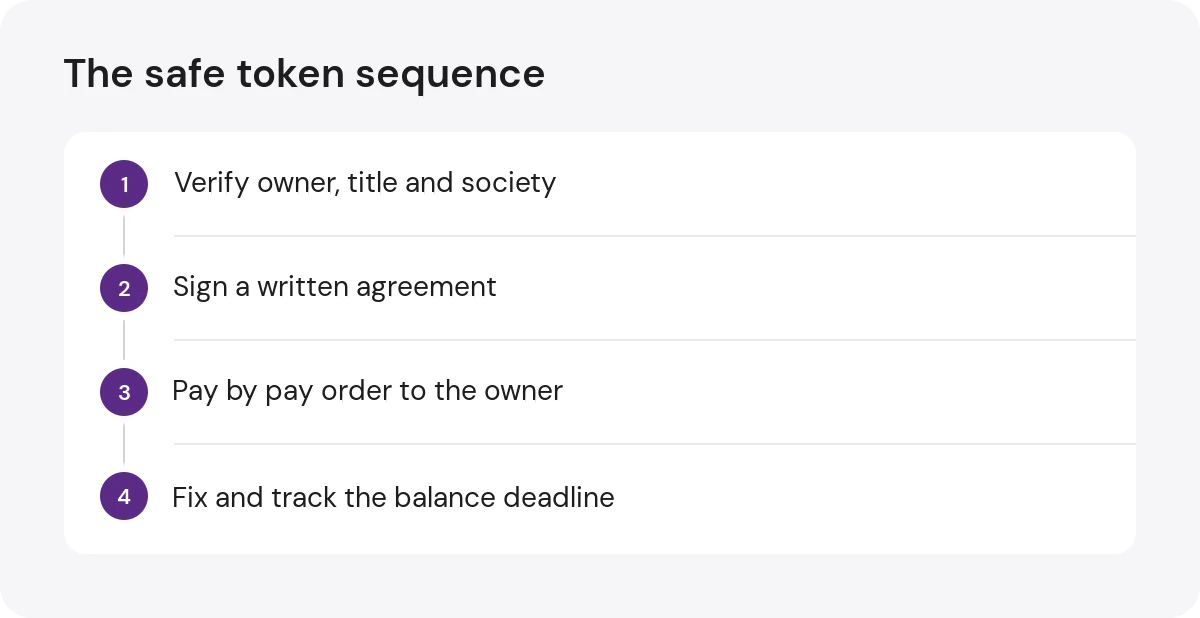
Four steps, in this order.
- Confirm the owner. Match the seller's original CNIC with the fard (for revenue land) or the society's record. The person taking your money should be the owner, or an attorney with a valid power of attorney that includes receiving payment.
- Confirm the society. Check that the society or scheme is approved by the right authority. RDA warned in February 2026 that labels such as "under scrutiny" are not approval. See how to check if a housing society is approved.
- Confirm the plot or file. Ask the society to verify the plot or file in the seller's name. In Lahore, LDA said in June 2026 that file trading in private schemes would end from 1 July and that transactions would use official property certificates. See how to verify a plot file.
- Ask about dues. Ask whether any dues, mortgages or court cases are attached to the property.
What the agreement must say
- Full names, father's names, CNIC numbers and addresses of buyer and seller
- Exact property description: plot or house number, block, society, khasra numbers, size in marla or kanal (and which marla size is used)
- Total price, in figures and words
- Token amount, date, and how it was paid (pay order or transfer number)
- Balance amount and the exact date it is due
- Who pays which taxes and fees: 236K, 236C, stamp duty, transfer fees
- What happens if the buyer misses the deadline
- What happens if the seller backs out or cannot transfer
- What happens if checks reveal a defect in title
- Signatures of both parties and two witnesses with CNIC numbers
In Punjab, the price written in an agreement to sell no longer sets the stamp duty on the final transfer deed, according to an October 2026 amendment reported by Minute Mirror. We could not read that ordinance itself, so confirm with the Board of Revenue Punjab or the Sub-Registrar before you rely on it. Punjab also created an "assignable deed" under the Stamp (Amendment) Act 2026 (Act XXIV of 2026, Punjab Gazette, 6 May 2026): stamp duty is 1% of the property's value on each assignment within twelve months, and 2% after twelve months. Ask a lawyer whether that route suits your deal.
How to pay
- Pay by pay order or bank transfer. Section 75A of the Income Tax Ordinance requires property worth more than PKR 50 lakh to be bought by crossed cheque, pay order, demand draft or digital transfer between bank accounts. If you do not, the amount is not treated as your cost for tax when you sell.
- Pay the owner, not the dealer. Make the pay order out to the person named on the record.
- Write the instrument number in the agreement and keep a copy.
- Never pay "to hold" a plot before seeing documents.
How the token fits into the whole deal
The token is the start of the deal, not the end. Ownership changes only when the sale deed is registered and the record is updated through mutation (intiqal) or the society's own transfer. Until then the seller is still the owner on paper, and in theory could take a token from someone else as well. That is why the gap between token and transfer should be short, and why the agreement should say what the seller may not do in the meantime, such as sell, mortgage or rent the property to anyone else.
A sensible sequence looks like this:
- Day 0: basic checks done, agreement signed, token paid by pay order.
- Next few days: society verification, NDC request, and a fresh fard or record check, because records can change after you first look.
- Before the deadline: balance arranged through your bank, and tax challans (236K for you, 236C for the seller) generated.
- Deadline day: balance paid, deed signed and registered, mutation or society transfer started on the same visit if possible.
Our step-by-step transfer guide covers what happens after the token, and our taxes guide lists the costs to budget for.
A simple example
A buyer agrees to buy a 5 marla house for PKR 1.2 crore. The parties agree a token of PKR 5 lakh, paid by pay order to the owner named on the fard, with the balance due in 30 days. The agreement says that if the buyer misses the deadline, the token is forfeited, and if the seller backs out, the token is returned with an agreed extra amount. Both outcomes are in numbers. Both signatures and two witnesses are on every page. This is an illustration, not a recommended amount.
Red flags
- The seller wants cash only, or payment to a third person.
- You are told to pay today "because another buyer is waiting".
- The person selling is not the person on the record, and the power of attorney is a photocopy.
- The receipt has no deadline or no consequence for either side.
- The price is far below similar properties in the same block.
- The society is "about to be approved".
If the deal breaks
If the seller backs out: Send a written notice through a lawyer asking the seller to complete the sale or return the money as the agreement says. Keep proof that you were ready and able to pay the balance on time. The Supreme Court said in June 2026 that a buyer seeking specific performance must show consistent readiness, willingness and financial capacity, not just claim it in the plaint.
If you cannot pay on time: Ask for a written extension before the deadline. Do not rely on a verbal promise.
If you suspect fraud: Stop payment, keep every document and message, and report it to the police and the relevant authority.
For a large deal, have a property lawyer review the agreement before you pay the token.
How Pakizzle helps
Our token money checklist turns this guide into a list you can tick off before you pay. On listings, look for "Documents checked" and "Visited" labels with their dates, ID-verified advertisers, and phone numbers verified by call-back. These help you judge who you are dealing with, but they are not a title check.
Questions
Bayana kitna dena chahiye?
No law we found fixes the token amount. It is whatever buyer and seller agree. A smaller token limits your loss if checks fail. Whatever the amount, pay it only after the first title and approval checks, and write the amount, date and purpose in the agreement.
If the seller backs out, do I get double the bayana?
'Double return' is a market custom, not a rule we found in any statute. What you can recover depends on what the written agreement says and, if it reaches court, on the judge's view of each side's conduct. Write the consequence of each side backing out into the agreement, in clear numbers.
If I can't pay the balance on time, will I lose the token?
You may. In June 2026 the Supreme Court refused to enforce a sale for a buyer who missed the agreed balance deadline. The agreement said the earnest money would be forfeited, and the court treated time as essential. If you need more time, get the seller's written extension before the deadline passes.
Can I pay bayana in cash?
Avoid it. Section 75A of the Income Tax Ordinance requires property worth more than PKR 50 lakh to be bought through a crossed banking instrument or digital transfer. Cash also leaves you without proof. Pay by pay order or bank transfer to the registered owner, and note the instrument number in the agreement.
Should the bayana be paid to the dealer?
No. Pay the registered owner, whose name matches the fard or the society record. If the owner is abroad, pay only an attorney holding a valid, verified power of attorney, and check that the attorney's powers include receiving money. A dealer's commission is a separate payment.
Sources
- FBR: Income Tax Ordinance 2001 (amended up to 30 June 2026), section 75A
- ProPakistani: Buyer can't claim property if full payment is not made on time, SC
- Pakistan Today: Supreme Court urges lower courts to weigh market realities in property disputes
- Minute Mirror: Punjab abolishes inheritance transfer fees, reduces stamp duty on property transactions
- The News: Punjab introduces Stamp Ordinance 2026
- Dawn: Changes to Punjab property law expected to revive real estate
- District Government Multan: Punjab laws list (Transfer of Property Act, Specific Relief Act, Registration Act, Stamp Act)
- ProPakistani: LDA announces ban on property file sales in private housing schemes
- The Nation: RDA declares 293 housing schemes illegal, announces legal action
- Punjab Gazette: Stamp (Amendment) Act 2026 (Act XXIV of 2026), Art. 11-AA
Corrections
- : We corrected the "assignable deed" rule using the Stamp (Amendment) Act 2026 itself: stamp duty is 1% on each assignment within 12 months and 2% after that. We had quoted a news report of the April 2026 ordinance (1% plus a 0.1% service charge for 12 months).
Tools for this
Related guides
- Checking ownership: fard, registry and records Scam Watch
To check who owns a property, first identify its record: the fard for revenue land, the registered deed for leased or built property, or…
- Fake society files: the warning signs Scam Watch
Fake or excess plot files are files sold with no land behind them.
- Fake "overseas quota" plots Scam Watch
A genuine overseas quota is announced by the authority itself, such as OPF or CDA, paid into that body's own account, and comes with…
- Double-sold plots: how the scam works Scam Watch
One plot, two buyers. Here is how double sales happen with bayana agreements, open files, oversold files and powers of attorney, and the…