Scam Watch · Guide
Fake allotment letters: how to check one
By Pakizzle Editorial Team · Checked against official sources on
Published · 10 min read

The short answer
To check an allotment letter, take the letter number, plot details and the allottee's CNIC to the issuing society or authority yourself, using contact details from its official website, and ask for written verification. Never use a phone number printed on the letter. At transfer, the original letter is surrendered and a new one is issued in your name.
Key facts
| Fact | Value | Source | As of |
|---|---|---|---|
| DHA Lahore lists a lump-sum charge for file verification in its dues schedule effective 1 July 2026. | PKR 5,250 | DHA Lahore: Revision in Dues 01 Jul 2026 | |
| DHA Lahore charges for issuing a duplicate allotment letter, so two papers can exist for one plot; ask why a letter is a duplicate. | PKR 63,000 | DHA Lahore: Revision in Dues 01 Jul 2026 | |
| For a regular transfer, DHA Lahore takes the seller's original allotment or transfer letter for cancellation and issues a new letter to the buyer. | Original letter surrendered | DHA Lahore: Regular Transfer form | |
| CDA says allotments and plot transfers in Islamabad's private schemes are made by the sponsors, without any check or involvement of CDA. | Verify with the sponsor | Capital Development Authority | |
| In October 2026 the FIA booked seven CDA officials and others over the alleged allotment of 10 plots in Sector I-12 on 'bogus documents'. | 10 plots, Sector I-12 | Dawn |
An allotment letter is often the only paper a buyer sees before paying for a plot in a housing society. It carries a letterhead, a stamp and a signature, and all three are easy to copy. This guide explains what a genuine letter is, how to check one with the office that issued it, and what to do if you find a fake.
Quick facts
- An allotment letter is issued by a housing society or development authority to say that a specific plot has been allotted to a named person. Some societies also issue "allocation" or "intimation" letters at earlier stages, before a plot number is fixed.
- A possession letter says the plot has been handed over on the ground. It normally comes after development and the clearing of dues.
- The record that matters is the society's own register, not the paper. A letter is only as good as the entry behind it.
- When a plot is sold in a society such as DHA Lahore, the seller hands in the original letter for cancellation and the society issues a new one in the buyer's name.
How fake allotment letters work
Fakes come in a few forms.
- A forged letter for a real plot. The plot exists, but the person selling it does not own it. The letter is a copy of a genuine design with changed names.
- A letter for a plot that does not exist. The plot number is outside the approved layout plan, or in a block the society never launched.
- Oversold files dressed up as allotments. Dawn has described developers selling more files than the land can hold, for example "1,500 imaginary files against a piece of land that can fit 1,000 plots". A letter does not fix that gap.
- A duplicate used twice. Societies issue duplicate letters when an original is reported lost. DHA Lahore's 2026 dues schedule lists a fee of PKR 63,000 for a duplicate allotment letter. If an "original" is still in someone's hands, two buyers can end up holding paper for one plot.
- Bogus allotments inside an authority. Fraud is not only on the street. In October 2026 Dawn reported that the FIA booked seven CDA officials and others over the alleged allotment of 10 plots in Sector I-12 "on the basis of bogus documents". The papers in such a case can look completely genuine.
How to check an allotment letter, step by step
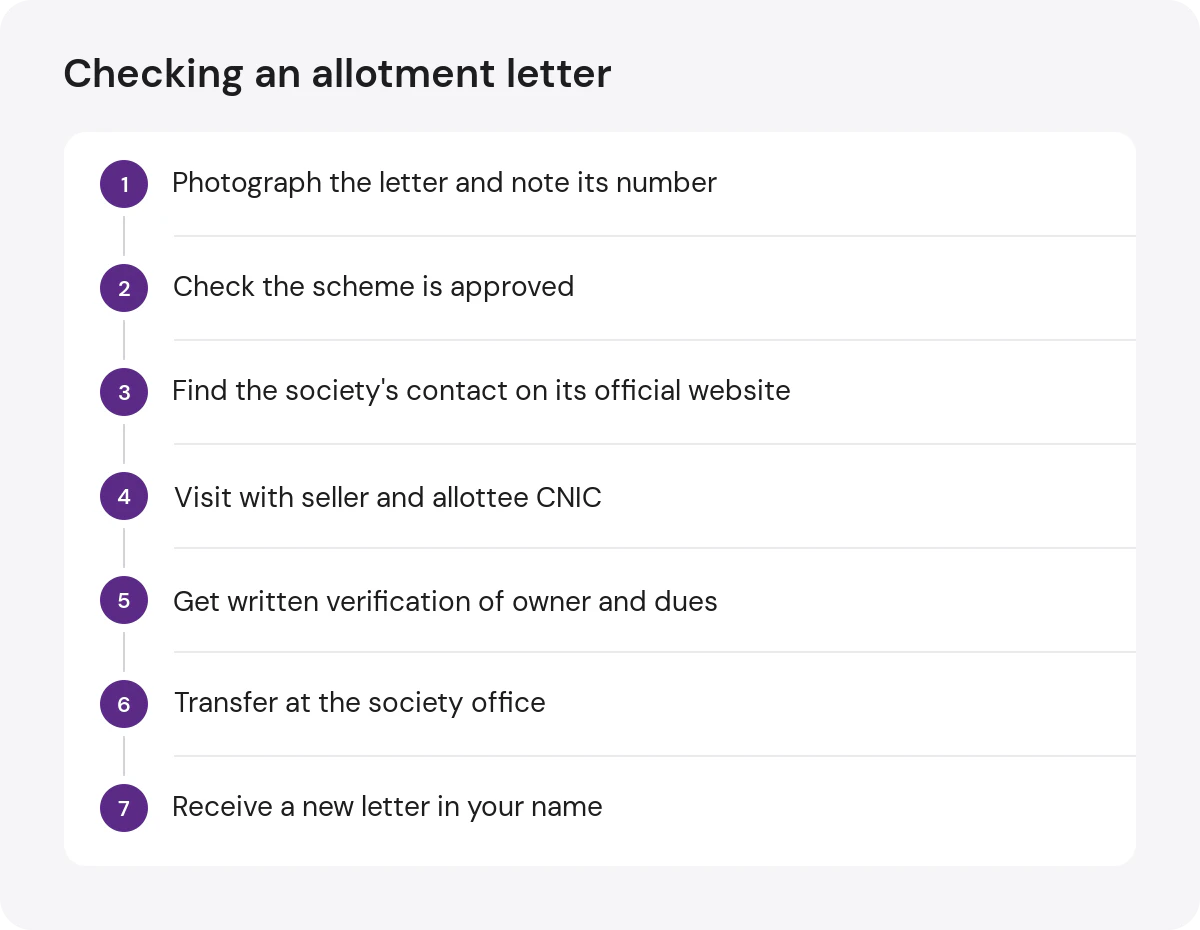
Verify with the issuer, not the paper.
- Photograph the whole letter. Note the letter number, date, plot number, block, phase, size, and the allottee's name and CNIC.
- Check the scheme first. Make sure the society is approved and that the block is on the approved layout plan. In Islamabad, CDA's list shows each scheme's layout plan (LOP) and NOC status. In Lahore, see our LDA list report, and use Pakizzle's society status page for other cities.
- Find the society's contact details yourself. Use the official website or the main office address. Never call a number printed on the letter or sent by the dealer.
- Ask the issuing office to verify. Give the letter number, plot details and the allottee's CNIC, and ask who the current owner is, whether any dues are outstanding, and whether a duplicate has ever been issued. Ask for the answer in writing. DHA Lahore lists "File Verification Charges" of PKR 5,250 and an "Ownership Certificate" of PKR 5,250 per property in its schedule effective 1 July 2026. Other societies set their own fees. DHA Islamabad-Rawalpindi's byelaws (2022, updated 2023) list a plot verification fee of PKR 6,000. DHA Karachi's June 2026 fee structure has no file-verification item; its nearest is a clearance certificate at PKR 6,000. We did not find a published verification fee for Bahria Town; ask its transfer office for the fee in writing.
- Ask about caution marks. A caution mark is a note on the society's record that blocks or flags a transfer, for example because of a court case or a dispute. DHA Lahore's schedule lists fees for placing and removing them. Ask whether any caution or lien is marked on the plot.
- Get a No Demand Certificate. An NDC (No Demand Certificate) confirms that the seller has cleared all dues. DHA Lahore's NDC form is signed by all co-owners or legal heirs and is checked by its transfer branch and legal adviser before the transfer.
- Complete the transfer at the society office. Do not pay the balance against a letter alone. Under DHA Lahore's regular transfer process, the seller surrenders the original letter, signs a transfer affidavit on e-stamp paper, both parties bring attested CNIC copies, and the buyer receives a new letter.
Documents to ask the seller for
- Original allotment, allocation or transfer letter (not a photocopy)
- Seller's original CNIC, matching the name on the society's record
- Latest paid dues receipts and the NDC
- Copy of the approved layout plan showing the plot
- For a possession letter: the possession certificate and site plan issued by the society
- If the seller is abroad: a valid power of attorney, which the society should verify
Red flags
- The seller has only a photocopy, or says the original is "with the bank" or "lost".
- The letter is a duplicate and the seller cannot explain why.
- The verification phone number is on the letter or comes from the dealer.
- The dealer wants payment before you have visited the society office.
- The plot is in a block that does not appear on the approved layout plan.
- The price is far below similar plots in the same block.
- The seller's CNIC name differs from the allottee name, with a story about an "open file" or "affidavit".
- Payment is to be made in cash or to a third person's account.
Possession letters need the same care
A possession letter is often shown to prove that a plot is "ready". Treat it like an allotment letter: verify it with the society, and match it to the site plan and the approved layout plan. Visit the plot, or ask someone you trust to visit, and check that the number on the ground matches the number on the letter. A possession letter for a plot in a block where no roads or services exist yet should make you ask more questions.
A note for Islamabad buyers
CDA's private housing schemes page says that in Islamabad's private schemes, allotments and plot transfers "are still made by the respective sponsors, without any check or involvement of CDA". CDA can tell you whether a scheme's layout plan and NOC are approved, and its status list shows when a layout plan was cancelled. Only the sponsor can confirm who holds a particular plot. So you need both checks: CDA for the scheme, the sponsor for the plot.
What to do if the letter is fake
- Stop paying. Do not pay any further instalment or balance.
- Get it in writing. Ask the society for a written statement that the letter or entry is not genuine.
- Keep the evidence. Keep the letter, receipts, bank transfers, WhatsApp chats, the dealer's card and any advertisement.
- Report it. File a complaint with the local police. Large or organised frauds can also be reported to the FIA. Tell the society too, so it can mark the plot.
- Get legal advice. A property lawyer can advise on criminal and civil action to recover your money.
For a large purchase, have a property lawyer check the letter and the society's written verification before you pay.
How Pakizzle helps
On Pakizzle, listings can carry dated checks such as "Documents checked" and "Visited", sellers can be ID verified (blue tick), and phone numbers are verified by call-back. These checks help you avoid obvious fakes. They are not a guarantee of title, and they do not replace verification with the society that issued the letter. Before you pay a token, run through our token money checklist.
Questions
How do I verify an allotment letter? Allotment letter asli hai ya naqli, kaise pata karein?
Go to the issuing society or authority yourself, using the address and helpline on its official website, not the number on the letter. Give the letter number, plot details and the allottee's name and CNIC, and ask for written verification of the current owner and dues. Many societies charge for this; DHA Lahore lists PKR 5,250 from July 2026.
What is the difference between an allotment letter and a possession letter?
An allotment letter says a specific plot has been allotted to a named person. A possession letter says the society has handed over the plot on the ground, usually after development and dues are cleared. A possession letter for a plot in an undeveloped block, or for a plot number not on the approved layout plan, is a warning sign. Verify both with the society.
The seller has only a photocopy of the allotment letter. Is that OK?
No. In a regular DHA Lahore transfer, the seller must hand in the original allotment or transfer letter so it can be cancelled and a new one issued to the buyer. If the original is 'lost', the society may issue a duplicate for a fee, but ask why, and check that no one else has used the original.
Does the development authority verify allotment letters in private societies?
Usually not. CDA says allotments and transfers in Islamabad's private schemes are made by the sponsors without any check or involvement of CDA. The authority can tell you whether the scheme and its layout plan are approved; only the society can confirm who holds a plot.
I think I paid for a fake allotment letter. What should I do?
Stop all payments, keep every receipt, message and the letter itself, and get written confirmation from the society that the letter is not genuine. Then file a complaint with the police and, for organised fraud, the FIA. A property lawyer can advise on recovering your money.
Sources
- DHA Lahore: Regular Transfer, documents required and forms (PDF)
- DHA Lahore: No Demand Certificate request form (PDF)
- DHA Lahore: Revision in Dues w.e.f. 01 Jul 2026 (PDF)
- Capital Development Authority: Private housing schemes (letter P)
- Capital Development Authority: Status of approved private housing schemes in Zone 2, 5 and E-11 (PDF)
- Dawn: FIA books seven CDA officials on charge of bogus plot allotments (10 Oct 2026)
- APP via UrduPoint: FIA arrests FGEHA official involved in corruption and land fraud (22 Oct 2025)
- Dawn: Real estate's fictitious file system (16 Jan 2023)
- DHA Islamabad-Rawalpindi: Revised Byelaws and Regulations 2022 (updated 2023), PDF
- DHA Karachi: Fee Structure, rates effective from 1 Jun 2026 (PDF)
Tools for this
Related guides
- Checking ownership: fard, registry and records Scam Watch
To check who owns a property, first identify its record: the fard for revenue land, the registered deed for leased or built property, or…
- Fake society files: the warning signs Scam Watch
Fake or excess plot files are files sold with no land behind them.
- Fake "overseas quota" plots Scam Watch
A genuine overseas quota is announced by the authority itself, such as OPF or CDA, paid into that body's own account, and comes with…
- Double-sold plots: how the scam works Scam Watch
One plot, two buyers. Here is how double sales happen with bayana agreements, open files, oversold files and powers of attorney, and the…