Overseas · Explainer
Property tax for non-resident Pakistanis (2026-27)
By Pakizzle Editorial Team · Checked against official sources on
Published · 11 min read

The short answer
A non-resident Pakistani holding a NICOP or POC, who spends under 183 days a year in Pakistan, can pay filer rates on property even without being on the Active Taxpayers' List. Under the Finance Act 2026 that means 1.25% advance tax when buying (236K) and 2.75% when selling (236C), applied through FBR's Overseas Pakistanis procedure.
Key facts
| Fact | Value | Source | As of |
|---|---|---|---|
| Overseas Pakistanis holding POC or NICOP who stay under 183 days in a financial year pay the filer rate under 236C and 236K even if they are non-filers. | Filer rate if POC/NICOP and under 183 days | FBR: FAQs for Overseas Pakistanis (PDF, 3 Jul 2025) | |
| From the Finance Act 2026, advance tax on a property purchase under 236K is a flat 1.25% of fair market value for ATL persons. | 1.25% of FMV (buyer) | FBR Circular No. 02 of 2026-27, para 21 | |
| From the Finance Act 2026, advance tax on a property sale under 236C is a flat 2.75% of the gross consideration for ATL persons. | 2.75% of consideration (seller) | FBR Circular No. 02 of 2026-27, para 21 | |
| Clause (111AC) of the Second Schedule says the higher non-ATL rates under 236C and 236K do not apply to non-resident POC or NICOP holders. | ATL rate for non-resident POC/NICOP holders | FBR: Income Tax Ordinance 2001, amended up to 30 June 2026 | |
| The Finance Act 2026 abolished tax on deemed income under section 7E, which had applied to some owners of more than one property. | Section 7E omitted | FBR Circular No. 02 of 2026-27, para 9 |
If you live abroad and own, buy or sell property in Pakistan, the biggest question is usually whether you count as a "filer". For non-resident Pakistanis there is a special rule that can save a large amount, and the Finance Act 2026 changed the rates again. This guide explains the rules as of November 2026.
Quick facts
FBR says overseas Pakistanis pay the filer rate under sections 236C and 236K "even if they are non-filer", on two conditions: they hold a Pakistan Origin Card (POC) or a National Identity Card for Overseas Pakistanis (NICOP), and they are non-resident, which FBR defines as staying in Pakistan for less than 183 days in a financial year. From the Finance Act 2026, as explained in FBR's Circular No. 2 of 2026-27 dated 8 September 2026, the filer rate is a flat 1.25% of fair market value when buying (236K) and a flat 2.75% of the price when selling (236C). The Act also abolished the "late filer" tier and the tax on deemed income under section 7E.
A note on terms: a "filer" in everyday speech means someone on FBR's Active Taxpayers' List (ATL). A non-filer is not on that list.
What you pay when you buy or sell (as of November 2026)
| Tax | Who pays | Filer rate (ATL, or eligible POC/NICOP holder) | Not on ATL | | --- | --- | --- | --- | | Advance tax on purchase, section 236K | Buyer | 1.25% of fair market value | 10.5% (up to PKR 5 crore), 14.5% (PKR 5 to 10 crore), 18.5% (above PKR 10 crore) | | Advance tax on sale, section 236C | Seller | 2.75% of gross consideration | 11.5% |
Filer rates are from FBR's circular, and both columns match FBR's withholding tax rate card for tax year 2027, "updated up to June 30, 2026 as per Finance Act, 2026". The legal basis for the overseas route is clause (111AC) of Part IV of the Second Schedule to the Income Tax Ordinance, which switches off the higher non-ATL rates under sections 236C and 236K for a non-resident individual holding a POC or NICOP. Both taxes are collected by "every person responsible for registering or attesting transfer", which means the sub-registrar, development authority or housing society.
Rates on FBR's own FAQ are out of date. FBR's overseas FAQ page, checked in November 2026, still shows the Finance Act 2025 table: 236K at 1.5%, 2% or 2.5%, and 236C at 4.5%, 5% or 5.5%, depending on value. FBR's later circular says these were replaced by the flat 1.25% and 2.75% rates. Rely on the circular, and ask the collecting office which rate its system is applying.
Late filers. The circular says the higher rates for people who are on the ATL but filed their return late (rule 1A of the Tenth Schedule) "have been abolished".
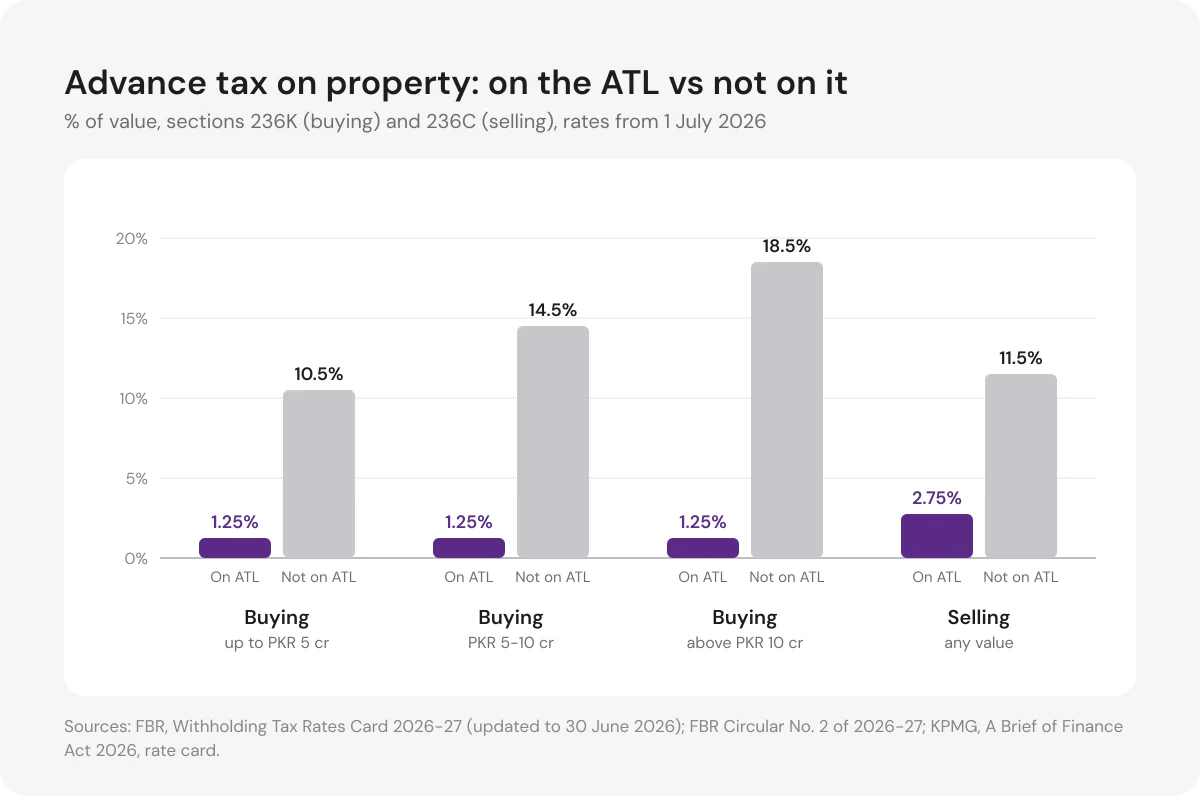
Advance tax on property for filers vs people not on the ATL, from 1 July 2026. Sources: FBR rate card 2026-27, FBR Circular No. 2 of 2026-27, KPMG.
How to claim the filer rate as a non-resident
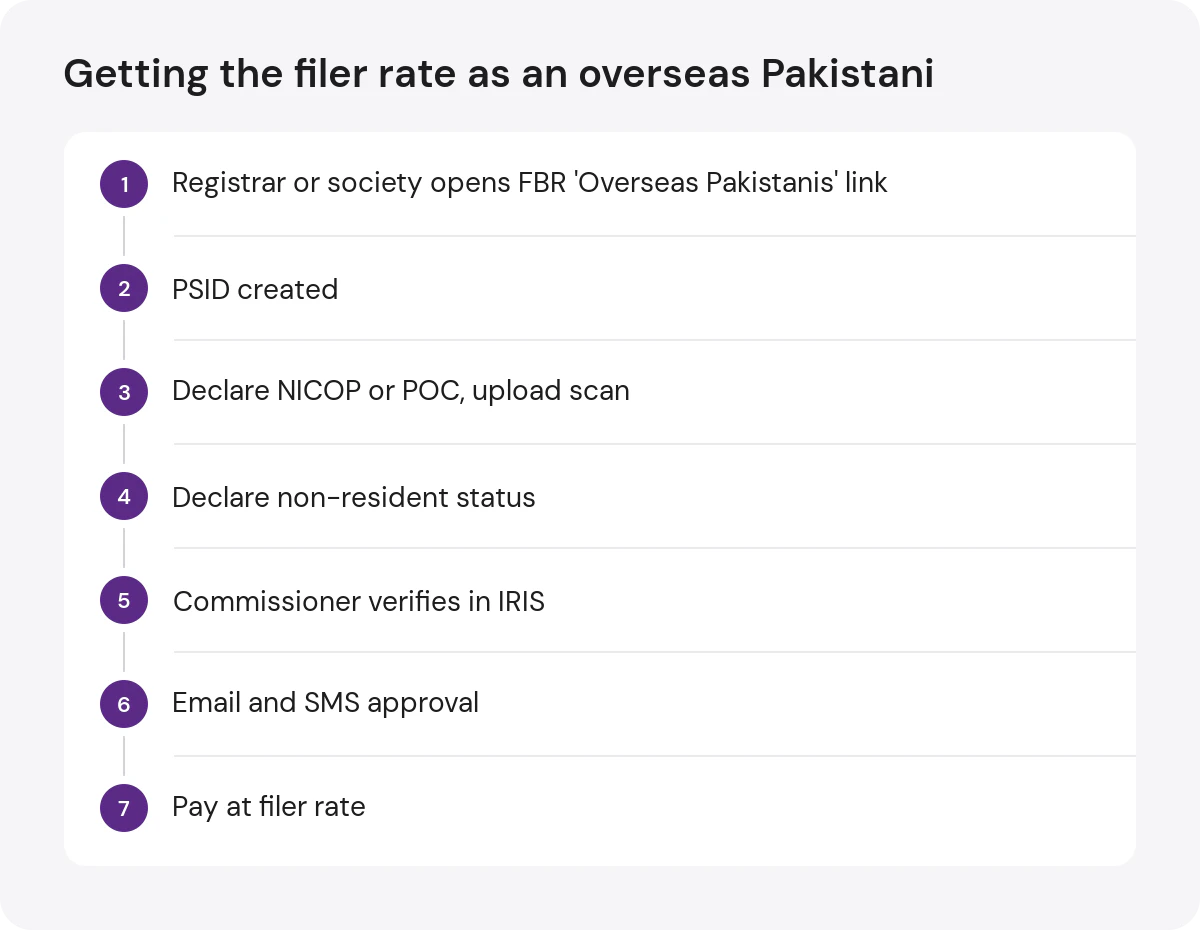
The steps described in FBR's Overseas Pakistanis FAQ.
FBR's FAQ describes this procedure:
- The relevant authority, registrar or housing society clicks the "Overseas Pakistanis" link on FBR's web portal to create a PSID (payment slip ID).
- You declare your POC or NICOP number and upload a scanned copy.
- You state whether you are resident or non-resident.
- The PSID goes to the concerned Commissioner's inbox in IRIS, FBR's tax system.
- The Commissioner verifies your documents and notifies you by email and SMS.
- The system then lets you pay advance tax "at filer rate despite being a non-filer".
Keep proof of your days outside Pakistan, such as passport entry and exit stamps, in case you are asked. DHA Lahore's seller-abroad procedure, for example, asks for a passport and visa copy with exit and entry stamps.
Capital gains tax when you sell
Advance tax under 236C is collected at the time of sale, but capital gains tax under section 37(1A) is your final tax on the gain. Division VIII of Part I of the First Schedule to the Income Tax Ordinance (as amended up to 30 June 2026) sets these rates:
- Property acquired on or after 1 July 2024: 15% of the gain if you are on the ATL on the date of sale. If not, the normal slab rates for individuals apply, and the rate cannot be less than 15%.
- Property acquired on or before 30 June 2024: a holding-period scale. Open plots: 15% (up to 1 year), falling to 2.5% (5 to 6 years) and 0% after 6 years. Constructed property: 15%, falling to 0% after 4 years. Flats: 15%, 7.5%, then 0% after 2 years.
The 236C advance tax is shown in the rate card as adjustable or minimum tax, subject to conditions. Whether it covers your full liability depends on your situation. For property bought on or after 1 July 2024, capital gains tax is 15% for a seller on the ATL on the date of sale, whatever the holding period; the test is ATL status, not residence. If you are not on the ATL, normal slab rates apply, with a floor of 15%. Outside the FCVA/NRVA route, 236C is advance tax that is adjusted against your final CGT when you file a return; if you do not file, it is not refunded or adjusted. We found no FBR instruction written specifically for non-residents who do not file, so ask a tax adviser before you sell.
Other changes in the Finance Act 2026 that matter abroad
- Deemed income (7E) abolished. FBR's circular says section 7E has been omitted. This was the tax on deemed income from certain immovable property, which many owners of a second house or plot had to consider.
- Inherited property. New section 76(8A) says the cost of inherited property is its fair market value on transfer to the beneficiary. That matters when you later sell inherited property, because the gain is measured from that value. Section 79 now also treats a family settlement after a death as part of the transmission to heirs.
- Foreign currency and NRVA accounts. Clause 114A was amended so that a person maintaining an FCVA, FCBVA, NRVA or NRBVA (foreign currency or non-resident rupee value accounts) is not required to file a return or register under sections 114(1)(ae) and 181, but only if their Pakistan-source income is limited to listed items. One listed item is a capital gain on immovable property acquired from the proceeds of an FCVA or NRVA. Section 236C itself makes the 236C tax the final discharge of tax, in place of capital gains tax, for a non-resident POC, NICOP or CNIC holder who bought the property through an FCVA or NRVA.
Provincial charges still apply
The filer-rate rule is federal. Stamp duty, registration fees and society or authority charges apply equally to residents and non-residents. As of November 2026, Punjab charges 1% stamp duty on a sale under its Stamp (Amendment) Act 2026, and Islamabad charges a flat 1% under the Finance Act 2025, with no separate non-filer rate. Our stamp duty by province guide has the details and the open questions. Housing societies add their own fees; DHA Lahore, for example, lists a PKR 5,250 charge for "Purchaser Abroad Document Signing" in its schedule from 1 July 2026.
Rental income
If you rent out property in Pakistan, the rent is taxable in Pakistan under the head "Income from Property" (section 15 of the Income Tax Ordinance). Some tenants must deduct tax from the rent they pay you under section 155: the federal, provincial and local governments, companies, non-profit organisations, diplomatic missions, private schools, boutiques, beauty parlours, hospitals, clinics and maternity homes, and individuals or associations of persons paying rent of PKR 15 lakh or more a year. FBR's rate card for tax year 2027 sets the deduction for an individual landlord on the ATL at nil on annual rent up to PKR 3 lakh, 5% of the amount above PKR 3 lakh up to PKR 6 lakh, PKR 15,000 plus 10% of the amount above PKR 6 lakh up to PKR 20 lakh, and PKR 1.55 lakh plus 25% of the amount above PKR 20 lakh. Whether that deduction settles your tax, and whether you need to file a return, depends on your other income, so ask a tax adviser.
Red flags
- An agent says "overseas Pakistanis pay no tax on property". They pay the same filer rate as residents, and CGT applies on sale.
- You are asked to pay the non-filer rate without anyone checking whether you qualify for the NICOP or POC route.
- Someone quotes the older FBR FAQ rates as current.
- You are told to put the property in a relative's name to avoid tax. That can create title problems later.
What to do if something goes wrong
If you were charged the non-filer rate but qualified for the filer rate, keep the PSID, payment receipt and travel proof, and ask a tax adviser about claiming an adjustment through your return. If the society or registrar's system will not show the "Overseas Pakistanis" option, ask them to contact the Regional Tax Office before the transfer is executed.
How Pakizzle helps
Pakizzle's Overseas mode shows prices in your own currency, and many sellers offer video viewing, so you can shortlist from abroad. Listings can carry "Video checked" or "Visited" labels with a date, and phone numbers are verified by call-back. Pakizzle does not calculate or collect tax, so confirm the figures with FBR or a tax adviser.
For any large sale or purchase, take advice from a qualified tax adviser in Pakistan before you sign.
Questions
Overseas Pakistani filer na ho to property par kitna tax lagega?
If you hold a NICOP or POC and stayed in Pakistan for less than 183 days in the financial year, FBR says you pay the filer rate even if you are not on the Active Taxpayers' List. As of the Finance Act 2026 that is 1.25% when buying and 2.75% when selling. Without that route, non-ATL rates are much higher: 10.5% to 18.5% when buying and 11.5% when selling.
How do I claim the filer rate as an overseas Pakistani?
FBR's FAQ says the registrar, authority or housing society creates a PSID through the 'Overseas Pakistanis' link on FBR's portal. You declare your NICOP or POC number, upload a scan, and state that you are non-resident. The Commissioner checks it in IRIS, and once approved you are told by email and SMS and can pay at the filer rate.
Do I pay capital gains tax when I sell a plot bought in 2025?
For property bought on or after 1 July 2024, the Income Tax Ordinance (First Schedule, Division VIII) sets capital gains tax at 15% if you are on the Active Taxpayers' List on the date of sale. If you are not, the normal income tax slab rates apply, with a floor of 15%. Older property is taxed on a holding-period scale that falls to zero over time.
Do I still pay tax on deemed rental income for a second house?
No. The Finance Act 2026 omitted section 7E, which taxed deemed income on certain immovable property, and the matching rate in the First Schedule. FBR's Circular No. 2 of 2026-27 describes this as the tax on deemed income being 'abolished'. Actual rental income is a separate matter.
Does the filer-rate rule cover stamp duty and provincial taxes?
No. The NICOP or POC rule applies to the federal advance taxes under sections 236C and 236K. Stamp duty, registration fees and other provincial or society charges apply in the same way to residents and non-residents. See our stamp duty by province guide for current rates.
Sources
- FBR: Overseas Pakistanis FAQ page (procedure; its rate table is out of date)
- FBR: Circular No. 02 of 2026-27, Finance Act 2026 explained (8 Sep 2026)
- KPMG Taseer Hadi & Co.: A Brief of Finance Act, 2026 (July 2026)
- DHA Lahore: Foreign Transfer, Seller Abroad, documents required (form 4433056, PDF)
- DHA Lahore: Revision in Dues, Dues on Services w.e.f. 01 Jul 2026 (PDF)
- FBR: Frequently Asked Questions and Answers for Overseas Pakistanis (PDF, 3 Jul 2025)
- FBR: Income Tax Ordinance 2001, amended up to 30 June 2026 (ss.15, 37(1A), 155, 236C; Second Schedule clauses 111AB, 111AC, 114A)
- FBR: Withholding Income Tax Rate Card, tax year 2027 (Finance Act 2026)
- Punjab Gazette: The Stamp (Amendment) Act 2026 (Act XXIV of 2026), 6 May 2026
- National Assembly: Finance Bill 2025 as passed (s.2, Stamp Act amendment for ICT)
Tools for this
Related guides
- Overseas Pakistanis Foundation (OPF) housing schemes Overseas
OPF, the government's Overseas Pakistanis Foundation, runs housing schemes in Islamabad, Lahore, Gujrat, Peshawar, Dadu, Larkana and Mirpur…
- Checking an agent remotely: a checklist Overseas
To check a property agent from abroad, verify their CNIC, office and FBR DNFBP registration, call past overseas clients, and insist on a…
- Renting out your property in Pakistan while abroad Overseas
To rent out property in Pakistan while abroad, appoint one trusted manager with a special power of attorney limited to renting, check the…
- Selling inherited property from abroad Overseas
To sell inherited property from abroad, first transfer it to all the legal heirs through a NADRA succession certificate, letter of…