Renting · Explainer
Security deposit and advance rent: what's normal
By M. Waqas Ur Rehman · Checked against official sources on
Published · 10 min read

The short answer
In Pakistan the amount of security deposit and advance rent is agreed between landlord and tenant. We found no fixed limit in the Punjab Rented Premises Act 2009 or the Sindh Rented Premises Ordinance 1979. Punjab's Act requires the amount to be written in the tenancy agreement, and the Rent Tribunal can order it adjusted in a dispute.
Key facts
| Fact | Value | Source | As of |
|---|---|---|---|
| Punjab's Rented Premises Act 2009, section 6(1)(g), says a tenancy agreement shall contain the 'amount of advance rent, security or pagri, if any'. | Must be written in the agreement | Punjab Laws Online: Punjab Rented Premises Act 2009 (Act VII of 2009) | |
| The Punjab Act defines a Rent Tribunal's final order as including an order on 'adjustment of pagri, advance rent, security, arrears of rent'. | Rent Tribunal decides deposit disputes | Punjab Laws Online: Punjab Rented Premises Act 2009 (Act VII of 2009) | |
| If a Punjab tenancy does not conform to the Act, a tenant must deposit a fine of 5% of annual rent, and a landlord 10%, before the Rent Tribunal hears them. | Tenant 5%, landlord 10% of annual rent | Punjab Laws Online: Punjab Rented Premises Act 2009 (Act VII of 2009) | |
| Sindh's Rented Premises Ordinance 1979, section 10, says rent is due by the tenth of the following month and the landlord shall acknowledge receipt in writing. | Written receipt; due by the 10th | Sindh Judicial Academy (updated law text) | |
| Section 6 of the Sindh Ordinance was omitted by Sind Ordinance IV of 1984; the updated text has no clause capping security deposits. | No deposit cap in updated text | Sindh Judicial Academy (updated law text) |
Before you get the keys to a rented house or flat in Pakistan, you usually pay three things: the first month's rent, some months of advance rent, and a security deposit. Tenants often ask what is "normal" and whether the law sets a limit. This explainer sets out what the Punjab and Sindh rent laws actually say, what is left to agreement, and how to get your deposit back.
Quick facts
- No fixed limit found. We read the Punjab Rented Premises Act 2009 and the updated Sindh Rented Premises Ordinance 1979 and found no clause limiting the amount of security or advance rent. The amount is agreed between landlord and tenant.
- Punjab: it must be written down. Section 6(1)(g) of the Punjab Act says the tenancy agreement shall contain the "amount of advance rent, security or pagri, if any".
- Punjab: the Rent Tribunal decides disputes. The Act's definition of a "final order" of a Rent Tribunal includes an order on "adjustment of pagri, advance rent, security, arrears of rent, compensation or costs".
- Sindh: receipts in writing. Section 10 of the Sindh Ordinance says the landlord "shall acknowledge receipt" of rent in writing. Unless agreed otherwise, rent is due by the tenth of the following month.
- Islamabad has its own law, the Islamabad Rent Restriction Ordinance 2001. Dawn reported in 2018 that the Interior Ministry extended it to Zone V and approved housing societies, beyond the urban sectors. Islamabad's Ordinance doesn't set a deposit amount. It does bar any "fine, premium or other like sum" beyond rent as a condition of the tenancy (s.12). A refundable security deposit agreed in writing is common practice, and the law sets no cap or rule for it.
Three different payments
| Payment | What it is | Comes back? | | --- | --- | --- | | Advance rent | Rent paid ahead for future months | No, it is used up month by month | | Security deposit | Money held against unpaid rent, bills or damage | Yes, less agreed and proven deductions | | Pagri | Under Punjab's Act, "any amount received by a landlord at the time of grant or renewal of a tenancy except advance rent or security" | Depends on the agreement |
Mixing these up causes most disputes. Write each one as a separate line in the agreement, with what happens to it at the end.
What is normal in practice?
Because the law leaves the amount to agreement, practice varies by city, by type of property and by landlord. We could not find a reliable figure for the "usual" deposit from an official source or a major newspaper we could open, so we do not quote one. Ask two or three other landlords or agents in the same block what they are asking before you agree.
We plan to publish our own figure from Pakizzle rental listings that show the deposit as a separate field, once there are enough listings to make it meaningful; we will state the sample size beside it. Until then, compare current rents on our Lahore, Karachi and Islamabad rent pages.
A rough test: if the total you are asked to pay before moving in is more than you could afford to lose in a dispute, negotiate. Offer a larger security against a smaller advance, or monthly rent by bank transfer in place of a big advance.
Before you pay: step by step
- See the owner's proof. Check the owner's CNIC and proof of ownership, or the agent's written authority.
- Put every amount in the agreement. Under the Punjab Act this is required. Elsewhere it is still your best evidence. Our guide on what to include in a rent agreement has a full list.
- Pay by bank transfer to the account named in the agreement. Section 6(1)(e) of the Punjab Act asks for the landlord's bank details if rent is paid through a bank, and section 7 makes money order or bank deposit the default where no mode is agreed.
- Get a signed receipt that says "security deposit" or "advance rent for [months]", not just "received".
- Register the agreement. In Punjab the landlord must present it to the Rent Registrar (section 5). If a tenancy does not conform to the Act, section 9 says the Rent Tribunal will not hear the tenant until they deposit a fine of 5% of the annual rent, or the landlord until they deposit 10%.
- Record the condition. Take a dated video of every room, meter readings and fittings on the day you move in.
- Register with the police as required in your city. A 2022 PIDE review notes that rental rules were amended in 2014 and 2015 so that information and identity-card copies of temporary residents go to the local police station. See tenant police registration.
Getting your deposit back
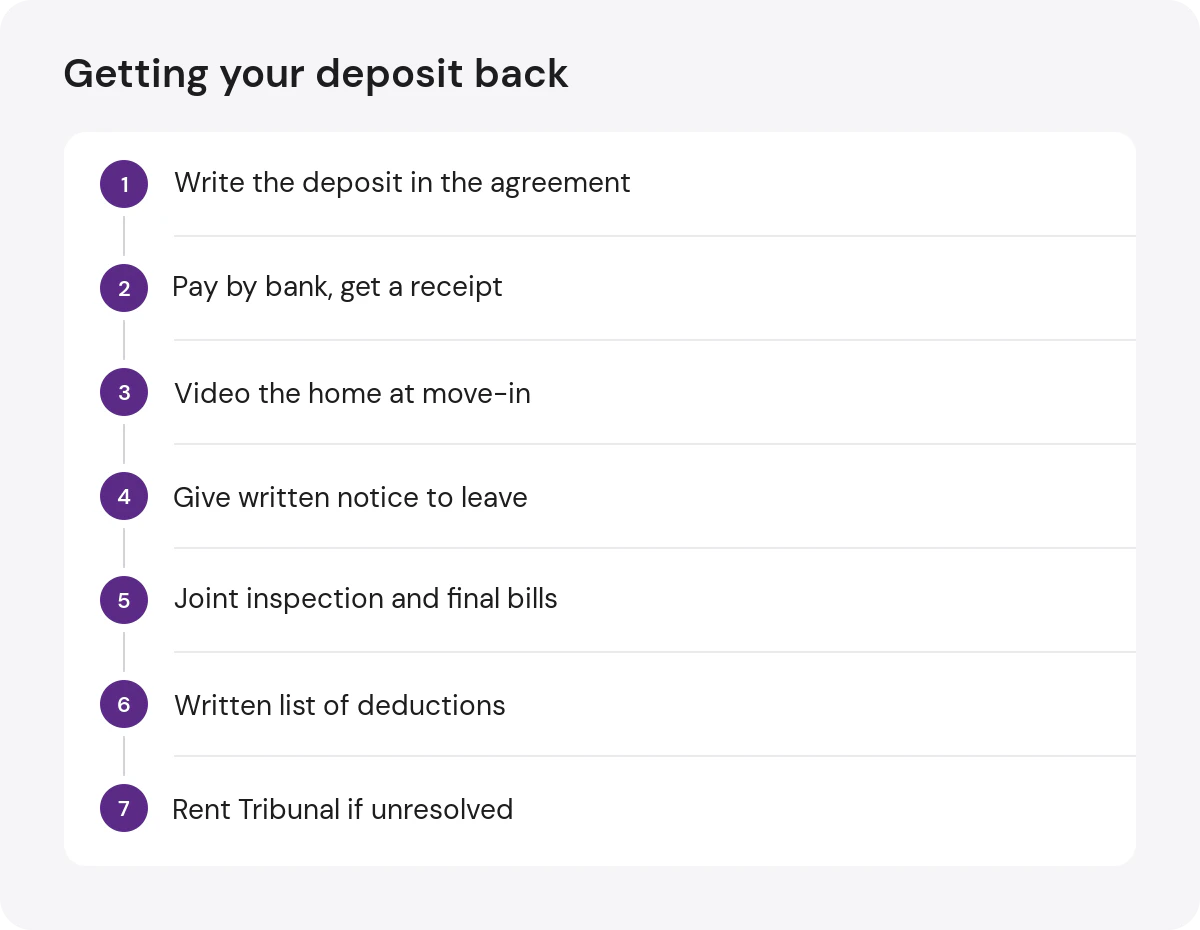
The steps that prevent most deposit disputes.
Punjab's Act says a tenant must keep the premises "in the condition in which it was let out except for normal wear and tear" (section 13). So a landlord can fairly deduct for damage, unpaid utility bills and unpaid rent, but not for ordinary ageing.
- Give written notice as your agreement requires.
- Pay final utility bills and keep the receipts.
- Ask for a joint inspection and record a move-out video.
- Ask for a written list of any deductions, with amounts.
- Hand over the keys against a signed note.
If the landlord will not return it
- Write first. Send a letter or email setting out the deposit, the date you left, and your evidence.
- Punjab: apply to the Rent Tribunal, which can make orders on adjustment of security and advance rent.
- Sindh: the 1979 Ordinance has no express provision on security deposits or their refund; a claim may go to the Rent Controller or to a civil court depending on the facts, so ask a lawyer in Karachi which forum fits your case before you file.
- Large amounts: speak to a lawyer about a civil claim.
Rent increases and your deposit
A deposit is often set as "two months' rent", so it helps to know how rent can change during the tenancy.
- Punjab: section 6(1)(d) of the Act says the agreement should state the "rate of rent, rate of enhancement, due date and mode of payment". Section 6(2) adds that if the tenure is fixed but rent is fixed only for part of it, the rent "shall be deemed to remain the same for the whole of the tenure" unless the agreement says otherwise. Write the yearly increase, and whether the deposit is topped up, into the agreement.
- Sindh: under section 9, once the Rent Controller has fixed a "fair rent", no further increase can be made for three years, and "the increase in rent shall not, in any case, exceed ten percent per annum on the existing rent". Either side can apply to the Controller to fix fair rent (section 8).
Our guide to rent increase rules by province covers this in more detail.
A note for landlords
Clear paperwork protects you too. Under the Punjab Act, a landlord whose tenancy does not conform must deposit a fine of 10% of the annual rent before the Rent Tribunal will hear an eviction or arrears case. Register the agreement, issue receipts, and keep the move-in video. If you deduct from the deposit, list each item with a bill or photo.
Red flags
- A landlord or agent refuses to write the deposit into the agreement.
- Cash only, or payment to a third person's account.
- A "non-refundable" security deposit. That is not a security deposit.
- The agreement says the deposit is forfeited for any early exit, whatever the reason.
- No receipt, or a receipt that does not say what the money is for.
How Pakizzle helps
Pakizzle rental listings can show the deposit separately from the rent, so you can compare total move-in cost before you call. Phone numbers are verified by call-back, "ID verified" (blue tick) shows the lister's identity was checked, and "Video checked" means the listing's video was reviewed. Use saved searches and alerts to watch an area, and our /prices pages to compare asking rents; a median figure appears only where at least five listings support it, with the listing count beside it. These checks are not a guarantee, so follow the steps above for every tenancy.
For a high-value lease or a dispute, take advice from a lawyer or the Rent Tribunal or Controller in your district.
Questions
How much security deposit can a landlord take in Pakistan?
We found no fixed legal limit in the Punjab Rented Premises Act 2009 or the Sindh Rented Premises Ordinance 1979, so the amount is agreed between landlord and tenant. In Punjab the agreement must state the amount of advance rent, security or pagri. Whatever you agree, write it in the agreement, pay by bank, and get a signed receipt.
What is the difference between advance rent and security deposit?
Advance rent is rent paid ahead for future months, and it is used up as those months pass. A security deposit is held by the landlord against unpaid bills, unpaid rent or damage, and should come back when you leave, less agreed deductions. Pagri is different again: Punjab's Act defines it as any amount taken at grant or renewal of a tenancy, other than advance rent or security.
Landlord security wapis nahi kar raha. Kya karun?
First, write to the landlord asking for the deposit with a list of any deductions, and keep proof of handover such as photos and final utility bills. In Punjab you can apply to the Rent Tribunal, which can make orders on adjustment of security and advance rent. Your agreement should be registered with the Rent Registrar, or a fine may apply before the Tribunal hears you.
Can the landlord keep my deposit for normal wear and tear?
Punjab's Act says the tenant must keep the premises in the condition in which it was let out 'except for normal wear and tear'. So faded paint or ordinary use should not be charged, while damage beyond that can be. A dated video at move-in and move-out is the best evidence either side can have.
Can I use my security deposit as the last month's rent?
Only if the agreement says so or the landlord agrees in writing. Otherwise the landlord may treat it as unpaid rent. Under Punjab's Act, failing to pay rent within thirty days after it is due is a ground for eviction. Agree any adjustment in writing before your last month.
Sources
- Punjab Laws Online (Provincial Assembly of the Punjab): The Punjab Rented Premises Act 2009 (PDF)
- Sindh Judicial Academy: Sindh Rented Premises Ordinance 1979 (updated)
- PIDE: A review of urban rental housing regulations in Pakistan (Knowledge Brief 92, Dec 2022)
- Dawn: Interior ministry extends rent restriction ordinance to Zone V, housing societies (20 Mar 2018)
- Gazette of Pakistan: Islamabad Rent Restriction (Amendment) Act 2021 (Act XLVII of 2021)
- Pakistan Code: Islamabad Rent Restriction Ordinance 2001 (IV of 2001)
Corrections
- : We replaced unofficial copies of the Punjab Rented Premises Act 2009 with the official text on Punjab Laws Online, added the Islamabad Rent Restriction (Amendment) Act 2021 as a source, and corrected the /prices note: a median rent appears only where at least five listings support it.
Tools for this
Related guides
- Ending a tenancy: notice, deposit and disputes Renting
End a tenancy in writing, following the notice clause in your agreement.
- Renting a portion in North Nazimabad: tenant and landlord rights under Sindh law Renting
Portions and houses in North Nazimabad are rented under the Sindh Rented Premises Ordinance.
- Water in North Nazimabad: KW&SC connection, tanker booking and complaints Renting
In North Nazimabad, water comes from the Karachi Water and Sewerage Corporation (KW&SC).
- New gas connection for a house in North Nazimabad: SSGC RLNG fees and documents Renting
New domestic gas connections in North Nazimabad come on RLNG from SSGC.