Overseas · Guide
Viewing a property by video from abroad
By Pakizzle Editorial Team · Checked against official sources on
Published · Updated on · 10 min read

The short answer
To view a property in Pakistan by video from abroad, book a live call in Pakistani daylight (Pakistan is UTC+5 all year), ask the person to walk from the street to every room without cuts, and check water, damp, power, light and noise on camera. A video shows condition only. Confirm ownership papers and the society's approval separately before paying.
Key facts
| Fact | Value | Source | As of |
|---|---|---|---|
| Pakistan Standard Time is UTC+5 and Pakistan does not observe daylight saving time. | UTC+5, no DST | Wikipedia: Pakistan Standard Time | |
| UK clocks went back on 25 October 2026 and go forward on 28 March 2027, so Pakistan is 5 hours ahead of the UK in winter and 4 in summer. | +5 h (GMT) / +4 h (BST) | GOV.UK | |
| RDA tells the public never to rely on screenshots of its society-status page shared on social media, and to check the live page. | Check the live page | Rawalpindi Development Authority | |
| Non-resident NICOP or POC holders pay 236C and 236K advance tax at the ATL (filer) rate even if not on the ATL (Second Schedule clause 111AC). | ATL rate for non-resident NICOP/POC holders | FBR: Income Tax Ordinance 2001, amended up to 30 June 2026 |
For an overseas Pakistani, the first viewing is usually the hardest step. Flying home to see three houses is expensive, and a cousin's quick WhatsApp video rarely answers the questions that matter. A well-run live video viewing can tell you most of what an in-person visit would, as long as you plan it, control it, and remember what it cannot prove.
Quick facts
Pakistan is on UTC+5 all year and does not change its clocks. The UK does, so the gap changes: in UK winter Pakistan is 5 hours ahead, in UK summer 4 hours. UK clocks went back on 25 October 2026 and go forward on 28 March 2027. The UAE and Oman are on UTC+4 all year, so Pakistan is 1 hour ahead. A video viewing shows the condition and surroundings of a home. It does not show who owns it, whether the society is approved, or whether the price is fair. Those are separate checks.
Before the call: book it properly
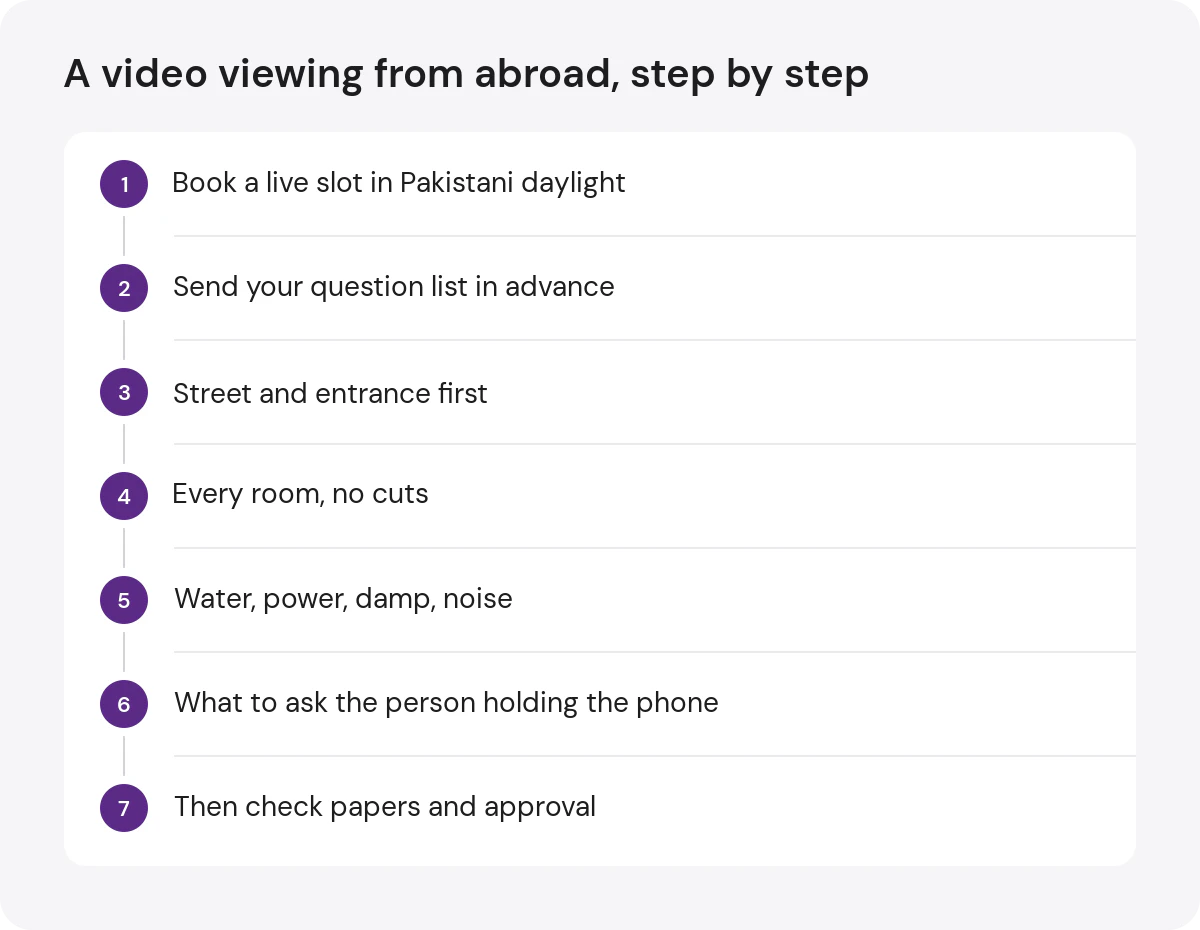
From booking to the paperwork that a video cannot replace.
- Pick Pakistani daylight. Natural light shows damp, cracks and paint better than tube lights. Aim for roughly 10am to 3pm Pakistan time.
| Where you are | Pakistan 10am to 3pm is | Notes | | --- | --- | --- | | UK, winter (GMT, until 28 March 2027) | 5am to 10am | Pakistan 5 hours ahead | | UK, summer (BST) | 6am to 11am | Pakistan 4 hours ahead | | UAE or Oman (UTC+4) | 9am to 2pm | Pakistan 1 hour ahead |
For other countries, convert from UTC+5 and check whether your country is on summer time.
- Avoid load-shedding hours if you can. Ask the agent when power cuts usually happen in that area, and either avoid them or book during one deliberately to see whether the home has a UPS or generator.
- Agree who will hold the phone. Ideally someone on your side: a relative, a friend, or your own agent. If only the seller's agent can do it, that is fine, but you lead the call.
- Send your questions in advance. Share the list below so the person can bring the bills and keys.
- Use a stable app and a charged phone. Ask them to switch to the rear camera, turn off beauty filters and keep the phone horizontal.
- Do not pay anything to book the viewing. A request for a token or "visit fee" before a viewing is a warning sign. Our advance-fee scam guide explains why.
During the call: what to look at
Ask the person to walk at a slow pace, without cutting the video, from the street to the last room.
Outside
- The street, the nearest landmark and the house or plot number. Ask them to show a street sign or a known building you can find on a map.
- The front of the building, the gate, the boundary wall and any cracks.
- Parking, street width and drainage. Ask what happens in heavy rain.
Inside, room by room
- Ceilings and the corners of walls for damp or seepage, especially under bathrooms and the roof.
- Floors, doors and windows. Ask them to open and close a few.
- Kitchen cabinets, the gas connection and the stove.
- Bathrooms: run the taps, check hot water, flush, and look under the sink.
- Switch on lights, fans and an AC. Ask where the distribution board is.
Services
- Electricity and gas meters, with the reference numbers visible, and the last few bills. Check that the name on the bills matches what you are told.
- Water source and storage: line water, boring, tanker, overhead and underground tanks.
- Mobile signal and internet. Ask them to run a speed test on the spot.
Surroundings
- Open a window for noise. Ask about the neighbours, a nearby market, mosque, school or main road.
- Go to the roof or balcony and pan slowly 360 degrees.
What to ask the person holding the phone
- How long has the owner had this property, and why are they selling or renting?
- Is the owner the person named on the registry, allotment or transfer letter?
- Are there any dues outstanding: society maintenance, utility bills, property tax?
- Has anything been built beyond the approved map, such as an extra floor or a covered lawn?
- Who lived here last, and when did they leave?
- Can you show me the original documents on camera now?
Record the answers. Ask permission before you record, and keep the recording for your own reference.
What a video cannot tell you
A video is about condition. It cannot confirm:
- Ownership. You need the title documents and the seller's CNIC, checked against each other, and for a society plot, confirmation from the society.
- Approval. Check the society on the development authority's own list. RDA, for example, tells the public never to rely on screenshots of its society-status page shared on social media, and to check the live page. RDA also says that statuses like "under process" are not approval. Our guide on how to check if a society is approved covers each city.
- Price. Compare with similar homes in the same block.
- Smell, noise at night and the neighbours. If the deal is large, a second visit by someone you trust, at a different time of day, is worth it.
After the call: the paperwork from abroad
Most of the paperwork can be started from abroad, but some steps still need someone in Pakistan.
- Power of attorney. If you will not be in Pakistan for the transfer, you will need a properly made power of attorney. In 2023 Dawn reported that Punjab's e-registration portal had trouble registering powers of attorney sent from abroad, which PLRA said it was fixing. Ask the Sub-Registrar or society how your attorney's documents will be accepted before you sign. NADRA's Digital Power of Attorney portal (poa.nadra.gov.pk) lets overseas Pakistanis apply online with biometrics, two witnesses and a video interview, but you still send the signed original to Pakistan with the system's receipt. Acceptance is not uniform, so ask both the Sub-Registrar and the society whether they will act on a NADRA power of attorney before you sign one. Our power of attorney guide has more.
- E-stamp OTP. In Punjab, stamp duty challans need an OTP. Business Recorder reported that overseas users can verify by email OTP instead of a Pakistani mobile.
- Tax at the filer rate. Under clause (111AC) of the Second Schedule to the Income Tax Ordinance (as amended to 30 June 2026), a non-resident holding a NICOP or POC pays advance tax on buying and selling (sections 236K and 236C) at the Active Taxpayer List rate, even if not on the list. FBR's overseas FAQ says non-resident means a stay in Pakistan of less than 183 days in the tax year, and that the registrar or society creates the payment slip (PSID) through the "Overseas Pakistanis" link on FBR's portal, which an FBR Commissioner then approves.
- Payments. Pay through banking channels to an account in the seller's name, never in cash through a middleman. Our guide to buying property from abroad covers safe payments.
Red flags on a video viewing
- The person refuses a live call and sends only edited clips.
- The camera never shows the street, the house number or a landmark.
- Rooms appear in a jumbled order, or the video cuts between rooms.
- Bills or documents are "with the owner" every time you ask.
- You are pushed to pay a token straight after the call, "before someone else does."
- The listing photos look different from what you see live.
If you pay and it turns out to be a fraud, contact your bank immediately and report it to the National Cyber Crime Investigation Agency on helpline 1799.
How Pakizzle helps
Pakizzle is built with overseas buyers in mind. Overseas mode shows prices in your currency, and you can request a video viewing from the listing. Listings can carry dated labels such as "Video checked" and "Self video checked", and owners and agents can be ID verified with the blue tick. Phone numbers are verified by call-back. Our society status page quotes official approval lists word for word with their dates. These checks help you shortlist with more confidence; they are not a guarantee of title, so always complete the paperwork checks above. See how we check for what each label means.
For a large purchase, speak to a property lawyer in Pakistan before you pay.
Questions
What time should I book a video viewing in Pakistan from the UK or UAE?
Book in Pakistani daylight so you can judge light and damp, ideally between 10am and 3pm Pakistan time. Pakistan is UTC+5 all year. In UK winter (GMT) that is 5am to 10am UK time; in UK summer (BST) 6am to 11am. The UAE is UTC+4, so Pakistan is one hour ahead: 9am to 2pm Dubai time.
Is a recorded video enough, or should I insist on a live call?
Insist on live. A recorded video can be edited, can be of a different unit, or can be old. On a live call you can ask the person to turn around, open a tap, show the meter or step outside to a landmark you name. Ask permission and record the call on your side for your own reference.
Video viewing mein kya check karein? What should I look at on the call?
Start at the street and the building entrance, then every room in order without cuts. Look at ceilings and wall corners for damp, run taps and flush, switch on lights and fans, open windows for noise, and check the gas and electricity meters. Ask to see the view from the roof or balcony and the parking.
Can a video viewing confirm that the seller owns the property?
No. A video shows condition and location, not ownership or approval. Check the title documents and the seller's CNIC against them, check the society's status with the development authority's own list, and use a trusted person or lawyer in Pakistan for the paperwork before you pay a token.
The agent says I must pay a token before the video call. Is that normal?
No. You should never need to pay to see a home, in person or on video. Paying before a viewing is the core of advance-fee scams. If you lose money this way, report it to your bank at once and to Pakistan's National Cyber Crime Investigation Agency on helpline 1799.
Sources
- Wikipedia: Pakistan Standard Time
- GOV.UK: When do the clocks change?
- Wikipedia: Gulf Standard Time
- Rawalpindi Development Authority: Illegal Housing Societies page (warning on screenshots)
- The Nation: RDA declares 293 housing schemes illegal, announces legal action (26 Feb 2026)
- FBR: FAQs on filer rate under section 236C or 236K for overseas Pakistanis
- Business Recorder: Punjab introduces OTP verification for property sale and purchase, email OTP for overseas (17 Nov 2025)
- Dawn: E-registration hitches cause sharp decline in property transactions (5 Jun 2023)
- APP: NCCIA recovers Rs1.4m in Rs21m fraud, helpline 1799 (9 Nov 2026)
- NADRA: Digital Power of Attorney portal (home, application fee and FAQ pages)
- FBR: Income Tax Ordinance 2001, amended up to 30 June 2026 (Second Schedule, clause 111AC)
Corrections
- : We corrected the basis for the overseas filer rate. A non-resident holding a NICOP or POC pays 236K and 236C advance tax at the Active Taxpayers' List rate under clause (111AC) of the Second Schedule to the Income Tax Ordinance (as amended to 30 June 2026), even if not on the list. We had cited only FBR's overseas FAQ.
Tools for this
Related guides
- Overseas Pakistanis Foundation (OPF) housing schemes Overseas
OPF, the government's Overseas Pakistanis Foundation, runs housing schemes in Islamabad, Lahore, Gujrat, Peshawar, Dadu, Larkana and Mirpur…
- Checking an agent remotely: a checklist Overseas
To check a property agent from abroad, verify their CNIC, office and FBR DNFBP registration, call past overseas clients, and insist on a…
- Renting out your property in Pakistan while abroad Overseas
To rent out property in Pakistan while abroad, appoint one trusted manager with a special power of attorney limited to renting, check the…
- Selling inherited property from abroad Overseas
To sell inherited property from abroad, first transfer it to all the legal heirs through a NADRA succession certificate, letter of…